Book Summary
Narrator: Ethan
Timeline
Summary Preview
Most people approach wealth and happiness backward. They chase money, hoping it will buy contentment. They work harder, assuming effort alone determines success. They compare themselves to others, measuring progress by status rather than fulfillment. And when neither wealth nor happiness arrives, they attribute the gap to bad luck, insufficient talent, or circumstances beyond their control.
Naval Ravikant spent years believing this himself. He rated his own happiness at two or three out of ten—consistently unhappy despite outward success. But over time, through deliberate practice, he moved that number to a consistent nine out of ten. Not by acquiring more things. Not by achieving more goals. By learning happiness as a systematic skill, the same way one learns to play an instrument or build a business.
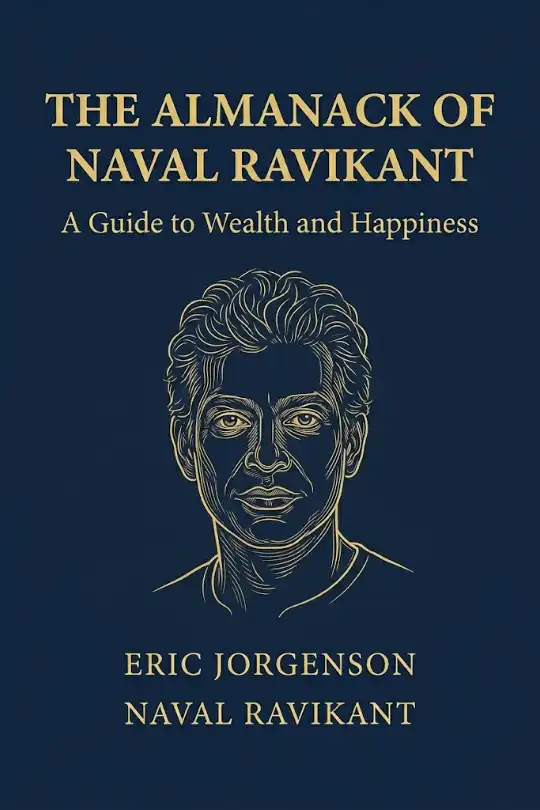
The central argument of The Almanack of Naval Ravikant is straightforward: both wealth creation and personal fulfillment are learnable skills, not matters of luck or circumstance. They follow predictable patterns. They respond to specific frameworks. And they can be developed through deliberate practice, just like any other capability.
The first step is understanding what you're actually pursuing. Ravikant draws a sharp distinction between three concepts most people treat as interchangeable.
Wealth is assets that earn while you sleep—businesses, investments, intellectual property that generate value without requiring your direct time. Money is simply a medium for transferring time and wealth between people; it's an IOU from society, not an end in itself. Status is your position in social hierarchies, a fundamentally zero sum game where one person's rise requires another's fall.
Most people chase money or status while neglecting wealth. They take jobs for prestige rather than ownership. They optimize for salary rather than assets. They compete for position rather than building things that generate value independently. Ravikant's framework redirects attention to what actually creates
Most people approach wealth and happiness backward. They chase money, hoping it will buy contentment. They work harder, assuming effort alone determines success. They compare themselves to others, measuring progress by status rather than fulfillment. And when neither wealth nor happiness arrives, they attribute the gap to bad luck, insufficient talent, or circumstances beyond their control.
Naval Ravikant spent years believing this himself. He rated his own happiness at two or three out of ten—consistently unhappy despite outward success. But over time, through deliberate practice, he moved that number to a consistent nine out of ten. Not by acquiring more things. Not by achieving more goals. By learning happiness as a systematic skill, the same way one learns to play an instrument or build a business.
The central argument of The Almanack of Naval Ravikant is straightforward: both wealth creation and personal fulfillment are learnable skills, not matters of luck or circumstance. They follow predictable patterns. They respond to specific frameworks. And they can be developed through deliberate practice, just like any other capability.
The first step is understanding what you're actually pursuing. Ravikant draws a sharp distinction between three concepts most people treat as interchangeable.
Wealth is assets that earn while you sleep—businesses, investments, intellectual property that generate value without requiring your direct time. Money is simply a medium for transferring time and wealth between people; it's an IOU from society, not an end in itself. Status is your position in social hierarchies, a fundamentally zero-sum game where one person's rise requires another's fall.
Most people chase money or status while neglecting wealth. They take jobs for prestige rather than ownership. They optimize for salary rather than assets. They compete for position rather than building things that generate value independently. Ravikant's framework redirects attention to what actually creates freedom: owning things that produce returns without your labor.
This leads to the core concept of productizing oneself. The phrase combines two ideas. First, you must be yourself—authentic, following your genuine interests and natural talents rather than imitating others. Second, you must productize—create something scalable that can serve many people without requiring proportional increases in your time. The combination creates wealth because it leverages your unique capabilities while removing the ceiling of hourly work.
The wealth-money-status distinction isn't just theoretical. It has immediate practical implications. When you understand that wealth means assets that work while you sleep, you stop optimizing for the highest salary and start asking different questions: What can I build that generates value without me? What skills can I develop that scale beyond my personal time? What ownership can I acquire rather than rent?
Consider the difference between a consultant who trades hours for dollars and a consultant who creates a course, writes a book, or builds software based on their expertise. The first has a high income but no wealth—stop working, and the income stops. The second has created an asset that continues generating value regardless of whether they're actively involved. That's the distinction between earning money and building wealth.
The happiness side of the framework follows the same logic. Ravikant's personal transformation from a happiness rating of two or three to nine out of ten didn't happen through acquiring more success or possessions. It happened through learning to reduce desire, accept reality, and cultivate presence. He treated happiness as a skill to be practiced rather than a condition to be achieved.
This reframes the entire problem. If happiness is a learnable skill, then unhappiness isn't a permanent condition—it's a signal that you haven't learned the skill yet. Just as you wouldn't expect to play piano well without practice, you shouldn't expect happiness without deliberate effort. The question shifts from "Why aren't I happy?" to "What specific practices would increase my baseline contentment?"
The framework Ravikant offers for both domains follows the same pattern: identify the underlying principles, develop specific practices, and apply them consistently over time. Wealth and happiness aren't mysteries. They're systems that respond to understanding and effort.
The key insight is that both pursuits require the same foundational shift: moving from passive hope to active learning. Most people hope wealth will arrive through a lucky break or that happiness will come with the next achievement. Ravikant argues that both require the same deliberate approach—study the principles, practice the skills, and trust the process.
This raises an uncomfortable question: If both wealth and happiness are learnable skills, what have you been treating as fixed circumstances that could actually be developed through deliberate practice?
About the Book
Naval Ravikant reveals that wealth and happiness are not matters of chance but learnable skills. This book distills his frameworks for building wealth through specific knowledge and leverage, and achieving happiness by reducing desire. Packed with actionable heuristics on decision-making, long-term thinking, and radical self-responsibility, it offers a practical guide to designing a life of freedom and fulfillment.
Key Takeaways
Build Wealth Through Specific Knowledge, Accountability, and Leverage
Wealth creation requires combining your unique innate talents (specific knowledge) with taking personal risks (accountability) and using scalable tools like code or media (leverage). Without all three, you're trading time for money; with them, you create assets that generate value while you sleep.
Play Long-Term Games with Long-Term People to Compound Trust
Choose careers, projects, and relationships where benefits increase over time, and only partner with people who think in decades rather than quarters. This approach builds a reputation that compounds like interest, creating opportunities that short-term thinkers never access.
Prioritize Judgment Over Effort by Using First Principles Thinking
In a leveraged economy, making slightly better decisions creates exponentially more value than working harder. Develop judgment by breaking problems down to fundamental truths and rebuilding from there, and use an aspirational hourly rate to filter out low-value busywork.
See Reality Without Distortion Through Radical Acceptance
Accurate decisions require seeing situations as they are, not as you wish them to be. Practice accepting what is (without approving it), question your fixed identities, and embrace radical honesty with yourself—suffering often signals the moment of truth needed for real progress.
Use Decision-Making Heuristics to Navigate Uncertainty
When undecided, default to 'no' to preserve optionality; when choices are evenly matched, pick the path with short-term pain because it compounds into long-term gain; and for any unsatisfactory situation, either change it, accept it, or leave it—never just wish things were different.
Treat Happiness as a Skill by Reducing Desire, Not Accumulating More
Happiness comes from eliminating the sense that something is missing, not from getting what you want. Practice noticing your desires, limit yourself to one major goal at a time, and use the 'wholesale swap' test to dissolve jealousy by asking if you'd trade your entire life for someone else's.
Save Yourself Through Radical Self-Responsibility and Authenticity
No one can beat you at being you, so stop imitating others and develop your unique combination of skills. Build from a foundation of physical health, then happiness, then relationships, then work—and accept that there are no adults; everyone is making it up, so you must own your own process.
Build Compound Knowledge Through Daily Reading and Genuine Curiosity
Reading one to two hours daily puts you in an elite minority and creates knowledge advantages that compound exponentially over decades. Make it a habit rather than a goal, read original sources instead of interpretations, and follow your curiosity wherever it leads.
Who Should Listen?
An entrepreneur or freelancer who feels stuck trading time for money and wants to build assets that generate income while they sleep.
A career professional in their 30s or 40s who has achieved external success but still feels a persistent sense of emptiness or dissatisfaction.
A recent graduate or early-career individual seeking a clear, systematic framework for making high-impact decisions about career, relationships, and personal growth.
A self-help enthusiast who has read many books on success and happiness but craves a no-nonsense, philosophically grounded approach that cuts through clichés.