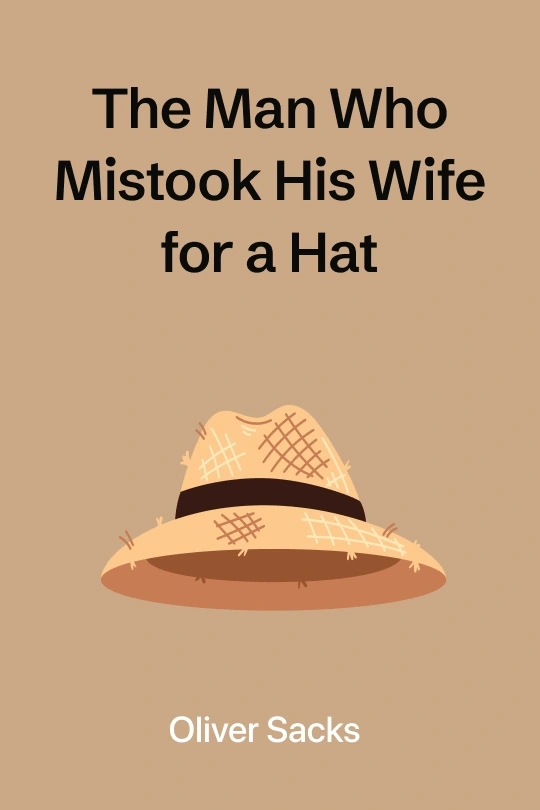
The Man Who Mistook His Wife for a Hat and Other Clinical Tales
Book Summary
Narrator: Ethan
Timeline
Summary Preview
In the preface to The Man Who Mistook His Wife for a Hat , Oliver Sacks makes a startling confession about his own field. "Neurology's favorite word is 'deficit,'" he writes. The word means loss—loss of speech, loss of memory, loss of vision, loss of identity. For generations, neurologists had built their science around cataloging what went wrong. They mapped the brain by studying its failures.
But Sacks saw a problem with this approach. Classical neurology had focused almost entirely on the left hemisphere of the brain, the side responsible for language, logic, and schematics. Damage to this hemisphere produced clear, measurable deficits that doctors could easily identify and document. The left hemisphere was the "dominant" hemisphere. It was sophisticated, evolved, uniquely human.
The right hemisphere was another story entirely. Called the "minor" hemisphere, it was presumed to be more primitive. Its functions remained mysterious, poorly understood, and largely ignored. When patients with right hemisphere damage did come to clinical attention, their symptoms were considered bizarre. They didn't fit the neat categories neurology had established. They seemed strange, almost fantastical.
Sacks realized that these neglected conditions happened just as frequently as left hemisphere deficits. Yet they remained underexplored because classical neurology had no framework for understanding them. The field had developed what Sacks called a kind of "agnosia" of its own—an inability to see the whole person, to recognize that a patient is more than a collection of broken parts.
To address this blind spot, Sacks turned to the work of A. R. Luria, a Russian neuropsychologist who had treated soldiers with brain wounds during World War II. Luria developed what he called "romantic science"—an approach that studied the whole person, not just the damaged brain. He believed that a patient had a soul, an imagination, a moral sense, a
In the preface to The Man Who Mistook His Wife for a Hat, Oliver Sacks makes a startling confession about his own field. "Neurology's favorite word is 'deficit,'" he writes. The word means loss—loss of speech, loss of memory, loss of vision, loss of identity. For generations, neurologists had built their science around cataloging what went wrong. They mapped the brain by studying its failures.
But Sacks saw a problem with this approach. Classical neurology had focused almost entirely on the left hemisphere of the brain, the side responsible for language, logic, and schematics. Damage to this hemisphere produced clear, measurable deficits that doctors could easily identify and document. The left hemisphere was the "dominant" hemisphere. It was sophisticated, evolved, uniquely human.
The right hemisphere was another story entirely. Called the "minor" hemisphere, it was presumed to be more primitive. Its functions remained mysterious, poorly understood, and largely ignored. When patients with right-hemisphere damage did come to clinical attention, their symptoms were considered bizarre. They didn't fit the neat categories neurology had established. They seemed strange, almost fantastical.
Sacks realized that these neglected conditions happened just as frequently as left-hemisphere deficits. Yet they remained underexplored because classical neurology had no framework for understanding them. The field had developed what Sacks called a kind of "agnosia" of its own—an inability to see the whole person, to recognize that a patient is more than a collection of broken parts.
To address this blind spot, Sacks turned to the work of A. R. Luria, a Russian neuropsychologist who had treated soldiers with brain wounds during World War II. Luria developed what he called "romantic science"—an approach that studied the whole person, not just the damaged brain. He believed that a patient had a soul, an imagination, a moral sense, a desire for connection. These weren't extras to be ignored. They were essential to understanding what had happened and what could be restored.
Sacks adopted this approach wholeheartedly. He decided to write case histories that were not just clinical reports but stories. "To restore the human subject at the centre," he wrote, "we must deepen a case history to a narrative or tale; only then do we have a 'who' as well as a 'what.'"
The book that emerged contains twenty-four case studies, grouped into four parts: "Losses," "Excesses," "Transports," and "The World of the Simple." Each section explores a different dimension of neurological experience. The losses are what classical neurology had always studied—the absence of function. But Sacks wanted to show that even in loss, there was often compensation, adaptation, and sometimes unexpected gifts. The excesses were conditions like Tourette's syndrome, where the brain produced too much activity rather than too little. The transports were temporary seizures or strokes that could unlock forgotten memories or produce visions. And the simple were patients with intellectual disabilities who, despite their limitations, possessed extraordinary abilities in music, art, or numbers.
Sacks was not just documenting curiosities. He was making an argument. Classical neurology, with its obsession with deficits, had missed something fundamental. When a person loses a function, the brain doesn't just sit there in passive absence. It reacts. It tries to restore, to replace, to compensate, to preserve its identity. These reactions might look strange, but they reveal how the brain actually works—not as a machine with interchangeable parts, but as a living system striving to maintain its coherence.
Take the contrast Sacks sets up in the preface between left-hemisphere and right-hemisphere conditions. Patients with left-hemisphere damage tend to be aware of their losses. They know they can't speak or understand language. They can describe what's missing. But patients with right-hemisphere damage often have no idea anything is wrong. They might lose the ability to recognize faces, to perceive the left side of space, to feel emotions. Yet they remain perfectly unaware of these deficits. They don't complain. They don't seek help. The problem is not just in their brains—it's in the very structure of how their brains perceive reality.
This created a profound challenge for neurology. How do you study a condition a patient doesn't know they have? How do you understand a loss that isn't experienced as a loss? Classical neurology had no tools for this. It needed a different kind of science—one that could enter the patient's subjective world, that could see what the patient couldn't see for themselves.
Sacks found his method in storytelling. Each patient became a character, each condition a plot. He described not just symptoms but lives—the music teacher who could no longer recognize faces, the sailor trapped in 1945, the woman who lost her sense of her own body. These weren't case studies in the traditional sense. They were narratives that invited readers to inhabit another person's experience, to feel the strangeness and the tragedy and sometimes the unexpected beauty of a brain that had gone off course.
The book's title case—the man who mistook his wife for a hat—became emblematic of this approach. Here was a brilliant musician who could see parts but not wholes. He could describe a glove or a shoe in abstract terms but couldn't identify them when placed in his hands. He could recognize his students by their movement but not by their faces. When reaching for his hat, he reached for his wife's head instead. The condition was bizarre, almost comical on the surface. But Sacks used it to illuminate something profound about how perception works—and how classical neurology had failed to understand it.
Sacks's ambition was not small. He wanted to change how doctors see their patients. He wanted to restore the human subject to the center of neurology. He wanted to prove that the most bizarre conditions could teach us the most about what it means to be human. And he believed that the language of poetry and painting was just as necessary as the language of medical textbooks.
The book opens with a question that haunted Sacks throughout his career: If neurology's favorite word is "deficit," what do we miss when we look only at what's missing? What do we fail to see in our patients, in ourselves, in the strange and wonderful ways the brain can go wrong?
About the Book
Oliver Sacks transforms 24 neurological case studies into profound stories of human resilience. From a man who mistakes his wife for a hat to twins who converse in prime numbers, Sacks shows that even in loss, the brain compensates, adapts, and reveals unexpected gifts. This is not a clinical catalog of deficits—it is a poetic exploration of identity, memory, and the soul.
Key Takeaways
Deficits are not the whole story; the brain's compensations reveal its true nature.
When a person loses a function, the brain does not passively accept the loss—it actively tries to restore, replace, and compensate, often creating unexpected gifts. This adaptive struggle, not the deficit itself, shows us how the brain truly works as a living system striving for coherence.
The most profound truths are often seen by those who have lost the ability to be deceived.
Patients with aphasia, who cannot understand words, become exquisitely sensitive to tone, body language, and emotional truth, acting as human lie detectors. Their loss strips away the social filters that allow 'normal' people to be fooled by smooth words and practiced gestures.
A person without memory can still possess a soul, held together by ritual and presence.
Jimmie G., trapped in a perpetual present by amnesia, found wholeness not in narrative but in the liturgy—prayer and communion gave him a structure that his broken memory could not. This reveals that identity can be sustained through sacred participation, even when the story of one's life is gone.
The cure can be worse than the condition when it destroys the source of a person's genius.
For Ray, the jazz drummer with Tourette's, medication stopped his tics but also killed the fire and killer instinct that made him an artist. His compromise—taking the drug on weekdays and stopping on weekends—shows that some neurological differences are not disorders to be erased but identities to be balanced.
The body's 'sixth sense' is invisible until it is lost, revealing how much of our existence is automatic grace.
Christina's loss of proprioception turned her body into a foreign object she had to manage with conscious effort, turning every movement into an exhausting act of will. Her story reveals the hidden, automatic symphony of sensation that most of us take for granted, and the extraordinary resilience required to live without it.
A seizure can be a healing transport, unlocking forgotten memories that restore a fractured self.
Mrs. O'C.'s stroke triggered music from her lost Irish childhood, filling a void of longing and giving her a sense of completeness she had never known. This shows that neurological 'mishaps' can sometimes be gifts, carrying us back to parts of ourselves we thought were gone forever.
What society calls 'simple' may actually be a different kind of genius that we fail to recognize.
The autistic twins who communicated in prime numbers, and José who drew dandelions with profound attention, possessed gifts that were invisible to a world obsessed with verbal intelligence. Their stories challenge us to look beyond deficits and see the hidden languages of art, nature, and mathematics.
To truly heal, medicine must become a 'romantic science' that sees the whole person, not just the broken parts.
Oliver Sacks argued that classical neurology suffered from its own agnosia—an inability to see the patient as a human subject with a soul, imagination, and moral sense. By turning case histories into narratives, he showed that the language of poetry and painting is just as necessary as the language of textbooks for understanding what it means to be human.
Who Should Listen?
Medical professionals and neurologists who want to see their patients as whole people, not just collections of symptoms.
Psychology and neuroscience students seeking a humanistic counterpoint to textbook descriptions of brain disorders.
Anyone who has experienced or witnessed a loved one's neurological condition and needs to understand the person behind the diagnosis.
Readers of narrative nonfiction who love deeply moving, strange, and beautiful true stories about the human mind.