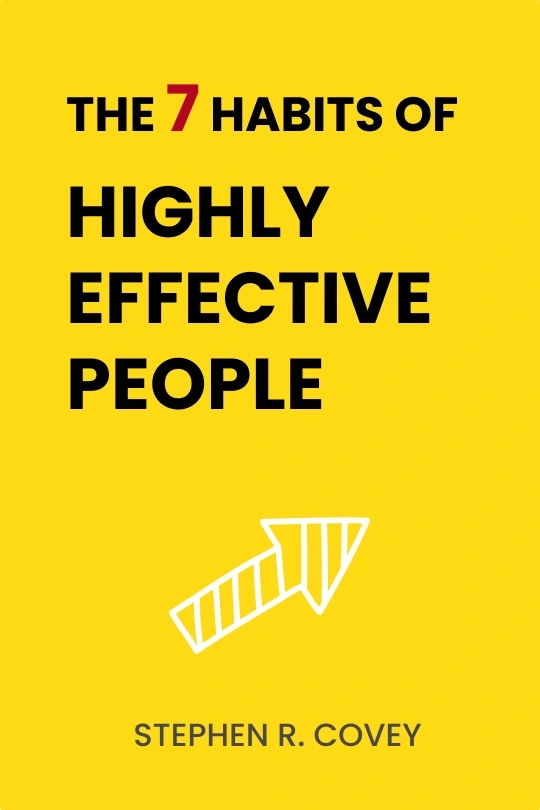
The 7 Habits of Highly Effective People
Powerful Lessons in Personal Change
Book Summary
Narrator: Ethan
Timeline
Summary Preview
Most people try to solve their biggest problems by changing their behavior. They read a self help book that promises a new technique for managing time, communicating better, or building confidence. They try the technique. It works for a few days. Then they're back where they started.
This isn't a failure of effort. It's a failure of approach.
Stephen Covey spent decades watching people chase quick fixes. He saw executives adopt the latest communication strategies only to find their teams still mistrusted them. He saw parents try new discipline methods only to find their children still resented them. The pattern was consistent: surface level changes produce surface level results.
Covey calls this the Personality Ethic. It's the belief that effectiveness comes from modifying your external behaviors, your attitudes, your techniques. It's the approach that says: "If I just smile more, speak more confidently, use the right words, people will respond differently." And sometimes they do. Temporarily.
But there's a deeper problem. When your character is fundamentally flawed—when you're insincere, manipulative, or untrustworthy—no amount of technique can compensate. People sense it. Your duplicity breeds distrust, and your polished behaviors feel hollow. The Personality Ethic treats symptoms, not causes.
Before the twentieth century, a different approach dominated. Covey calls it the Character Ethic. This view holds that true effectiveness flows from inner virtues: integrity, humility, courage, justice, patience. The founding fathers of American self help literature, from Benjamin Franklin to Thomas Jefferson, wrote from this perspective. They believed that lasting change required strengthening the roots of character, not just trimming the leaves of behavior.
The difference matters because the Character Ethic makes no promises of quick results. You cannot cram for character growth the way you cram for an exam. As Covey puts it, trying to shortcut this process is like trying
Most people try to solve their biggest problems by changing their behavior. They read a self-help book that promises a new technique for managing time, communicating better, or building confidence. They try the technique. It works for a few days. Then they're back where they started.
This isn't a failure of effort. It's a failure of approach.
Stephen Covey spent decades watching people chase quick fixes. He saw executives adopt the latest communication strategies only to find their teams still mistrusted them. He saw parents try new discipline methods only to find their children still resented them. The pattern was consistent: surface-level changes produce surface-level results.
Covey calls this the Personality Ethic. It's the belief that effectiveness comes from modifying your external behaviors, your attitudes, your techniques. It's the approach that says: "If I just smile more, speak more confidently, use the right words, people will respond differently." And sometimes they do. Temporarily.
But there's a deeper problem. When your character is fundamentally flawed—when you're insincere, manipulative, or untrustworthy—no amount of technique can compensate. People sense it. Your duplicity breeds distrust, and your polished behaviors feel hollow. The Personality Ethic treats symptoms, not causes.
Before the twentieth century, a different approach dominated. Covey calls it the Character Ethic. This view holds that true effectiveness flows from inner virtues: integrity, humility, courage, justice, patience. The founding fathers of American self-help literature, from Benjamin Franklin to Thomas Jefferson, wrote from this perspective. They believed that lasting change required strengthening the roots of character, not just trimming the leaves of behavior.
The difference matters because the Character Ethic makes no promises of quick results. You cannot cram for character growth the way you cram for an exam. As Covey puts it, trying to shortcut this process is like trying to harvest crops the day after planting seeds. The farm is a natural system. The price must be paid. The process must be followed.
So how do you actually change your character? This is where the concept of a paradigm shift becomes essential.
A paradigm is the mental map you use to navigate the world. It's the lens through which you interpret everything you experience. The problem is that most people assume their map is the territory. They think the way they see things is the way things really are. They're wrong.
Covey illustrates this with a simple but powerful demonstration. He shows readers two sketches of a woman's face. Look at the first sketch, and you might see an attractive young woman with a delicate chin and a fashionable hat. Look at the second, and you might see an elderly crone with a large nose and a hunched posture. Both images are present in both sketches. Your brain automatically picks one interpretation based on your conditioning. You can't see the other until someone points out its outline. Once you do, the shift is permanent. You can now see both images, and you can switch between them at will.
That's a paradigm shift. It's not about adding new information. It's about seeing the same information from an entirely new perspective.
Albert Einstein captured this perfectly: "The significant problems we face cannot be solved at the same level of thinking we were at when we created them." Your current problems exist because of how you currently think. Solving them requires a shift in that thinking—a change in your fundamental paradigms.
This is the inside-out approach. Instead of hacking at the leaves of behavior, you strike at the root: the paradigms that shape your character and create the lens through which you see the world.
Let's be concrete about what this looks like in practice.
Covey shares an example from his own family. His daughter was struggling with a school project. She was frustrated, overwhelmed, and resistant to help. Covey's instinct was to solve the problem. He had techniques. He knew how to motivate, how to reason, how to persuade. But none of it worked. The more he pushed his solutions, the more she withdrew.
The breakthrough came when he stopped trying to fix the external problem and instead examined his internal paradigm. He realized he was approaching his daughter as a problem to be solved rather than a person to be understood. He was operating from a paradigm of control, not connection. Once he recognized this, he could shift. He sat with her. He listened. He validated her frustration. The project got done, but more importantly, their relationship deepened.
This is the inside-out approach in action. The external behavior change—listening instead of advising—was important, but it only worked because the internal paradigm shift came first.
Now here's the practical framework Covey offers for making paradigm shifts yourself.
First, recognize that you have paradigms. Most people never question their mental maps. They assume their perception is objective reality. The first step is acknowledging that you see the world not as it is, but as you are. Your conditioning, your experiences, your assumptions all shape your perception.
Second, identify where your current paradigm is failing you. Look for patterns of frustration, conflict, or stagnation. If you keep encountering the same problems in your relationships, your work, your personal growth, your current way of seeing is likely part of the problem.
Third, expose yourself to alternative perspectives. Paradigm shifts rarely happen in isolation. They require input from others who see things differently. This might mean reading books that challenge your assumptions, having honest conversations with people who disagree with you, or seeking feedback from those who know you well.
Fourth, be patient with the process. Paradigm shifts are not instant conversions. They emerge gradually as you gather new experiences and reflect on them. Covey compares it to the slow growth of a seed into a tree. You can't force it, but you can create the conditions for it.
The core principles that ground these paradigm shifts are universal and unchanging. Covey identifies several: fairness, integrity, honesty, human dignity, service, excellence, potential, growth, patience, nurturance, encouragement. These aren't cultural preferences or personal opinions. They're natural laws that operate whether you believe in them or not, just like gravity.
When you center your life on these principles, you develop a changeless inner core. This core gives you stability when circumstances shift. It provides a reference point for decisions. It creates the character from which effective behavior naturally flows.
This is the fundamental choice the book presents. You can continue trying to modify your surface behaviors, hoping that this time the technique will stick. Or you can do the harder, slower work of changing your paradigms and strengthening your character.
The Personality Ethic promises speed but delivers frustration. The Character Ethic demands patience but delivers lasting change.
Which approach are you currently using to solve your most persistent problems? And what would it look like to shift your paradigm from "what can I do differently" to "who do I need to become"?
About the Book
Most self-improvement fails because it targets behavior, not character. Stephen Covey reveals why lasting success requires an inside-out transformation—shifting your paradigms from reactive to proactive, from urgency to importance, and from independence to interdependence. Through seven timeless habits, this book provides a principle-centered framework for achieving genuine effectiveness in work, relationships, and life.
Key Takeaways
Shift from Personality Ethic to Character Ethic for lasting change
Stop chasing quick-fix techniques and surface-level behavior changes; instead, focus on developing inner virtues like integrity, humility, and patience. True effectiveness flows from who you are at your core, not from polished external behaviors that fade when tested.
Focus your energy on your Circle of Influence, not your Circle of Concern
Identify what you can actually control—your own choices, reactions, and skills—and invest your time there. When you stop worrying about external factors you cannot change, your influence expands naturally as you take proactive, constructive action.
Create a personal mission statement to guide every major decision
Write a principle-centered constitution for your life by defining your values, roles, and long-term purpose. Use this as a decision-making filter to ensure you climb the right mountain, not just climb efficiently.
Spend most of your time on Quadrant II activities that are important but not urgent
Use the Time Management Matrix to identify tasks like relationship building, long-term planning, and personal development—then block weekly time for them. This prevents you from being consumed by crises and busywork that don't move you toward your mission.
Build Emotional Bank Accounts through consistent small deposits
Strengthen trust in every relationship by understanding what the other person values, keeping commitments, clarifying expectations, and apologizing sincerely when you make mistakes. A high balance makes communication flow easily and turns problems into opportunities for deeper connection.
Seek first to understand before trying to be understood
Practice empathic listening by setting aside your own judgments and genuinely trying to see the world through the other person's eyes. Only after they feel heard can you present your logic effectively—ethos and pathos must precede logos.
Create Win/Win or No Deal agreements in all interdependent situations
Refuse to settle for compromise or win-lose outcomes; instead, explore solutions that genuinely benefit both parties. If no such solution exists, agree to walk away—preserving the relationship is more valuable than forcing a bad deal.
Sharpen the saw daily by renewing your physical, spiritual, mental, and social dimensions
Invest one hour each day in exercise, reflection, learning, and meaningful interactions to maintain your production capability. This upward spiral of renewal prevents burnout and enables you to practice all other habits at increasingly higher levels.
Who Should Listen?
A mid-career professional who feels stuck in a cycle of busywork and wants to focus on what truly matters instead of just putting out fires.
A manager or team leader struggling with low trust and poor collaboration who needs a practical system for building stronger, more productive relationships.
A parent or partner who keeps repeating the same conflicts and wants to break reactive patterns to create deeper, more respectful connections at home.
An entrepreneur or high-achiever experiencing burnout who needs a sustainable approach to balancing high performance with personal renewal and long-term growth.