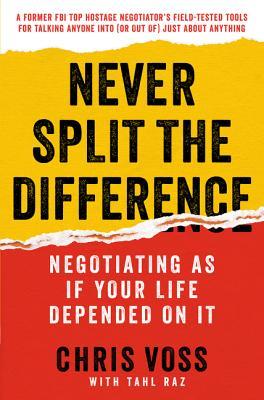
Never Split the Difference
Negotiating as if Your Life Depended on It
Book Summary
Narrator: Ethan
Timeline
Summary Preview
Fifteen years into his career as an FBI hostage negotiator, Chris Voss walks into a Harvard office. Two professors who study negotiation sit him down for what they think will be a casual chat. Instead, they turn it into a role playing session. They take Voss's son hostage and demand a ransom.
The professors expect to rattle him. They're academics who've spent years studying the rational models of negotiation. They know the theory cold. But Voss doesn't play along. Instead of making arguments or counteroffers, he responds with a series of open ended questions. He doesn't push. He doesn't demand. He just asks.
Within minutes, the professors are flustered. Their scripted approach falls apart. One of them finally looks at Voss and says, "The FBI might have something to teach us."
That moment captures the central problem this book exists to solve. The traditional models of negotiation—the ones taught at Harvard, the ones enshrined in books like Getting to Yes —treat negotiation as a rational process. They assume people are logical actors who want to reach a win win solution. They teach you to separate the people from the problem, to focus on interests not positions, to generate options for mutual gain.
All of that sounds good on paper. In practice, it misses something fundamental about how human beings actually operate.
Voss learned this the hard way, in situations where the stakes weren't a better deal on a car or a raise at work. They were life and death. And in those situations, people don't behave like rational calculators. They're scared. They're angry. They're impulsive. They're driven by emotions they don't fully understand and fears they won't admit.
The history of negotiation, Voss explains, started with brute force. If you wanted something, you took it. That worked until the 1970s,
Fifteen years into his career as an FBI hostage negotiator, Chris Voss walks into a Harvard office. Two professors who study negotiation sit him down for what they think will be a casual chat. Instead, they turn it into a role-playing session. They take Voss's son hostage and demand a ransom.
The professors expect to rattle him. They're academics who've spent years studying the rational models of negotiation. They know the theory cold. But Voss doesn't play along. Instead of making arguments or counteroffers, he responds with a series of open-ended questions. He doesn't push. He doesn't demand. He just asks.
Within minutes, the professors are flustered. Their scripted approach falls apart. One of them finally looks at Voss and says, "The FBI might have something to teach us."
That moment captures the central problem this book exists to solve. The traditional models of negotiation—the ones taught at Harvard, the ones enshrined in books like Getting to Yes—treat negotiation as a rational process. They assume people are logical actors who want to reach a win-win solution. They teach you to separate the people from the problem, to focus on interests not positions, to generate options for mutual gain.
All of that sounds good on paper. In practice, it misses something fundamental about how human beings actually operate.
Voss learned this the hard way, in situations where the stakes weren't a better deal on a car or a raise at work. They were life and death. And in those situations, people don't behave like rational calculators. They're scared. They're angry. They're impulsive. They're driven by emotions they don't fully understand and fears they won't admit.
The history of negotiation, Voss explains, started with brute force. If you wanted something, you took it. That worked until the 1970s, when a series of high-stakes hostage situations ended badly. The FBI realized they needed a better approach. Around the same time, the Harvard Negotiation Project emerged, offering a more civilized alternative: rational, principled negotiation.
But while Harvard was publishing Getting to Yes, researchers at the University of Chicago were demonstrating something inconvenient: people's emotions almost always override their rational thought. We don't make decisions logically. We make them emotionally, then rationalize them afterward.
The FBI's hostage negotiation team learned this through failure. In the 1990s, a string of setbacks forced them to reconsider their approach. They'd been trying to reason with people who weren't operating from reason. So they started incorporating psychological techniques designed to build emotional rapport. They stopped trying to convince counterparts to be rational. Instead, they learned to work with their irrationality.
Voss's core thesis is simple but radical: negotiation is not a rational process. It's an emotional one. The foundational assumption you need to accept before using any of the techniques in this book is that people are irrational, emotional, fear-driven animals. Not broken versions of rational actors. That's just what people are.
This means the goal of negotiation isn't to find the logical middle ground. It's to understand and leverage the emotional reality of the person across from you. The tool for doing that is something Voss calls tactical empathy—not feeling someone's pain, but understanding it well enough to influence their behavior.
Think about what this means for the way most of us approach negotiations. We prepare arguments. We gather data. We plan our counterpoints. We think about what we're going to say. All of that assumes the other person will be persuaded by logic. But they won't be. At least not until you've dealt with their emotional state first.
Voss's visit to Harvard wasn't just a good story. It was a demonstration of the gap between theory and practice. The professors had all the right frameworks. They just couldn't use them when the pressure was on and the emotions were real. Voss, who'd spent years negotiating with people who had nothing to lose, had a different set of tools. Tools that started not with logic, but with listening.
The rest of this book lays out those tools one by one. Mirroring. Labeling. Calibrated questions. The Ackerman method. Each one is designed to work with human nature, not against it. Each one starts from the premise that you can't argue someone into changing their mind. You have to understand them first.
So before you learn any of the specific techniques, you need to accept this: the person you're negotiating with is not a rational actor. Neither are you. The sooner you stop pretending otherwise, the sooner you'll actually start getting what you want.
What would change about your next negotiation if you stopped trying to be logical and started trying to be understood?
About the Book
Former FBI hostage negotiator Chris Voss reveals why traditional rational negotiation fails and offers a counterintuitive system based on tactical empathy, mirroring, and calibrated questions. Drawing from high-stakes kidnappings and bank robberies, Voss shows how to leverage emotion, harness the power of 'no,' and uncover hidden leverage to transform any negotiation—from salary talks to business deals—into a win.
Key Takeaways
Start with tactical empathy, not logic, to lower emotional barriers
Instead of trying to reason with someone who is emotional, use labeling to name their feelings out loud (e.g., 'It sounds like you're frustrated'). This activates their rational brain and defuses tension, making them open to negotiation.
Use mirroring to gather information and buy thinking time
Repeat the last one to three words your counterpart says with an upward inflection, then stay silent. This makes them feel heard and compels them to elaborate, revealing more than they intended while giving you time to plan your next move.
Invite 'no' to create safety and genuine commitment
Instead of chasing 'yes,' ask questions that invite a 'no' (e.g., 'Is now a bad time?'). 'No' makes people feel in control and safe, which leads to honest engagement and a real commitment when they eventually agree.
Trigger 'that's right' to signal deep understanding and build rapport
Summarize both the facts and emotions of your counterpart's position back to them. When they say 'that's right' (not 'you're right'), it means they feel truly understood, which unlocks influence and behavioral change.
Bend their reality by anchoring with odd numbers and acknowledging negatives first
Lower expectations by naming the bad stuff upfront, then use non-round numbers (e.g., $4,751) to signal deliberation. Let the other side go first with an offer, and use phrases like 'Please stop me if I'm being unfair' to redefine what's reasonable.
Ask calibrated 'how' and 'what' questions to give them the illusion of control
Replace direct statements and 'why' questions with open-ended inquiries (e.g., 'How am I supposed to do that?'). This forces your counterpart to solve your problems themselves, making them feel in charge while you steer the outcome.
Guarantee execution with the Rule of Three and 'how' questions
Get agreement three different ways—initial yes, summary confirmation, and a question about implementation. Use 'How will we make that happen?' to force logistics, and watch for vague language or tone mismatches that signal hidden reservations.
Use the Ackerman bargaining method to structure offers and avoid splitting the difference
Set a target price, start at 65% of it, then raise in decreasing increments (85%, 95%, 100%) using non-round numbers. Pair each offer with calibrated questions and a non-monetary concession at the end to trigger reciprocity and close the deal on your terms.
Who Should Listen?
Sales professionals who struggle to close deals against resistant or emotional clients and need a practical system to build rapport and influence outcomes.
Managers and team leaders who frequently negotiate budgets, timelines, or resources and want to move beyond compromise to get better results without damaging relationships.
Entrepreneurs and founders who negotiate with investors, partners, or vendors and need tools to uncover hidden leverage and bend perceptions of fairness.
Anyone preparing for a major life negotiation—like a salary raise, home purchase, or contract dispute—who wants a step-by-step, psychologically grounded approach to achieve their goals.