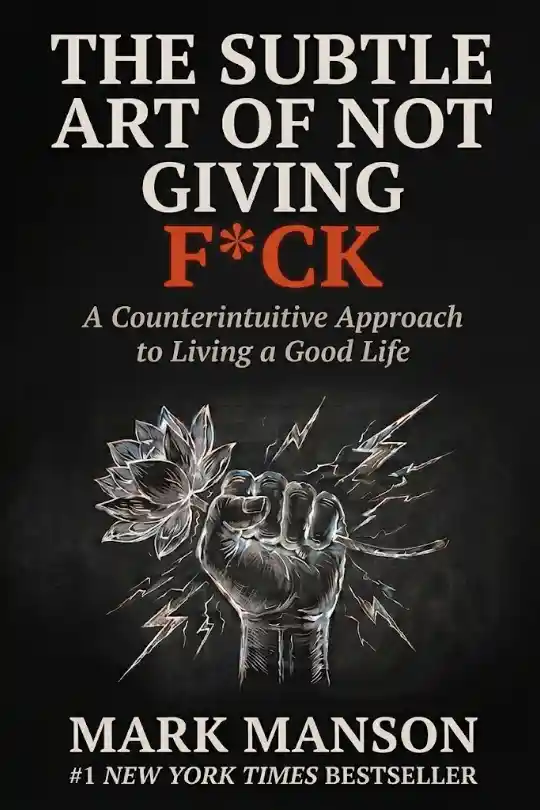
The Subtle Art of Not Giving a F*ck
A Counterintuitive Approach to Living a Good Life
Book Summary
Narrator: Ethan
Timeline
Summary Preview
Charles Bukowski spent decades as a drunk, a deadbeat, a womanizer, a chronic gambler, and a poet. He was fifty years old before any publisher would touch his work. His epitaph reads simply: "Don't Try."
You'd think a self help book would begin with a success story. Someone who climbed the mountain, checked all the boxes, and found happiness at the summit. Instead, Mark Manson opens with a man who spent most of his life failing, drinking himself into stupors, and writing about his own misery. And here's the twist: Bukowski's success came precisely because he stopped trying to succeed. He knew he was a loser, accepted it, and then wrote honestly about it. That authenticity made his work resonate.
This is the first paradox you need to understand. The more desperately you pursue feeling good, the worse you'll feel. The more you try to be happy, the more unhappy you become. Manson calls this the Feedback Loop from Hell.
Here's how it works. You feel anxious about something. Then you notice you're feeling anxious, and you get anxious about being anxious. Now you're anxious about your anxiety, which makes you more anxious. The same loop applies to anger, insecurity, loneliness, or any negative emotion. The awareness of the problem becomes the problem itself. You spiral.
Or consider this: you feel sad, so you decide you need to be happier. You start measuring how happy you are. But measuring your happiness only reminds you that you're not happy enough. The pursuit of happiness becomes proof of your unhappiness. You're trapped.
This is what philosopher Alan Watts called the Backwards Law. Manson states it plainly: "The desire for more positive experience is itself a negative experience. And, paradoxically, the acceptance of one's negative experience is itself a positive experience."
Think about
Charles Bukowski spent decades as a drunk, a deadbeat, a womanizer, a chronic gambler, and a poet. He was fifty years old before any publisher would touch his work. His epitaph reads simply: "Don't Try."
You'd think a self-help book would begin with a success story. Someone who climbed the mountain, checked all the boxes, and found happiness at the summit. Instead, Mark Manson opens with a man who spent most of his life failing, drinking himself into stupors, and writing about his own misery. And here's the twist: Bukowski's success came precisely because he stopped trying to succeed. He knew he was a loser, accepted it, and then wrote honestly about it. That authenticity made his work resonate.
This is the first paradox you need to understand. The more desperately you pursue feeling good, the worse you'll feel. The more you try to be happy, the more unhappy you become. Manson calls this the Feedback Loop from Hell.
Here's how it works. You feel anxious about something. Then you notice you're feeling anxious, and you get anxious about being anxious. Now you're anxious about your anxiety, which makes you more anxious. The same loop applies to anger, insecurity, loneliness, or any negative emotion. The awareness of the problem becomes the problem itself. You spiral.
Or consider this: you feel sad, so you decide you need to be happier. You start measuring how happy you are. But measuring your happiness only reminds you that you're not happy enough. The pursuit of happiness becomes proof of your unhappiness. You're trapped.
This is what philosopher Alan Watts called the Backwards Law. Manson states it plainly: "The desire for more positive experience is itself a negative experience. And, paradoxically, the acceptance of one's negative experience is itself a positive experience."
Think about what this means. Every time you tell yourself "I need to be more confident," you're reinforcing the belief that you lack confidence. Every time you say "I should be happier," you're confirming that you're not happy. The very act of chasing these states pushes them further away.
[A brief pause to let that sink in]
In practice, the Feedback Loop from Hell shows up in everyday situations. You're at a party and feel socially awkward. You notice the awkwardness and think "I shouldn't feel awkward, everyone else seems fine." Now you feel awkward about feeling awkward. The original discomfort multiplies. Or you're trying to meditate and can't stop your mind from wandering. You get frustrated that you can't focus, which makes your mind wander more. The frustration becomes the obstacle.
The diagnostic framework is simple but powerful. Ask yourself: Am I having a feeling, or am I having a feeling about my feeling? The second is the loop. The question to break it is not "how do I stop feeling this way?" but "what if I just let myself feel this way without judging it?"
Manson extends the Backwards Law beyond emotions to everything we pursue. The more you try to be certain, the more insecure you feel. The more you try to be impressive, the more inadequate you appear. The more you try to be right, the more wrong you prove yourself. The effort itself creates the opposite result.
This is why Bukowski's "Don't Try" is so radical. It's not about giving up. It's about dropping the exhausting performance of trying to be something you're not. Bukowski tried hard at writing. He worked at his craft for decades. But he didn't try to be a success. He didn't try to be impressive. He just wrote what was true.
The practical takeaway: stop trying to feel good all the time. Stop trying to eliminate negative experiences. The desire for more positive experiences is itself a negative experience. True fulfillment comes from accepting negative ones. When you stop fighting your anxiety, your sadness, your insecurity, they lose their power over you. They become just feelings, not crises.
So here's the question that will echo through the rest of this book: What if your problems aren't obstacles to happiness, but the very source of it? What if the goal isn't to feel good, but to feel the right things for the right reasons? What if the secret isn't giving more fucks, but giving fewer, better ones?
Because if the Backwards Law is true, then everything you've been told about how to live well might be exactly wrong.
About the Book
This book flips conventional self-help on its head by arguing that true fulfillment comes not from avoiding pain but from accepting it and choosing what to care about. Through counterintuitive frameworks like the Backwards Law and the 'Choose Your Struggle' method, Mark Manson shows how embracing limitation, uncertainty, and mortality can free you from the exhausting pursuit of being special.
Key Takeaways
Stop chasing happiness directly—accept negative experiences instead.
The more desperately you pursue feeling good, the worse you'll feel due to the 'Feedback Loop from Hell.' Instead, accept your negative emotions without judgment, because the desire for positive experience is itself a negative experience, while accepting negative ones is a positive one.
Choose your problems deliberately—happiness comes from solving the right ones.
Life is an endless series of problems, so your goal isn't to eliminate them but to pick which ones are worth having. Conduct a 'Pain Audit' to identify your current struggles, then ask if they serve something you truly value—if not, stop giving a fuck about them.
Accept your averageness to free yourself from the pressure to be exceptional.
Constant exposure to the exceptional makes you feel inadequate, but if everyone is special, no one is. Redefine your identity in mundane, controllable terms (e.g., 'someone who shows up' instead of 'the best parent') so that failure becomes useful feedback rather than a threat to your self-worth.
Peel the 'Self-Awareness Onion' to uncover values you can actually control.
Ask 'why' five times to go from surface desires (like wanting money) to core values (like autonomy). Then evaluate those values: good ones are reality-based, socially constructive, and immediately controllable (e.g., honesty), while bad ones depend on external validation (e.g., popularity).
Separate fault from responsibility to reclaim your power in any situation.
Fault is about who caused the problem (past tense), while responsibility is about what you'll do now (present tense). You can be responsible without being at fault—as Malala Yousafzai showed—so stop asking 'Who's to blame?' and start asking 'What am I going to do about it?'
Embrace uncertainty—growth comes from being 'less wrong,' not from being right.
Certainty is a drug that makes you fragile; the more you try to be certain, the more insecure you become. When you feel sure about something, ask 'What if I'm wrong?' and 'Would being wrong create a better problem?'—this iterative process of chipping away at errors is how you actually grow.
Act first—motivation follows action, not the other way around.
Don't wait to feel inspired or ready; pick one small concrete action and do it now. Action generates motivation and inspiration, and the pain you feel along the way isn't a sign to stop—it's proof you're in the process of growth.
Say no to most things so you can say a powerful yes to what truly matters.
True freedom and meaning come not from unlimited options but from committing to something and actively rejecting alternatives. Use the 'Freedom through Commitment' model: identify what you're willing to invest decades in, then close the doors on everything else to give your life shape and depth.
Who Should Listen?
The overachiever who feels burned out from constantly chasing success and validation, yet never feels good enough.
The chronic people-pleaser who exhausts themselves caring about everyone else's opinions and needs their own permission to stop.
The anxious perfectionist who is trapped in a 'Feedback Loop from Hell,' worrying about their own worrying and unable to accept imperfection.
The directionless seeker who has tried every self-help trend but still feels empty, needing a practical system to decide what actually matters.