Book Summary
Narrator: Ethan
Timeline
Summary Preview
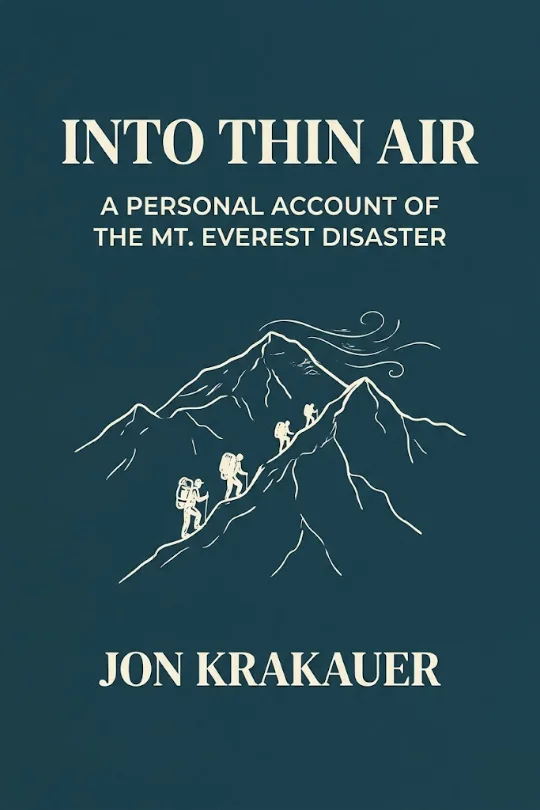
Jon Krakauer stood on the summit of Mount Everest on May 10, 1996. He had not slept in days. He had barely eaten. At 29,028 feet above sea level, he had reached the highest point on earth—the goal that had driven him since childhood.
And he felt nothing.
No rush of triumph. No relief. Just a drained, disconnected emptiness. The moment he had dreamed of for decades felt hollow. Krakauer spent less than five minutes on top of the world. He snapped a quick photo of Andy Harris, a guide from his expedition, alongside Anatoli Boukreev, a Russian climber from another team. Then he turned around and began to descend.
What Krakauer didn't know yet was that he was descending into the deadliest disaster in Everest's history. By the time the mountain was done, twelve people would be dead. Among them would be his friends. His guides. People he had shared meals with, laughed with, trusted with his life.
This is the story of that day. But it's also the story of what led to it, and what came after.
Krakauer wrote Into Thin Air not as a journalist looking for a story, but as a survivor searching for catharsis. He had been assigned by Outside magazine to write about the commercialization of Everest—how wealthy but inexperienced climbers were paying guided expeditions to take them to the summit. The assignment was supposed to be straightforward. Instead, it became a nightmare that would haunt him for the rest of his life.
The book is deeply personal. It's driven by survivor's guilt, by the need to understand what went wrong, and by the weight of knowing that he lived while others died. Krakauer is painfully honest about his own failures—his inability to recognize when his friends were in trouble, his confusion in
Jon Krakauer stood on the summit of Mount Everest on May 10, 1996. He had not slept in days. He had barely eaten. At 29,028 feet above sea level, he had reached the highest point on earth—the goal that had driven him since childhood.
And he felt nothing.
No rush of triumph. No relief. Just a drained, disconnected emptiness. The moment he had dreamed of for decades felt hollow. Krakauer spent less than five minutes on top of the world. He snapped a quick photo of Andy Harris, a guide from his expedition, alongside Anatoli Boukreev, a Russian climber from another team. Then he turned around and began to descend.
What Krakauer didn't know yet was that he was descending into the deadliest disaster in Everest's history. By the time the mountain was done, twelve people would be dead. Among them would be his friends. His guides. People he had shared meals with, laughed with, trusted with his life.
This is the story of that day. But it's also the story of what led to it, and what came after.
Krakauer wrote Into Thin Air not as a journalist looking for a story, but as a survivor searching for catharsis. He had been assigned by Outside magazine to write about the commercialization of Everest—how wealthy but inexperienced climbers were paying guided expeditions to take them to the summit. The assignment was supposed to be straightforward. Instead, it became a nightmare that would haunt him for the rest of his life.
The book is deeply personal. It's driven by survivor's guilt, by the need to understand what went wrong, and by the weight of knowing that he lived while others died. Krakauer is painfully honest about his own failures—his inability to recognize when his friends were in trouble, his confusion in the thin air, his mistaken reports that caused families to celebrate prematurely.
But the book is also an investigation. Krakauer examines how the commercialization of Everest created conditions where disaster was almost inevitable. He explores the interplay between human ambition and nature's raw power. He looks at the systemic failures—the broken rules, the missed turnarounds, the guides torn between getting clients to the top and keeping them alive.
The story follows a chronological arc. It begins with the dream of climbing Everest, traces the grueling preparation, and then descends into the chaos of the summit day and its aftermath. Krakauer's account draws on his own memories—though he admits these are imperfect, distorted by hypoxia and trauma—as well as interviews with other survivors.
What emerges is not a simple story of heroes and villains. It's a complex portrait of people pushed to their limits, making impossible decisions in conditions where clear thought is nearly impossible. The guides, despite their experience, were powerless to save even themselves. The clients, despite their determination, were in over their heads. And the mountain, beautiful and indifferent, simply did what mountains do.
Krakauer opens with that moment on the summit—the anti-climax of his greatest achievement—because it captures something essential about the whole experience. The summit was never the real goal. The real goal was getting back down alive. And for too many people on that day, that goal remained tragically out of reach.
How did it come to this? How did a childhood dream turn into a nightmare that would claim a dozen lives? And what does it say about us—about human ambition, about our relationship with nature, about what we're willing to risk and what we're willing to lose?
The answers begin long before May 10, 1996. They begin with the history of Everest itself, with the dreamers and explorers who first looked at the world's highest peak and decided, against all reason, to try to stand on top of it.
About the Book
Jon Krakauer chronicles the 1996 Mount Everest disaster, where twelve climbers perished in a single storm. A journalist on a commercial expedition, he delivers a raw, personal investigation into the fatal decisions, systemic failures, and raw human ambition that turned a childhood dream into a nightmare. This is a haunting story of survival, guilt, and the mountain's unforgiving power.
Key Takeaways
The summit is not the goal; survival is.
Krakauer's hollow feeling upon reaching Everest's peak reveals that achieving a lifelong dream can feel empty if the journey itself becomes disconnected from the deeper purpose of returning safely, highlighting that true success lies not in reaching a destination but in enduring the path back.
Commercialization can corrupt even the noblest ambitions.
The transformation of Everest from a pure challenge for elite mountaineers into a luxury product for wealthy amateurs created dangerous incentives, where guides prioritized summit success over safety and clients underestimated the mountain's lethal indifference.
Systems fail when human judgment is impaired by extreme conditions.
Hypoxia, exhaustion, and trauma eroded the rational decision-making of even the most experienced guides, turning meticulous plans into cascading errors—like broken turnaround times and misread oxygen gauges—proving that no system is foolproof when the mind itself is compromised.
Survivor's guilt is a wound that never fully heals.
Krakauer's obsessive replaying of his mistakes, from misidentifying a fallen climber to giving false hope to a family, demonstrates that surviving a tragedy can burden one with a relentless sense of responsibility, where the living carry the weight of the dead.
Nature's indifference is the ultimate equalizer.
The mountain does not distinguish between the skilled guide and the inexperienced client; its avalanches, storms, and thin air claim lives without malice or mercy, reminding us that human ambition is fragile against forces that simply 'do what mountains do.'
The line between determination and recklessness vanishes at high altitude.
When oxygen is scarce and the summit is within reach, the rational rule of a 2:00 PM turnaround time becomes an abstraction, and the drive to achieve can override survival instincts, turning a calculated risk into a fatal gamble.
True heroism is not found in conquest but in compassion.
Rob Hall's decision to stay with his dying client Doug Hansen, despite knowing it meant his own death, and Anatoli Boukreev's solo rescue of stranded climbers in a blizzard, reveal that the most profound acts of courage are those that prioritize another's life over personal glory.
Sacred spaces resist being reduced to trophies.
The Sherpa orphan's indictment of climbers who 'violate every limb' of Sagarmatha challenges the Western narrative of conquest, suggesting that some places are meant to be revered rather than conquered, and that the true sin lies in treating the world's highest peak as a commodity.
Who Should Listen?
Adventure travelers and mountaineers who want to understand the real, unglamorous risks of high-altitude climbing.
Business leaders and project managers interested in case studies of catastrophic decision-making and group dynamics under pressure.
True crime and disaster non-fiction fans who appreciate deeply personal, investigative accounts of systemic failure.
Anyone grappling with survivor's guilt or trauma, seeking a narrative that explores the psychological aftermath of a life-altering event.