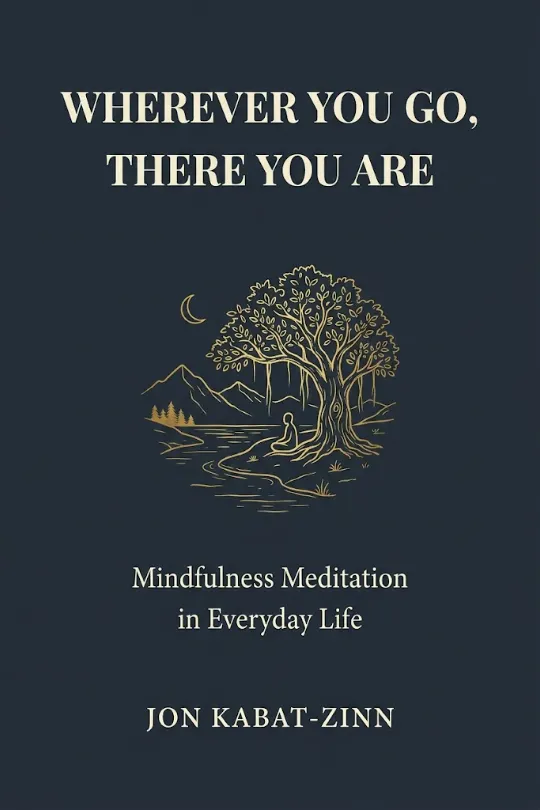
Wherever You Go, There You Are
Mindfulness Meditation in Everyday Life
Book Summary
Narrator: Ethan
Timeline
Summary Preview
Here's a question worth sitting with for a moment: When was the last time you were truly, completely present? Not thinking about what happened earlier today, not planning what you'll say in that meeting tomorrow, not replaying an old conversation or worrying about a future one. Just... here. Right now.
For most of us, the honest answer is: not recently. And that's the central problem this book addresses.
Jon Kabat Zinn describes our ordinary state of mind as something like a cluttered attic. Imagine walking up to the attic of an old house. Over the years, it's filled up with old bags, accumulated junk, things you meant to sort through but never did. The space is so crowded that you can barely move, barely see what's actually there. That's what our minds are like, Kabat Zinn says. Our thoughts—worries about the past, anxieties about the future, judgments, opinions, preferences, fears—they pile up over time until they obscure everything. We can't see reality clearly because we're looking through a fog of our own mental clutter.
This state has a name: mindlessness. It's not a judgment; it's a description. Most people operate on autopilot, driven by automatic thoughts and unconscious habits. We wake up, brush our teeth, commute, work, eat, scroll, sleep—and much of it happens without us actually being there. We're sleepwalking through our own lives.
Kabat Zinn draws on Buddhist philosophy to explain this. In that tradition, most of us live in what's called "ignorance"—not ignorance in the sense of stupidity, but ignorance as a kind of dream. We're dreaming while awake, lost in a world of thoughts about what's already happened or what hasn't happened yet. We mistake these thoughts for reality. We believe our interpretations, our fears, our mental stories are the truth. But they're not. They're just
Here's a question worth sitting with for a moment: When was the last time you were truly, completely present? Not thinking about what happened earlier today, not planning what you'll say in that meeting tomorrow, not replaying an old conversation or worrying about a future one. Just... here. Right now.
For most of us, the honest answer is: not recently. And that's the central problem this book addresses.
Jon Kabat-Zinn describes our ordinary state of mind as something like a cluttered attic. Imagine walking up to the attic of an old house. Over the years, it's filled up with old bags, accumulated junk, things you meant to sort through but never did. The space is so crowded that you can barely move, barely see what's actually there. That's what our minds are like, Kabat-Zinn says. Our thoughts—worries about the past, anxieties about the future, judgments, opinions, preferences, fears—they pile up over time until they obscure everything. We can't see reality clearly because we're looking through a fog of our own mental clutter.
This state has a name: mindlessness. It's not a judgment; it's a description. Most people operate on autopilot, driven by automatic thoughts and unconscious habits. We wake up, brush our teeth, commute, work, eat, scroll, sleep—and much of it happens without us actually being there. We're sleepwalking through our own lives.
Kabat-Zinn draws on Buddhist philosophy to explain this. In that tradition, most of us live in what's called "ignorance"—not ignorance in the sense of stupidity, but ignorance as a kind of dream. We're dreaming while awake, lost in a world of thoughts about what's already happened or what hasn't happened yet. We mistake these thoughts for reality. We believe our interpretations, our fears, our mental stories are the truth. But they're not. They're just thoughts.
The consequence of living this way is severe: we miss our own lives. If you're constantly somewhere else in your mind—in the past, in the future, in some imagined scenario—you're not actually experiencing the moments that make up your existence. You're missing the texture, the richness, the vividness of what's happening right now.
And there's another cost. When we're mindless, we're ruled by automatic patterns. Our actions are driven by fear, insecurity, old conditioning, unexamined beliefs. We react instead of respond. We make choices based on habits we never consciously chose. We feel stuck, out of touch, disconnected from our authentic selves.
Kabat-Zinn describes this as being carried along by a river of thoughts. We don't realize we're in the current; we just go wherever it takes us. We think we're choosing our direction, but really we're being swept along by momentum from the past.
The core challenge, then, is to wake up from this dream. To step out of the automatic stream and start living deliberately. But here's the catch: most people don't even know they're dreaming. The mindlessness is so habitual, so constant, that we mistake it for normal consciousness. We think this is just what being awake feels like.
It's not. There's another way to live.
This diagnosis—that we're living in a dream of thoughts—isn't meant to be depressing. It's meant to be clarifying. Because once you see the problem clearly, you can start to address it. And the solution, which we'll explore in the coming sections, is both simple and profoundly challenging.
But first, take a moment to consider: Right now, in this very moment, are you actually here? Or is your mind somewhere else, telling you stories about what's already happened or what might come next?
About the Book
Most of us live on autopilot, lost in thoughts about the past and future, missing the only moment that ever exists: now. Jon Kabat-Zinn offers a simple yet profound path back to presence through mindfulness. With practical meditations and real-world wisdom, this guide teaches you to step out of the river of automatic thoughts and into a life of genuine awareness, purpose, and peace.
Key Takeaways
Step out of the river of thoughts by anchoring to your breath.
Your mind is constantly swept away by automatic thoughts about the past and future, like a river current. The breath is your portable tether to the present moment—simply notice the sensation of breathing, and each time your mind wanders, gently return your attention to the breath without judgment.
Cultivate the seven attitudinal pillars through practice, not as prerequisites.
Non-judging, patience, trust, non-striving, acceptance, letting go, and generosity are not qualities you need before you start meditating—they emerge from the practice itself. Each time you notice a judgment or frustration and return to the breath, you are strengthening these pillars one breath at a time.
Become the mountain to weather emotional storms without being moved.
When difficult emotions like anger or anxiety arise, visualize yourself as a mountain—solid, rooted, and unmoved by the weather passing over it. Feel the emotion fully but identify with the mountain's stability, allowing the feeling to pass like a storm while you remain centered.
Drop beneath the surface of thoughts to access the still depths of awareness.
Your thoughts and emotions are like waves on the surface of a lake; they come and go. Through the Lake Meditation, practice identifying not with the waves but with the vast, calm water below—the awareness that holds all experience without being disturbed by it.
Use difficult emotions as a 'pot for mindfulness' to cook them into insight.
Instead of reacting to anger or frustration, pause and hold the feeling in awareness like a hot pot. Investigate what's underneath—often it's a deeper need like respect or being heard—and then choose a wise response rather than an automatic reaction.
Practice loving-kindness starting with yourself to undo self-rejection.
Genuine care for others begins with unconditional self-acceptance. Use phrases like 'May I be happy, safe, healthy, and live with ease' to bathe yourself in kindness, then extend that same warmth outward to friends, neutral people, and even those you conflict with.
Pose your 'capital-J job' question in meditation to uncover your unique contribution.
Ask yourself in stillness: 'What needs doing on this planet that I know something about and that probably won't happen unless I take responsibility for it?' Hold the question without forcing an answer—over time, clarity will emerge about your unique purpose and contribution.
Integrate mindfulness into daily life by treating every moment as practice.
Formal meditation is training for real life—bring the same presence to washing dishes, difficult conversations, and commutes. When you notice yourself on autopilot, gently return to the present moment, dissolving the boundary between practice and living.
Who Should Listen?
Anyone who feels constantly distracted, anxious, or overwhelmed by the pace of modern life and wants a practical way to find calm and clarity.
A stressed professional who struggles with work-life balance and needs tools to manage difficult emotions like anger and frustration without reacting.
A spiritual seeker who has tried other self-help or meditation approaches but wants a grounded, non-mystical, and scientifically-informed path to inner peace.
A person recovering from burnout or a major life transition who needs to reconnect with themselves and discover their deeper purpose.