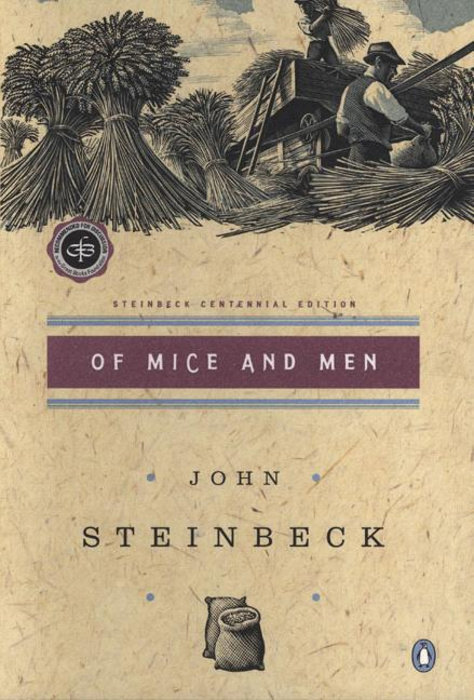
Of Mice and Men
Book Summaries
Hosts: Ethan
Timeline
Summary Preview
The Salinas River runs slow and warm through a valley south of Soledad, California. On a Thursday evening in the 1930s, two men emerge from a beaten path that winds through sycamore trees down to a green pool. The setting is beautiful—golden foothills, leaves whispering in the breeze, water so still it's covered with algae. It's the kind of place that offers rest, a brief reprieve from the blistering sun.
But these two men aren't here for scenery. They're migrant ranch workers, dressed in identical denim trousers and floppy black hats, carrying their belongings in bindles over their shoulders. And they're running.
The smaller man is George Milton—sharp-featured, quick-witted, restless. The larger man is Lennie Small—massive, lumbering, with the mind of a child and the strength to crush a man's hand without meaning to. Lennie drops to his knees at the pool and drinks like a horse, gulping stagnant water until George pulls him back, warning him he'll get sick.
This opening scene captures the heart of John Steinbeck's classic novella, *Of Mice and Men*. Published in 1937, the story unfolds over just four days on a ranch in California's Salinas Valley. It's a story about friendship during the Great Depression, when millions of men wandered alone from job to job, carrying nothing but loneliness. George and Lennie are different. They travel together. They have each other. And they share a dream.
The dream is simple: a small farm of their own. A vegetable patch. A few chickens. A hutch full of rabbits for Lennie to tend. A place where they answer to no one, where they can "live off the fatta the lan'." In a world of poverty, isolation, and back-breaking labor, this dream is everything. It's hope. It's purpose. It's what keeps them going.
But the title itself carries a warning. Steinbeck took it from Robert Burns's 1785 poem "To a Mouse," in which a farmer accidentally destroys a mouse's nest while plowing. The poem's famous line—"The best-laid schemes o' mice an' men gang aft agley"—means that even our most careful plans often go wrong. No matter how pure the intention, how deep the hope, circumstances can crush it in an instant.
That tension runs through every page of this novella. The idyllic river setting contrasts sharply with the harsh reality of George and Lennie's lives. They have no home. No family. No security. They survive by moving from ranch to ranch, earning small stakes, and losing them just as fast. George describes it bluntly: "Guys like us, that work on ranches, are the loneliest guys in the world. They got no family. They don't belong no place."
Yet George and Lennie are different. They belong to each other. And that bond—rare, fragile, precious—is what makes this story a classic of American literature. It's also what makes it a tragedy.
As George sits by the fire that first night, staring into the flames, he tells Lennie about the trouble that forced them to flee their last job. A girl in a red dress. Lennie's innocent but dangerous desire to touch something soft. The accusations that followed. The lynch mob. The desperate escape.
Lennie listens quietly. He knows he's done bad things. He knows George gets frustrated. He offers to leave, to go live in a cave alone. But George softens. He can't imagine life without Lennie. So he does what he always does when Lennie needs comfort: he tells the story of the farm. The rabbits. The future.
And for a moment, the dream feels real.
This is the world Steinbeck creates—a world where hope and heartbreak exist side by side, where the most beautiful setting can hide the cruelest reality, where two friends hold onto a dream that the reader already suspects will never come true.
The question Steinbeck leaves us with is this: In a world designed to crush the weak, the poor, and the different, is friendship itself an act of defiance—or just another fragile dream waiting to be destroyed?
About the Book
In Depression-era California, two migrant workers—sharp-witted George and gentle giant Lennie—cling to a shared dream of owning a farm. But when Lennie’s innocent strength leads to tragedy, George faces an impossible choice: watch his friend suffer or end his life with mercy. A devastating story of friendship, loneliness, and the cost of hope.
Key Takeaways
Friendship is an act of defiance in a world designed for isolation
In a world where migrant workers drift alone, George and Lennie's bond is a radical choice against loneliness. Their friendship is not just comfort—it's a rebellion against a system that treats people as disposable labor, proving that human connection can survive even in the most dehumanizing conditions.
The dream is more powerful than its fulfillment
The farm is never real, yet it sustains George and Lennie through every hardship. The true value of a dream lies not in achieving it, but in the hope and purpose it provides along the way—a beacon that transforms suffering into meaning.
Innocence without power is a death sentence
Lennie's childlike purity makes him vulnerable in a brutal world that punishes weakness. His inability to understand his own strength or the consequences of his actions reveals a cruel truth: the world has no mercy for those who cannot protect themselves, regardless of their goodness.
The greatest act of love can be the hardest choice
George's decision to kill Lennie himself is not murder but mercy—a sacrifice born from deep love. He spares Lennie from Curley's cruelty and the terror of a violent death, choosing to carry the unbearable weight of that act so his friend can die peacefully inside their shared dream.
Loneliness is a cage that traps even the cruel
Every character in the novella is isolated—Curley's wife, Crooks, Candy, even Curley himself. Their loneliness makes them desperate, bitter, or dangerous. Steinbeck shows that isolation is not just a condition but a poison that corrupts the soul, turning people against each other.
The American Dream is a luxury denied to the marginalized
Crooks, Candy, and Curley's wife all glimpse the dream but are barred from it by race, age, or gender. The novella exposes the cruel irony that those who need hope most are systematically excluded from it, revealing the dream as a privilege rather than a right.
Violence is the only language the powerless are heard in
From Curley's aggression to Lennie's accidental killings, violence erupts when words fail. The characters lack the education, status, or voice to communicate their pain, so their bodies speak for them—often with devastating consequences that no one fully understands.
The world will never understand the depth of your sacrifice
Carlson's final question—'Now what the hell ya suppose is eatin' them two guys?'—captures the ultimate tragedy. George's monumental loss is invisible to everyone else. The most profound human experiences—love, grief, sacrifice—often go unseen and unacknowledged by a world too blind to look.
Who Should Listen?
Readers who love classic American literature and want to understand why *Of Mice and Men* remains a staple of high school and college curricula.
Anyone interested in stories about the Great Depression, social injustice, and the fragility of the American Dream for the poor and marginalized.
Fans of tragic, character-driven narratives that explore deep themes of friendship, loyalty, and moral sacrifice.
People who appreciate concise, powerful storytelling—a novella that delivers emotional impact in under 150 pages.