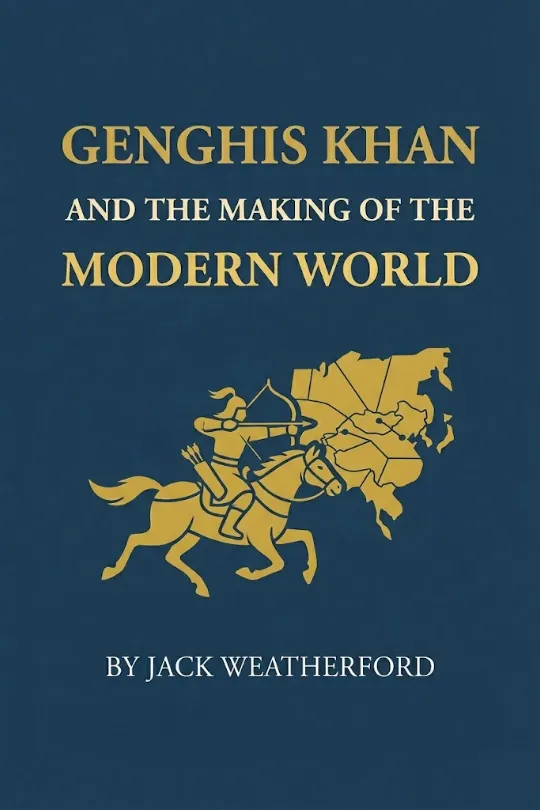
Genghis Khan and the Making of the Modern World
Book Summary
Narrator: Ethan
Timeline
Summary Preview
In the early 1990s, Jack Weatherford found himself in the Mongolian wilderness, riding across a landscape that had been closed to outsiders for generations. The Soviet Union had collapsed. Mongolia was finally independent. And for the first time in decades, foreign scholars could explore the places where Genghis Khan had lived, fought, and died.
Weatherford had come to study a figure most Westerners knew only as a barbarian. The name "Genghis Khan" conjured images of mounted hordes sweeping across Asia, leaving cities in ashes and pyramids of skulls in their wake. But as Weatherford traveled with Mongolian guides through the steppes where Temujin—the boy who would become Genghis Khan—had grown up, he discovered something startling. The man he found in Mongolian memory bore almost no resemblance to the monster of Western imagination.
Medieval sources told a different story. The poet Geoffrey Chaucer portrayed Genghis as a wise and just ruler. European chroniclers described him as humane, tolerant, and remarkably progressive. It was only in the eighteenth and nineteenth centuries, as racial pseudoscience took hold in the West, that Genghis Khan became a symbol of Asian savagery. The word "Mongoloid" entered the vocabulary as a slur. The real history had been buried under centuries of bias.
Weatherford's journey was possible because of a revolution in access. Soviet authorities had long suppressed the history of Genghis Khan, fearing that his legacy might inspire Mongolian nationalism. They sealed off the region of his birth and early life. They banned research into his achievements. But with the fall of the Soviet Union, the barriers collapsed. Weatherford could now visit sites that had been forbidden for decades.
Even more important, a remarkable medieval text had resurfaced. The Secret History of the Mongols was written shortly after Genghis Khan's death, probably in 1228. It tells the
In the early 1990s, Jack Weatherford found himself in the Mongolian wilderness, riding across a landscape that had been closed to outsiders for generations. The Soviet Union had collapsed. Mongolia was finally independent. And for the first time in decades, foreign scholars could explore the places where Genghis Khan had lived, fought, and died.
Weatherford had come to study a figure most Westerners knew only as a barbarian. The name "Genghis Khan" conjured images of mounted hordes sweeping across Asia, leaving cities in ashes and pyramids of skulls in their wake. But as Weatherford traveled with Mongolian guides through the steppes where Temujin—the boy who would become Genghis Khan—had grown up, he discovered something startling. The man he found in Mongolian memory bore almost no resemblance to the monster of Western imagination.
Medieval sources told a different story. The poet Geoffrey Chaucer portrayed Genghis as a wise and just ruler. European chroniclers described him as humane, tolerant, and remarkably progressive. It was only in the eighteenth and nineteenth centuries, as racial pseudoscience took hold in the West, that Genghis Khan became a symbol of Asian savagery. The word "Mongoloid" entered the vocabulary as a slur. The real history had been buried under centuries of bias.
Weatherford's journey was possible because of a revolution in access. Soviet authorities had long suppressed the history of Genghis Khan, fearing that his legacy might inspire Mongolian nationalism. They sealed off the region of his birth and early life. They banned research into his achievements. But with the fall of the Soviet Union, the barriers collapsed. Weatherford could now visit sites that had been forbidden for decades.
Even more important, a remarkable medieval text had resurfaced. The Secret History of the Mongols was written shortly after Genghis Khan's death, probably in 1228. It tells the story of his life in vivid, sometimes uncomfortable detail. Communist authorities in China had tried to suppress it, but copies circulated among scholars. When it was finally translated, it became the foundation for a new understanding of the Mongol Empire.
What Weatherford found in these pages challenged everything he thought he knew. The Mongol Empire, he came to argue, was not primarily a project of destruction. Its central aim was something far more ambitious: the creation of a unified world system. Genghis Khan and his successors pursued humanistic goals that seem remarkably modern. They established a common language for administration. They created a standardized currency that could be used across continents. They built a postal system that allowed messages to travel from China to Persia in weeks. And perhaps most remarkably, they granted religious freedom to every faith within their borders.
The empire became a conduit for cultural exchange on an unprecedented scale. Chinese engineers taught Persian architects. Persian astronomers shared their knowledge with Korean scholars. European craftsmen worked alongside Mongol metalworkers in the capital of Karakorum. Goods, ideas, and technologies flowed freely along routes that had once been blocked by warring kingdoms.
This was not accidental. Genghis Khan had grown up in a world of tribal violence, where families were destroyed by feuds and clans were wiped out by raids. He had been abandoned by his own tribe after his father's murder. He had watched his half-brother die by his own hand. These experiences, Weatherford argues, taught him that the old ways were broken. The only path to peace was to unite all people under a single system of laws and trade.
The evidence for this argument lies scattered across the Mongolian landscape. Weatherford's guides led him through valleys and over mountain passes, pointing out sites mentioned in The Secret History of the Mongols. They knew the land intimately, not from books but from stories passed down through generations. For them, Genghis Khan was not a distant historical figure. He was an ancestor, a source of pride, a living presence in the soil and sky.
But Weatherford also found evidence of suppression. Soviet-era monuments had been defaced. Historical sites had been neglected. The official narrative had painted Genghis as a reactionary warlord, an enemy of progress. The truth was far more complex. The Mongol Empire had destroyed cities and killed millions. But it had also created the conditions for the modern world to emerge.
This is the central thesis of Weatherford's book: that the Mongol Empire played a pivotal, underappreciated role in shaping the world we live in today. The free trade, open communication, religious tolerance, and international law that we take for granted all have roots in the innovations of Genghis Khan and his descendants. The empire collapsed centuries ago, but its ideals continued to spread.
Standing on the Mongolian steppe, looking out at the endless horizon under the Eternal Blue Sky, Weatherford understood why this land had produced such a world-changing figure. The vastness of the landscape, the harshness of the climate, the constant struggle for survival—these had forged a people who could adapt to anything. And out of that crucible had come a leader who dared to imagine a world without borders.
As Weatherford prepared to write his history, he carried with him the words of The Secret History of the Mongols and the memories of his journey. He knew that the story he was about to tell would challenge deeply held beliefs. But he also knew that the truth, when finally uncovered, was more remarkable than any myth.
What kind of man could unite warring tribes, conquer the largest empire in history, and then establish laws that protected religious freedom and promoted international trade? How did a boy born into poverty on the remote steppes of Mongolia become the architect of the modern world system? The answers lie in the story that follows—a story that begins, as all great stories do, with a birth marked by blood and prophecy.
About the Book
This book shatters the myth of Genghis Khan as a barbarian, revealing him instead as a visionary who united warring tribes, established religious freedom, and created a global network of trade and ideas. Jack Weatherford’s journey through Mongolia uncovers how the Mongol Empire’s innovations—from paper money to the postal system—laid the foundation for our interconnected modern world.
Key Takeaways
Loyalty forged in crisis outlasts loyalty inherited by blood.
The oath at Lake Baljuna, sworn by nineteen men from nine different tribes bound by choice rather than kinship, became the founding covenant of the Mongol nation, proving that a society built on voluntary commitment and shared purpose can be stronger than one held together by clan or family ties.
The greatest empires are built not by destroying the old order, but by institutionalizing a new one.
Genghis Khan's Great Law abolished the abduction of women, prohibited enslaving fellow Mongols, granted universal religious freedom, and established a merit-based military—transforming a chaotic collection of warring tribes into a unified nation where loyalty to law replaced loyalty to blood.
Fear is a weapon that can conquer cities before a single arrow is fired.
By deliberately cultivating a reputation for ruthless destruction and allowing terrified refugees to spread apocalyptic stories ahead of his army, Genghis Khan turned psychological warfare into a strategic tool that made entire civilizations surrender without resistance.
True power lies in the ability to hold together what you have built, not in the conquest itself.
The Mongol Empire's greatest vulnerability was not external enemies but internal division—the bitter rivalry between Genghis's sons over succession and territory planted the seeds of fragmentation that would ultimately tear the empire apart from within.
Women can be the unseen architects of empires, ruling with intelligence and ruthlessness when men fail.
While Mongol male heirs squabbled and drank, queens like Toregene and Sorkhokhtani held the vast empire together through strategic alliances, bribery, and political maneuvering, ultimately elevating their sons to power and shaping the empire's golden age.
To rule a civilization, you must sometimes become more like them than they are themselves.
Khubilai Khan conquered China not by force alone but by masterful political theater—adopting Chinese rituals, robes, and governance while secretly preserving Mongol identity behind the walls of his Forbidden City, creating a dual identity that allowed him to rule millions while remaining true to his own people.
The very systems that create prosperity can become the engines of destruction.
The Mongol Empire's greatest achievement—an unprecedented network of trade routes connecting continents—became its undoing when the Black Death traveled along those same roads, turning the Pax Mongolica from a conduit of commerce into a vector of plague that killed half of China and shattered the empire's foundations.
A legacy lives not in monuments or political structures, but in the ordinary systems we no longer remember as revolutionary.
Paper money, international postal systems, diplomatic immunity, religious tolerance, and global trade routes—innovations introduced by the Mongols—have become so embedded in modern life that we forget they originated with a nomadic people who dared to imagine a world without borders.
Who Should Listen?
History buffs who are tired of Eurocentric narratives and want a fresh, revisionist take on the Mongol Empire’s global impact.
Business leaders and entrepreneurs fascinated by how a decentralized, merit-based organization conquered and unified a continent.
Travelers and cultural explorers who dream of the Silk Road and want to understand the real story behind the world’s first global superhighway.
Readers of narrative nonfiction like Sapiens or The Silk Roads who love big-picture histories that connect ancient events to modern life.