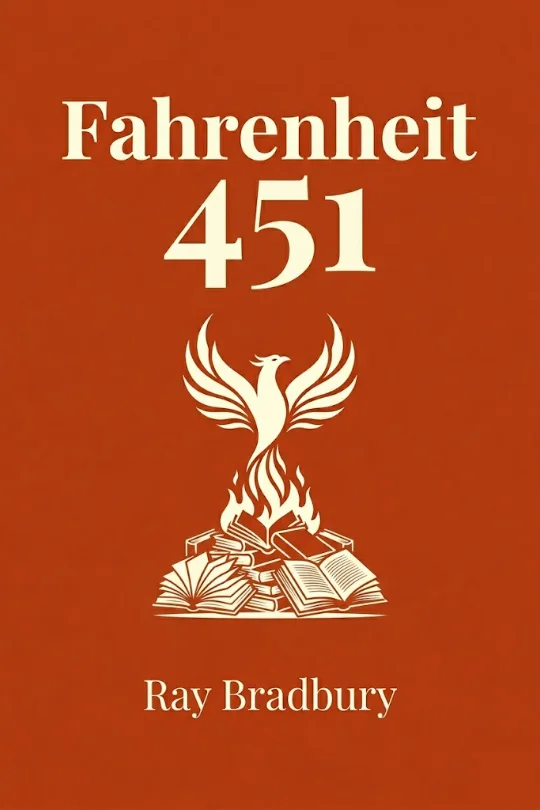
Fahrenheit 451
Book Summaries
Hosts: Ethan
Timeline
Summary Preview
It was a pleasure to burn. That's how Ray Bradbury opens his 1953 novel *Fahrenheit 451*. The first sentence hits you cold: "It was a pleasure to burn. It was a special pleasure to see things eaten, to see things blackened and changed."
Meet Guy Montag. He's a fireman. But this isn't the firefighting you know. In Montag's world, firemen don't put out fires. They start them. Their job is to burn books. Every book, every page, every word that might make someone think too hard. Montag stands in the middle of a house, holding a brass nozzle that spews kerosene. His eyes are "all orange flame with the thought of what came next." When he lights the match, the house erupts in a "gorging fire" that devours everything inside—the furniture, the walls, and most importantly, the books hidden in the attic.
The old woman who lived there watches from the window. She doesn't scream. She doesn't run. She just burns with her books.
Montag doesn't question any of this. He's thirty years old, with black hair and black brows and what Bradbury calls a "fiery smile" that never leaves his face. He wears it at work, at home, even in his sleep. He loves his job. He loves the rush of the Salamander—the fire truck—racing through the silent streets. He loves the smell of kerosene. He loves watching paper curl and blacken and turn to ash. For Montag, burning is a kind of religion, and he's a devoted priest.
But here's the thing about *Fahrenheit 451*. It's not really a book about book burning. It's about what happens when a man who loves to burn begins to doubt.
The world Montag lives in is a strange one. It looks like mid-century America—suburban houses, cars, television sets—but everything's been twisted. People drive at insane speeds, running down pedestrians without a second thought. The walls of every home are covered with giant television screens, "parlor walls" that blast mindless entertainment twenty-four hours a day. Families don't talk to each other; they watch their "family" on the screens. The government has banned almost all literature, not through some dictator's decree, but because the people themselves demanded it. Books made them feel stupid. Books made them argue. Books made them uncomfortable. So they got rid of them.
In their place came speed. Came noise. Came the endless chatter of game shows and commercials and "news" that was really just more entertainment. The country is on the brink of war with an unnamed enemy, but nobody cares. They're too busy watching the parlor walls.
Bradbury wrote *Fahrenheit 451* in 1953, at the height of the Cold War and McCarthyism, when the U.S. government was hunting down supposed communists and burning books—literally and figuratively. But the novel isn't just a warning about government censorship. It's a warning about what happens when people choose ignorance. When they trade real life for distraction. When they stop asking questions.
Montag's journey from happy book-burner to hunted fugitive is the spine of the novel. It's a story in three parts, each one marking a stage in his transformation. The first part, "The Hearth and the Salamander," shows him as the perfect fireman—until the cracks begin to show. The second part, "The Sieve and the Sand," finds him desperately trying to understand the books he's spent his life destroying. And the third part, "Burning Bright," follows his escape and his discovery of a hidden world of people who have dedicated their lives to preserving what the firemen burn.
But before any of that happens, we have to understand what Montag is leaving behind. We need to see the world as he sees it at the start: a world where fire is beautiful, where books are evil, and where a man with a flamethrower is a hero. Only then can we understand why he risks everything to change.
So here's the question that hangs over the first pages of *Fahrenheit 451*: What could possibly make a man stop loving the thing he loves most? What could make a fireman turn against fire?
About the Book
In a world where firemen burn books and TVs scream for attention, Guy Montag loves his job—until a curious girl asks if he's happy. After witnessing a woman die for her library, Montag steals a book and begins a dangerous journey from destroyer to keeper of knowledge. A haunting warning about censorship, distraction, and what we lose when we stop thinking.
Key Takeaways
The questions we avoid are the ones that save us.
Clarisse's simple question—'Are you happy?'—shatters Montag's entire worldview because he has never dared to ask it himself. The most dangerous threat to a comfortable lie is not an accusation, but an honest inquiry.
We burn what we fear to understand.
Society in Fahrenheit 451 didn't ban books through tyranny, but through a collective choice to avoid discomfort. People demanded the destruction of what made them feel inferior, proving that the deepest censorship is self-inflicted.
The opposite of happiness is not sadness, but numbness.
Mildred's overdose and her immediate return to the parlor walls reveal a life so hollowed out by distraction that she cannot even register her own suicide attempt. True misery is not feeling pain—it is feeling nothing at all.
A life worth living requires three things: quality of information, leisure to digest it, and the right to act on it.
Professor Faber distills the essence of a meaningful existence into these three gifts, which the book-burning world has systematically eliminated. Without them, people become passive consumers of noise, not active participants in their own lives.
Courage is not the absence of fear, but action taken despite it.
Faber admits he is a coward who watched the world burn books for years, yet he still chooses to help Montag. The old woman who burns with her books shows that even the most frightened person can find a moment of defiant bravery.
Memory is the only library that fire cannot destroy.
The Book People survive not by hoarding physical books, but by memorizing entire texts word for word. When all paper turns to ash, the human mind becomes the last sanctuary for knowledge—and the only hope for rebuilding.
The phoenix burns and rises unchanged; humanity can choose to learn.
Granger contrasts the mythical bird's endless cycle of destruction and rebirth with humanity's capacity for memory and growth. Our greatest power is not to rise from ashes, but to understand why we fell and build something wiser.
What we carry in our hearts is more real than what we build with our hands.
Montag ends his journey not as a destroyer or a revolutionary, but as a vessel for words that might heal a broken world. The true legacy of a life is not what we accumulate or burn, but what we preserve and pass on.
Who Should Listen?
Readers who feel overwhelmed by constant digital noise and crave a story about reclaiming deep thought and attention.
Anyone who has ever questioned why certain books are banned or challenged in their community or school.
Fans of dystopian fiction who want to understand the original blueprint that inspired modern classics like The Handmaid's Tale and 1984.
People who work in education, libraries, or media and want a powerful reminder of why their work preserving knowledge matters.