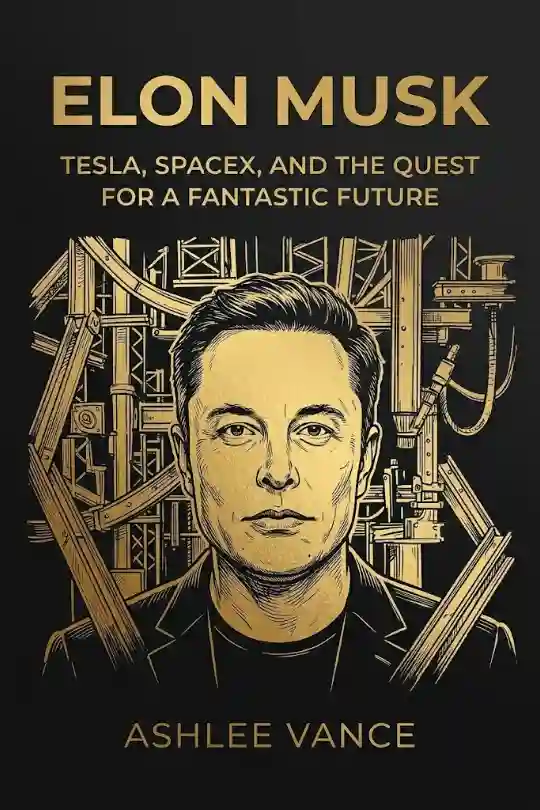
Elon Musk
Tesla, SpaceX, and the Quest for a Fantastic Future
Book Summary
Narrator: Ethan
Timeline
Summary Preview
Walter Isaacson opens his biography of Elon Musk with a question that haunts every page that follows. Could a kinder, gentler Elon Musk have launched us toward Mars and an electric vehicle future? The question isn't rhetorical. Isaacson spent two years shadowing Musk, interviewing his family, his ex wives, his employees, and his enemies. What emerged is a portrait of a man whose cruelty and compulsion for crisis are not bugs in the system—they're features.
The book's central argument is uncomfortable but direct. Musk's abrasive personality, his "demon mode," his need for drama and conflict—these aren't separate from his achievements. They're the engine. Isaacson doesn't just document what Musk did. He tries to understand why. And the answer, he suggests, lies in a childhood that would break most people.
Musk grew up in South Africa during the 1970s and 80s, a violent place at a violent time. His father, Errol, was a brilliant engineer with a dark streak. Elon and his brother Kimbal describe Errol as volatile, deceptive, and abusive—a man who could be charming one minute and launch into hours of verbal assault the next. The bullying at school was just as brutal. Musk was beaten so badly by classmates that he ended up in the hospital. When he came home, his father berated him, claiming he'd provoked the attack.
This wasn't a childhood that produced a well adjusted adult. It produced someone who learned to shut down emotionally, to thrive in crisis, to see the world as a battlefield. Isaacson calls this "demon mode"—a state of cold, intense focus that Musk can enter when under extreme pressure. It's the mode that allows him to fire employees on the spot, to push teams to work through the night for weeks on end, to make decisions that seem callous or
Walter Isaacson opens his biography of Elon Musk with a question that haunts every page that follows. Could a kinder, gentler Elon Musk have launched us toward Mars and an electric-vehicle future? The question isn't rhetorical. Isaacson spent two years shadowing Musk, interviewing his family, his ex-wives, his employees, and his enemies. What emerged is a portrait of a man whose cruelty and compulsion for crisis are not bugs in the system—they're features.
The book's central argument is uncomfortable but direct. Musk's abrasive personality, his "demon mode," his need for drama and conflict—these aren't separate from his achievements. They're the engine. Isaacson doesn't just document what Musk did. He tries to understand why. And the answer, he suggests, lies in a childhood that would break most people.
Musk grew up in South Africa during the 1970s and 80s, a violent place at a violent time. His father, Errol, was a brilliant engineer with a dark streak. Elon and his brother Kimbal describe Errol as volatile, deceptive, and abusive—a man who could be charming one minute and launch into hours of verbal assault the next. The bullying at school was just as brutal. Musk was beaten so badly by classmates that he ended up in the hospital. When he came home, his father berated him, claiming he'd provoked the attack.
This wasn't a childhood that produced a well-adjusted adult. It produced someone who learned to shut down emotionally, to thrive in crisis, to see the world as a battlefield. Isaacson calls this "demon mode"—a state of cold, intense focus that Musk can enter when under extreme pressure. It's the mode that allows him to fire employees on the spot, to push teams to work through the night for weeks on end, to make decisions that seem callous or cruel to anyone watching from the outside.
But it's also the mode that built SpaceX from nothing, that forced Tesla through production hell, that drove the acquisition and transformation of Twitter. The question Isaacson keeps returning to: can you separate the two?
The book traces Musk's journey from South Africa to Canada to Silicon Valley, from Zip2 to PayPal to SpaceX to Tesla to the Twitter takeover. Each chapter adds another layer to the portrait of a man who seems incapable of operating without conflict. When things are stable, Musk creates crises. When there's no enemy, he invents one. His ex-wife Justine described him as a "drama magnet." His brother Kimbal said it more bluntly: "That's his compulsion, the theme of his life."
Isaacson doesn't excuse this behavior. But he does contextualize it. Musk, he argues, operates from a "siege mentality" that was forged in the crucible of his South African childhood. The boy who was beaten and humiliated became the man who needs to own the playground. The child who had no control over his environment became the adult who must control everything around him.
The biography covers Musk's major ventures with remarkable access. Isaacson was there for key moments: the tense meetings, the factory floors, the rocket launches. He interviewed Musk's inner circle, his adversaries, his ex-partners. The result is a book that feels intimate without being sycophantic, critical without being dismissive.
What emerges is a fundamental tension. Musk's companies have accomplished what seemed impossible. SpaceX proved that private companies could launch rockets cheaper and more efficiently than NASA. Tesla forced the entire automotive industry to take electric vehicles seriously. These aren't small achievements. They're world-changing.
But the cost is real. Employees burn out. Partners leave. Safety concerns get dismissed. The Twitter acquisition, which Isaacson covers in detail, shows Musk at his most unfiltered—firing executives, alienating advertisers, reinstating banned accounts based on Twitter polls, and attacking former employees in ways that put their safety at risk.
Isaacson's book doesn't resolve the tension. It presents the evidence and lets the reader decide. The final chapter returns to the opening question, this time with more weight behind it. Could a restrained Musk accomplish as much as a Musk unbound? Is being unfiltered and untethered integral to who he is? Can you get the rockets to orbit or the transition to electric vehicles without accepting all aspects of him—hinged and unhinged?
The biography leaves you with a question that has no easy answer: What do we lose when we ask our innovators to be nice? And what do we accept when we let them be cruel?
About the Book
Walter Isaacson's explosive biography reveals the man behind the myth—a genius driven by childhood trauma, a 'demon mode' that fuels world-changing innovation but destroys everything in its path. From SpaceX's near-bankruptcy to the chaotic Twitter takeover, this is the unfiltered story of whether we can have the rockets without the recklessness.
Key Takeaways
Trauma Forges the Engine of Ambition
Musk's relentless drive and 'demon mode' were not born in boardrooms but forged in the crucible of a violent South African childhood and an abusive father, teaching him that survival requires emotional shutdown and a constant state of crisis.
First Principles Thinking Breaks the Idiot Index
By stripping away industry assumptions and calculating the raw material cost of a rocket, Musk exposed the 'idiot index'—the gap between price and true value—proving that accepted limitations are often just lazy choices waiting to be overturned.
Crisis Is Not a Bug, It's the Operating System
Musk's compulsion to create drama and thrive in chaos is a direct inheritance from his childhood, where stability was a fantasy; he functions best when the world is on fire because that is the only weather he was ever trained to navigate.
The Algorithm of Deletion Precedes Optimization
Musk's five-step 'hardcore algorithm' demands that you question every requirement and delete unnecessary parts before you optimize, because perfecting a process that shouldn't exist is a waste of time and a path to mediocrity.
Absolute Control Is the Price of Vision
After being ousted from PayPal, Musk structured every subsequent company to ensure he could never be pushed aside again, revealing that for him, protecting a world-changing idea requires the unilateral power to defend it from all collaborators and critics.
The Playground Bully Becomes the Owner of the Playground
Musk's purchase of Twitter was not merely a business deal but a psychological reclamation of the playground where he was once beaten, allowing him to finally dictate the rules of a social arena that had previously humiliated him.
Unchecked Influence Has a Human Cost
Musk's willingness to attack a former employee on Twitter, disable Starlink during a war, and exaggerate Autopilot's capabilities reveals that the same impulsivity that drives innovation can also cause real, irreversible harm to individuals and global stability.
The Unanswered Question: Can We Separate the Rocket from the Recklessness?
Isaacson leaves us with an unresolved tension: Musk's achievements in space and energy are world-changing, but they are inseparable from his cruelty and chaos, forcing us to ask whether we can have the breakthroughs without accepting the brokenness.
Who Should Listen?
Entrepreneurs and startup founders who want to understand the psychological cost of extreme ambition and whether a 'hardcore' management style is necessary for breakthrough innovation.
Tech industry professionals and engineers who have worked under demanding leaders and want to contextualize the chaos of high-stakes, crisis-driven workplaces.
Investors and business analysts following Tesla, SpaceX, and X (Twitter) who need a deeper understanding of Musk's decision-making patterns and their impact on company valuations.
Readers interested in biographies of complex figures who want to grapple with the ethical tension between world-changing achievements and the human cost required to achieve them.