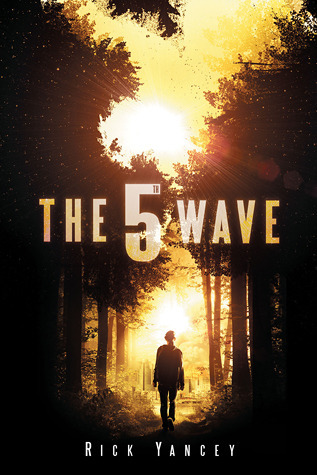
The 5th Wave
Book Summary
Narrator: Ethan
Timeline
Summary Preview
Cassie Sullivan lies under a rusted car on a cold Ohio highway. Blood seeps through her pant leg where a sniper's bullet tore into her thigh. She waits for the second shot—the one that will finish the job. Her M16 rifle is useless against a shooter half a mile away. She can't run. She can't fight. She can only lie there in the dirt, staring at the undercarriage, wondering if this is how it ends.
But Cassie isn't thinking about her wound. She's thinking about Sammy. Her five year old brother. The promise she made to him before soldiers tore them apart. She promised she would find him. She promised she would bring back his teddy bear. And lying under that car, bleeding out, she refuses to let that promise die.
Run equals die. Stay equals die. That's the math of survival now. The world ended, and these are the only equations that matter.
The Arrival. The Others came without warning. Their ship simply appeared in the sky—a massive gray green presence that hung there for ten days without moving, without communicating. Some people fled the cities. Most stayed, assuming the aliens were peaceful or that the military would handle them. Cassie herself was in calculus class when the lights went out.
That was the First Wave. An electromagnetic pulse that fried every electronic device on Earth. Phones dead. Cars dead. Planes falling from the sky. The world went silent in seconds.
The Second Wave came next. The Others dropped a metal rod—just a rod—from their ship. It hit the ocean and triggered earthquakes and tsunamis that destroyed every coastline on the planet. The East Coast. The West Coast. Australia. Japan. London. Rome. Rio. Millions dead in hours. Survivors fled inland, packed into refugee camps and abandoned towns.
Then the
Cassie Sullivan lies under a rusted car on a cold Ohio highway. Blood seeps through her pant leg where a sniper's bullet tore into her thigh. She waits for the second shot—the one that will finish the job. Her M16 rifle is useless against a shooter half a mile away. She can't run. She can't fight. She can only lie there in the dirt, staring at the undercarriage, wondering if this is how it ends.
But Cassie isn't thinking about her wound. She's thinking about Sammy. Her five-year-old brother. The promise she made to him before soldiers tore them apart. She promised she would find him. She promised she would bring back his teddy bear. And lying under that car, bleeding out, she refuses to let that promise die.
Run equals die. Stay equals die. That's the math of survival now. The world ended, and these are the only equations that matter.
The Arrival. The Others came without warning. Their ship simply appeared in the sky—a massive gray-green presence that hung there for ten days without moving, without communicating. Some people fled the cities. Most stayed, assuming the aliens were peaceful or that the military would handle them. Cassie herself was in calculus class when the lights went out.
That was the First Wave. An electromagnetic pulse that fried every electronic device on Earth. Phones dead. Cars dead. Planes falling from the sky. The world went silent in seconds.
The Second Wave came next. The Others dropped a metal rod—just a rod—from their ship. It hit the ocean and triggered earthquakes and tsunamis that destroyed every coastline on the planet. The East Coast. The West Coast. Australia. Japan. London. Rome. Rio. Millions dead in hours. Survivors fled inland, packed into refugee camps and abandoned towns.
Then the Third Wave. Birds. The Others infected birds with an airborne version of the Ebola virus. They flew across the continent, spreading death from the sky. Ninety-seven percent of the remaining population died in weeks. Cassie's mother was one of them.
The Promise. Cassie remembers watching her father bury her mother in their garden. He washed her body first, dressed her in her favorite clothes, then dug the grave himself. After that, he packed what they could carry and took Cassie and Sammy to a survivor camp twenty miles from home. They called it Camp Ashpit later, after the ash pit where Crisco—a thirteen-year-old orphan—dug through the burned remains of plague victims looking for valuables to trade.
At Camp Ashpit, Cassie's father refused a weapon. "Guns won't stop the Others," he said. But Cassie thinks differently now. Guns might not stop them, but they keep you alive long enough to try.
For a few weeks, the camp felt almost normal. Food. Medicine. A Marine named Hutchfield keeping order. Then the drones appeared. Then the Black Hawk helicopter. Then the Humvees and the school bus and the soldiers in gas masks.
They said they were from Wright-Patterson Air Force Base. They said they were there to rescue the children. Only the children. Everyone under fifteen would be taken to safety. Everyone else would follow later.
Cassie's father insisted she go with Sammy. She argued. She fought. But he was firm. Sammy needed her. She had to protect him.
So Cassie let her five-year-old brother board that bus. He gave her his teddy bear and made her promise: Don't leave it behind. I'll be back for it. I'll be back for you.
She watched the bus drive away. She didn't know she would never see her father alive again.
The Fourth Wave. Cassie realized too late what the soldiers really were. She found Crisco in the ash pit, digging as always. The soldier with her shot him without hesitation. When he turned his gun on Cassie, she pulled her own weapon and fired first. She ran back to camp, only to watch Lieutenant Colonel Alexander Vosch shoot her father in the courtyard.
She escaped. She hid in the ash pit while soldiers searched for her. She returned to camp to find survivors and saw soldiers setting up a gray globe in the center. It began to glow. She dove into a reservoir just before the explosion leveled everything.
After that, Cassie understood the Fourth Wave: distrust. The Others didn't need bombs or diseases anymore. They could look like humans. Act like humans. Walk among humans. The Fourth Wave was the inability to trust anyone, even yourself.
If a stranger is a little old lady sweeter than your great-aunt Tilly, hugging a helpless kitten, you can't know—you can never know—that she isn't one of them.
This is why Cassie killed the wounded soldier in the convenience store. This is why she travels alone. This is why, even now, bleeding under a car with a sniper waiting to finish her, she trusts no one.
But she has to survive. Not for herself. For Sammy. She has no idea what the Fifth Wave will be. She doesn't know that the Others are already setting it in motion, using the very children they took to finish what the first four waves started.
All Cassie knows is the promise she made. And the sniper still watching from the shadows.
What would you risk to keep a promise to someone you love?
About the Book
Cassie Sullivan is alone after an alien invasion wipes out most of humanity in four devastating waves. Her only mission: rescue her five-year-old brother from a military base. But the fifth wave is the most terrifying yet—the Others are turning human children into soldiers to kill the last survivors. Cassie must navigate betrayal, love, and impossible choices in this heart-pounding sci-fi thriller.
Key Takeaways
A promise is the anchor that keeps us human when everything else is lost
In a world reduced to survival math—'run equals die, stay equals die'—Cassie's promise to find her little brother Sammy becomes the only thing that separates her from the animal instinct to merely endure. The promise transforms her from a victim into someone with purpose, proving that our commitments to others are what preserve our humanity when civilization crumbles.
The deepest betrayal comes not from enemies, but from those who wear the face of salvation
The Fourth Wave—distrust—is the most devastating weapon because it weaponizes the very instinct that keeps humans alive: the need to trust one another. When soldiers who claim to rescue children instead massacre parents and train orphans to kill their own kind, the book reveals that the most dangerous enemy is the one who looks exactly like a friend.
Guilt is the most powerful fuel for transformation, but it can also become a prison
Ben Parish becomes 'Zombie' because he cannot forgive himself for letting his sister's hand slip from his grasp. His guilt is weaponized by the Others to turn him into a killer, yet it also drives him to protect Nugget—showing that the same wound that breaks us can also be the source of our greatest courage, if we learn to channel it rather than be consumed by it.
Love can emerge in the space between who we are and who we were programmed to become
Evan Walker, a Silencer designed to exterminate humans, finds himself unable to kill Cassie because the human host's emotions refuse to fade. His love for her is not a weakness but a rebellion—proof that even the most sophisticated programming cannot fully erase the capacity for connection, and that redemption begins with a single choice to disobey.
The stories we tell about ourselves can either trap us in survival or set us free to live
Cassie calls herself a cockroach—the only thing that can survive the apocalypse—but Evan renames her a mayfly, a creature that lives fully in a single day. The shift in narrative transforms her identity from mere endurance to meaningful existence, showing that the names we give ourselves determine whether we merely survive or truly live.
True strength is not the absence of fear, but the willingness to feel it and act anyway
Every character—Cassie bleeding under a car, Ben facing his drill instructor's betrayal, Evan defying his alien programming—acts not because they are fearless, but because they feel terror and choose to move forward. The book insists that courage is not the eradication of fear but the decision to let love, duty, or hope be louder than the voice that says run.
We are not defined by what we have lost, but by what we refuse to let go of
Cassie carries Sammy's teddy bear across a dead Ohio, through blizzards and gunfire, not because it has practical value, but because it represents the promise that binds her to her brother. In a world where everything has been stripped away, the objects and commitments we cling to become the architecture of our new identity—proof that we are more than our grief.
The end of the world does not erase the need for connection—it makes it more urgent
Despite the Fourth Wave's mandate to trust no one, the survivors repeatedly find strength in unlikely alliances: Cassie and Evan, Ben and Ringer, the broken squad of child soldiers. The book argues that isolation is not survival but a slow death, and that the only way to rebuild after destruction is to risk the terrifying vulnerability of reaching for another hand.
Who Should Listen?
Fans of fast-paced, character-driven YA sci-fi like *The Hunger Games* or *Divergent* who want a fresh alien invasion twist.
Readers who love stories about fierce sibling bonds and a sister's relentless determination to protect her family.
Anyone who enjoys psychological tension and moral ambiguity, where you can't trust anyone—not even the person you love.
Survival story enthusiasts who want a gritty, emotional journey through a broken world with high stakes and unexpected alliances.