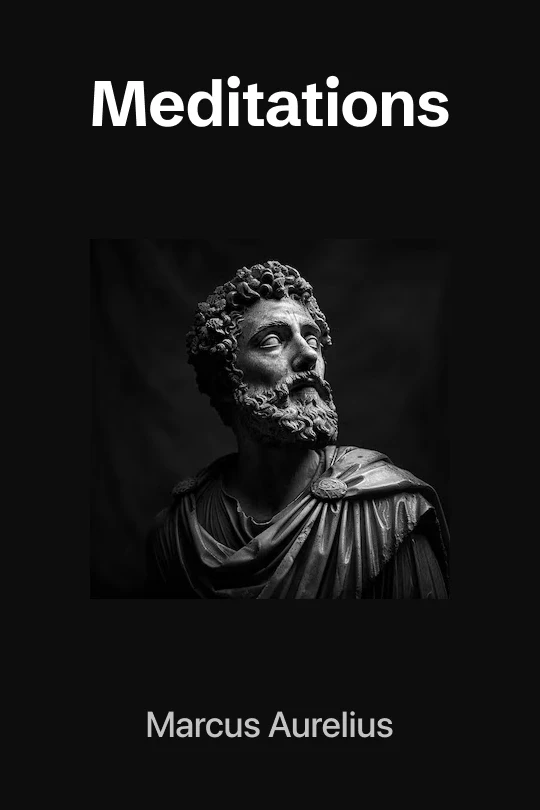
Meditations
Book Summary
Narrator: Ethan
Timeline
Summary Preview
He was the most powerful man in the known world. Emperor of Rome, commander of legions, master of millions. Yet when Marcus Aurelius sat down to write, he wasn't drafting laws or dictating military orders. He was talking to himself.
Meditations was never meant for publication. Marcus composed these reflections in Koine Greek—the language of philosophy, not the Latin of Roman administration—and scholars believe he wrote them during military campaigns along the empire's northern frontiers. The original Greek title translates to "things to himself." This was a private journal, a set of spiritual exercises designed to keep one man on the path of virtue.
And here's the paradox that makes this book so compelling: an emperor who could have anything, who wore purple robes and commanded absolute authority, spent his private moments warning himself against the very trappings of his power.
The core message of Meditations is deceptively simple. Happiness doesn't come from external circumstances—from wealth, fame, or power. It comes from inner virtue. From controlling your judgments, accepting fate, and acting for the common good. Marcus believed that humans are composed of body, breath, and directing mind. Only the mind matters. Only reason is truly ours.
But this wasn't abstract theorizing. Marcus was wrestling with real problems. He faced war, plague, betrayal, and the death of children. He dealt with difficult people daily. And he wrote to steel himself, to remind himself of what he truly believed when circumstances tempted him to forget.
One warning stands out. In Book 6, Marcus cautions himself not to be "Caesarified, or dyed in purple." The phrase is striking. Purple dye was reserved for Roman emperors—it signaled wealth, status, absolute power. But Marcus saw it as a stain. A corruption. Something that could seep into his soul and distort his judgment. He was
He was the most powerful man in the known world. Emperor of Rome, commander of legions, master of millions. Yet when Marcus Aurelius sat down to write, he wasn't drafting laws or dictating military orders. He was talking to himself.
Meditations was never meant for publication. Marcus composed these reflections in Koine Greek—the language of philosophy, not the Latin of Roman administration—and scholars believe he wrote them during military campaigns along the empire's northern frontiers. The original Greek title translates to "things to himself." This was a private journal, a set of spiritual exercises designed to keep one man on the path of virtue.
And here's the paradox that makes this book so compelling: an emperor who could have anything, who wore purple robes and commanded absolute authority, spent his private moments warning himself against the very trappings of his power.
The core message of Meditations is deceptively simple. Happiness doesn't come from external circumstances—from wealth, fame, or power. It comes from inner virtue. From controlling your judgments, accepting fate, and acting for the common good. Marcus believed that humans are composed of body, breath, and directing mind. Only the mind matters. Only reason is truly ours.
But this wasn't abstract theorizing. Marcus was wrestling with real problems. He faced war, plague, betrayal, and the death of children. He dealt with difficult people daily. And he wrote to steel himself, to remind himself of what he truly believed when circumstances tempted him to forget.
One warning stands out. In Book 6, Marcus cautions himself not to be "Caesarified, or dyed in purple." The phrase is striking. Purple dye was reserved for Roman emperors—it signaled wealth, status, absolute power. But Marcus saw it as a stain. A corruption. Something that could seep into his soul and distort his judgment. He was telling himself: don't let this role change who you are. Don't become the mask you wear.
This single line captures the central tension of the entire work. Here was a man who ruled an empire, who could have indulged every appetite, yet who saw his own power as a threat to his virtue. He wasn't writing to impress posterity. He was writing to save himself.
So the question Meditations poses is timeless: How do you live a virtuous life amid chaos? When everything around you screams for your attention, when people disappoint you, when death approaches, what do you hold onto?
Marcus's answer runs through every page. You hold onto reason. You strip away illusions. You remember that you are part of a larger whole. And you focus on what you can actually control—your own thoughts, judgments, and actions.
He was a Roman emperor who scorned Rome. A master of the world who doubted himself daily. A man who wrote only for himself—and ended up speaking to millions across two thousand years.
What did he find when he looked inward? What did he discover about the nature of a good life? And how did a man who had everything learn to want nothing?
About the Book
Written by the most powerful man in the ancient world for his own eyes only, Meditations is a raw, timeless guide to inner peace. Marcus Aurelius reveals how to control your judgments, accept fate, and find virtue amid chaos. This is not abstract philosophy—it’s a daily toolkit for anyone wrestling with anger, fear, or the meaning of life.
Key Takeaways
Virtue Is Learned Through Living Examples, Not Abstract Theory
Marcus Aurelius opens his private journal not with grand philosophy but with a catalog of gratitude for the real people who shaped his character, proving that wisdom is transmitted person-to-person through observed integrity, not through books alone.
No One Can Harm You Without Your Consent
The emperor's morning mantra reveals that external attacks can damage your body or reputation, but your soul remains untouched unless you let it—true harm lies in your judgment about events, not in the events themselves.
Strip Away Illusions to See Reality Clearly
Marcus's signature technique of mentally reducing fine wine to grape juice and purple robes to sheep hair soaked in shellfish blood is a radical practice of clear-eyed reason that frees you from being seduced by the world's glittering surfaces.
You Are a Thread in an Infinite Fabric, Not an Isolated Self
The universe is one living creature where every event serves the whole; to resent what happens is to revolt against Nature itself, while acceptance and cooperation align you with the cosmic design and bring peace.
Death Is Not an Enemy but a Liberator
By confronting death daily—having lost nine of his fourteen children and watching plague sweep his armies—Marcus discovered that mortality strips away attachment to trivialities and makes every virtuous choice matter.
Kindness Is the Most Powerful Weapon Against Conflict
Marcus's nine-step strategy for dealing with difficult people culminates in the radical insight that sincere kindness is invincible—it disarms hostility, preserves your own virtue, and keeps you connected to the shared humanity of even your worst enemy.
True Freedom Lies in How You Respond, Not What Happens
The Stoic paradox resolves when you stop fighting fate: Providence weaves the circumstances, but your choice of response—acceptance or resistance—is the only freedom that matters, and it can never be taken from you.
Meet the End Calmly, Kindly, and at Peace with the God Inside You
Marcus's final preparation for death is not a dramatic farewell but a quiet settling of accounts—stripping away everything superfluous, trusting that a lifetime of practicing virtue has prepared him to face eternity with the same discipline he brought to every ordinary moment.
Who Should Listen?
A busy professional overwhelmed by office politics and difficult colleagues, seeking a practical, ancient strategy to stay calm and kind without being a doormat.
A recent graduate or young adult feeling anxious about the future, who needs a clear framework for focusing on what they can control and letting go of what they cannot.
A caregiver or parent exhausted by the emotional demands of others, looking for a daily practice to protect their inner peace and respond with patience instead of resentment.
A high-achiever or leader who has achieved external success yet feels empty, wanting to strip away illusions of status and reconnect with what truly matters.