Book Summary
Narrator: Ethan
Timeline
Summary Preview
Deep in southern France, inside the Chauvet Pont d'Arc Cave, a handprint adorns the limestone wall. It is thirty thousand years old. Someone pressed their palm against the rock, blew pigment around it, and left an outline behind. The message was simple: "I was here."
That handprint marks something revolutionary. It is not a tool. It is not a weapon. It is a declaration. A human being wanted to be remembered, wanted to connect with people who would come long after they were gone. This was symbolic communication—the ability to think beyond the present moment, to imagine an audience that did not yet exist.
Yuval Noah Harari opens Sapiens: A Brief History of Humankind with this image. It is the starting point for an extraordinary story. How did a species that began as an insignificant animal in the middle of the food chain come to dominate the entire planet? How did Homo sapiens go from small bands of foragers to a global force capable of reshaping ecosystems, building skyscrapers, and splitting the atom?
The answer, Harari argues, is not what most people expect. It is not our individual intelligence. It is not our opposable thumbs. It is not even our ability to make tools. The secret to human dominance is our unique capacity to create and believe in shared fictions.
Harari traces the entire arc of human history through three major revolutions. The first, the Cognitive Revolution, began around seventy thousand years ago. Something changed inside the human brain. Our language evolved beyond simple warnings about predators or food sources. Suddenly, humans could talk about things that did not exist in the physical world. They could gossip about each other. They could tell stories about spirits and gods. They could imagine things that had never been seen.
This ability changed
Deep in southern France, inside the Chauvet-Pont-d'Arc Cave, a handprint adorns the limestone wall. It is thirty thousand years old. Someone pressed their palm against the rock, blew pigment around it, and left an outline behind. The message was simple: "I was here."
That handprint marks something revolutionary. It is not a tool. It is not a weapon. It is a declaration. A human being wanted to be remembered, wanted to connect with people who would come long after they were gone. This was symbolic communication—the ability to think beyond the present moment, to imagine an audience that did not yet exist.
Yuval Noah Harari opens Sapiens: A Brief History of Humankind with this image. It is the starting point for an extraordinary story. How did a species that began as an insignificant animal in the middle of the food chain come to dominate the entire planet? How did Homo sapiens go from small bands of foragers to a global force capable of reshaping ecosystems, building skyscrapers, and splitting the atom?
The answer, Harari argues, is not what most people expect. It is not our individual intelligence. It is not our opposable thumbs. It is not even our ability to make tools. The secret to human dominance is our unique capacity to create and believe in shared fictions.
Harari traces the entire arc of human history through three major revolutions. The first, the Cognitive Revolution, began around seventy thousand years ago. Something changed inside the human brain. Our language evolved beyond simple warnings about predators or food sources. Suddenly, humans could talk about things that did not exist in the physical world. They could gossip about each other. They could tell stories about spirits and gods. They could imagine things that had never been seen.
This ability changed everything. Other primates, like chimpanzees, can only form groups based on personal relationships. The maximum size is about fifty individuals. Beyond that, you cannot know everyone well enough to maintain cooperation. Humans have the same natural limit. Without shared fictions, we cannot trust strangers.
But with them? The boundaries dissolve.
When a group of strangers all believe in the same god, the same nation, the same set of laws, or the same currency, they can cooperate as if they were family. They can build cities. They can wage wars. They can trade across continents. They can create corporations that employ thousands of people who have never met each other.
Harari calls these shared beliefs "imagined realities." They are not lies. They are fictions that everyone agrees to treat as real. Money is the perfect example. A dollar bill has no intrinsic value. It is a piece of paper. But because seven billion people believe in its value, it works. It can buy food, shelter, and services. It can move economies. It can topple governments.
The same principle applies to nations. There is no physical boundary in the soil that says "France." The line exists only in the collective imagination of French citizens and the rest of the world. Laws, human rights, corporations, universities—all are imagined orders. They exist because enough people agree to believe in them.
This ability to cooperate flexibly in large numbers is what made the Agricultural Revolution possible about ten thousand years ago. Humans settled down, domesticated plants and animals, and created the first villages. But Harari is not sentimental about this transition. He argues that the Agricultural Revolution was a trap. It allowed more humans to survive, but individual quality of life declined. Farmers worked harder, ate worse food, and lived in crowded, disease-ridden settlements. The luxuries of civilization quickly became necessities.
The Scientific Revolution, beginning five hundred years ago, accelerated everything. Humans admitted their ignorance and started systematically acquiring new knowledge. This created a feedback loop. More knowledge led to more power. More power led to more wealth. More wealth funded more research. The cycle has not stopped.
Harari's account is not a celebration. He is clear about the costs. The same shared fictions that enabled human cooperation also enabled human cruelty. Empires conquered and enslaved. Religions justified violence. Economic systems created vast inequalities. The handprint on the cave wall was an act of creation, but it was also the beginning of a story that would see humans destroy countless other species and reshape the planet in ways that may prove catastrophic.
The book argues that humans have never been content. We have always wanted more. The hunter-gatherer was not satisfied with enough food for today. The farmer wanted a surplus for tomorrow. The capitalist wants infinite growth. The scientist wants to conquer death itself. We are, Harari suggests, a species driven by dissatisfaction.
And now we stand at a new threshold. Genetic engineering, artificial intelligence, and biotechnology are giving us the power to design life itself. We are becoming gods—but dissatisfied gods who do not know what we want.
The handprint on the cave wall was a beginning. It said "I was here." Thirty thousand years later, the question is no longer whether we can leave our mark. We have left it everywhere. The question is whether we have the wisdom to decide what kind of mark we want to leave next.
How did a vulnerable ape become the master of the planet? And what happens when that ape gains the power to remake life itself?
About the Book
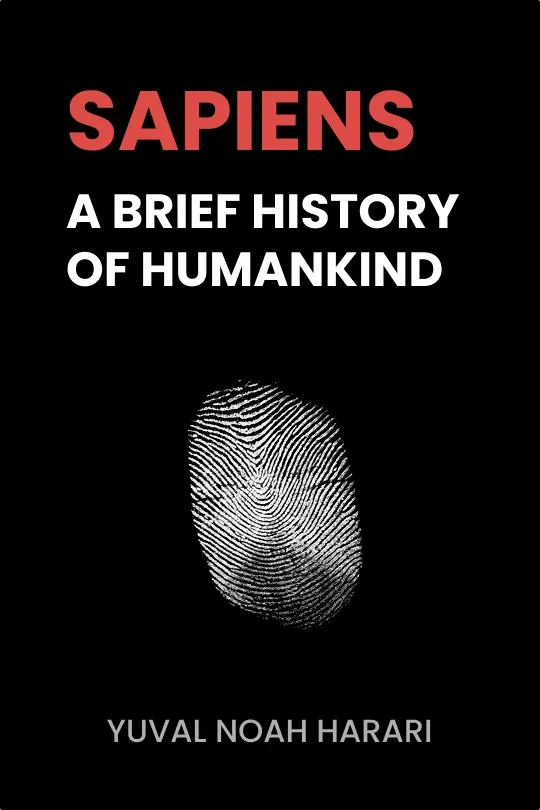
Yuval Noah Harari reveals how Homo sapiens rose from insignificance to global dominance through a unique ability: creating and believing in shared myths like money, nations, and laws. This provocative history traces three revolutions—Cognitive, Agricultural, and Scientific—that enabled mass cooperation, but at a devastating cost to happiness, other species, and the planet. A sweeping, unsettling look at where we came from and where we're headed.
Key Takeaways
Shared Fictions Are the Foundation of Human Civilization
Humans dominate the planet not because of individual intelligence or strength, but because we can create and believe in shared fictions—gods, nations, money, laws—that allow millions of strangers to cooperate flexibly toward common goals, transcending the biological limits of personal acquaintance.
The Agricultural Revolution Was History's Biggest Trap
The shift to farming was not a triumph of progress but a catastrophic trade-off: it allowed more humans to survive while dramatically reducing individual quality of life through harder work, worse nutrition, new diseases, and constant anxiety about the future, turning luxuries into necessities.
Human Happiness Depends on Expectations, Not Circumstances
Despite all technological and material progress, human happiness has not increased because our biochemistry and rising expectations create a permanent gap between what we have and what we want, making dissatisfaction the defining feature of modern life.
Writing and Money Were Born from Memory Overload
The invention of writing and money was not driven by noble aspirations but by the practical crisis of managing information in large societies—the human brain could not remember everything, so we created external systems of record-keeping that enabled empires, trade, and bureaucracy to scale.
History Has an Arrow Pointing Toward Global Unification
Over the last 2,500 years, empires, religions, and economic systems have relentlessly merged smaller cultures into larger ones, creating a single global network where strangers across continents cooperate through shared currencies, laws, and beliefs—a process both violent and transformative.
The Scientific Revolution Began with the Humble Admission of Ignorance
The breakthrough that unleashed modern science was not new instruments but a psychological shift: the willingness to admit we don't know everything and to actively seek new knowledge, creating a self-correcting process that rewards doubt and questioning rather than preserving ancient authorities.
We Are Dissatisfied Gods Who Do Not Know What We Want
Having gained godlike power to redesign life through genetic engineering, AI, and biotechnology, humans remain fundamentally dissatisfied and irresponsible—we have the tools to reshape existence but lack the wisdom to choose a worthy direction, making us the greatest danger to ourselves.
The Forager Was Healthier and Happier Than the Farmer
Hunter-gatherers worked only three to six hours daily, ate a diverse and nutritious diet, suffered fewer diseases, and lived with far less anxiety than agricultural societies—challenging our romanticized view of civilization as progress and revealing that the original affluent society was the one with the fewest possessions.
Who Should Listen?
History buffs who want a fresh, contrarian take on the human story that challenges everything they learned in school.
Leaders and managers struggling to understand why large groups of strangers can cooperate effectively—and how to harness that power.
Environmentalists and conservationists seeking a deep-time perspective on humanity's destructive impact on ecosystems and megafauna.
Tech entrepreneurs and futurists grappling with the ethical implications of genetic engineering, AI, and our godlike power to redesign life.