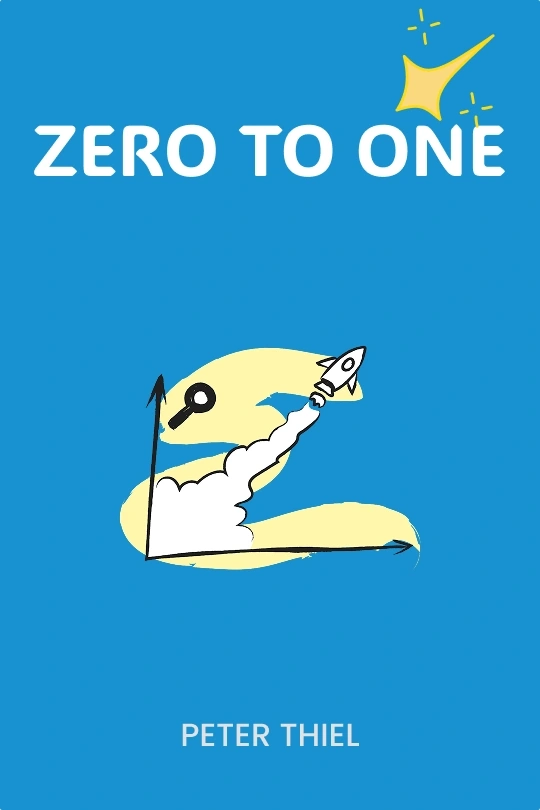
Zero to One
Notes on Startups, or How to Build the Future
Book Summary
Narrator: Ethan
Timeline
Summary Preview
Peter Thiel opens his book with a simple question he asks every job candidate: "What important truth do very few people agree with you on?" Most people answer by taking a side in a familiar debate, recycling opinions that are already popular. The best answers, Thiel says, see into the future.
This question gets at the fundamental challenge every entrepreneur faces. Most businesses copy what already works. They take an existing product, make it slightly better or cheaper, and compete in crowded markets. Thiel calls this going "from 1 to n." It's horizontal progress—spreading existing ideas to more people. But the kind of progress that actually changes the world is different. It's going "from 0 to 1"—creating something entirely new.
Think about the difference between building a hundred typewriters versus inventing a word processor. The first is horizontal: you take one typewriter, copy it a hundred times, and now a hundred people have typewriters. Useful, yes. But nothing has fundamentally changed. The second is vertical: you take the concept of writing and transform it. A word processor isn't just a better typewriter—it's a different category of tool. That's going from 0 to 1.
Thiel argues that most people today assume the future will be more of the same. They think progress means globalization—taking what works in developed countries and spreading it to developing ones. If China modernizes using today's tools, that's horizontal progress. But there's a problem. If every household in India and China tried to live like Americans, using only today's technology, the environmental impact would be catastrophic. Globalization without new technology is unsustainable.
This is where the contrarian question becomes practical. Thiel's own answer to it is that technology matters more than globalization. Most people assume the future will be defined by catching up and spreading wealth around.
Peter Thiel opens his book with a simple question he asks every job candidate: "What important truth do very few people agree with you on?" Most people answer by taking a side in a familiar debate, recycling opinions that are already popular. The best answers, Thiel says, see into the future.
This question gets at the fundamental challenge every entrepreneur faces. Most businesses copy what already works. They take an existing product, make it slightly better or cheaper, and compete in crowded markets. Thiel calls this going "from 1 to n." It's horizontal progress—spreading existing ideas to more people. But the kind of progress that actually changes the world is different. It's going "from 0 to 1"—creating something entirely new.
Think about the difference between building a hundred typewriters versus inventing a word processor. The first is horizontal: you take one typewriter, copy it a hundred times, and now a hundred people have typewriters. Useful, yes. But nothing has fundamentally changed. The second is vertical: you take the concept of writing and transform it. A word processor isn't just a better typewriter—it's a different category of tool. That's going from 0 to 1.
Thiel argues that most people today assume the future will be more of the same. They think progress means globalization—taking what works in developed countries and spreading it to developing ones. If China modernizes using today's tools, that's horizontal progress. But there's a problem. If every household in India and China tried to live like Americans, using only today's technology, the environmental impact would be catastrophic. Globalization without new technology is unsustainable.
This is where the contrarian question becomes practical. Thiel's own answer to it is that technology matters more than globalization. Most people assume the future will be defined by catching up and spreading wealth around. But the real opportunity—and the real necessity—is creating new technologies that let us do more with less.
The mechanism for this kind of progress isn't big corporations or lone inventors. Big corporations have too much bureaucracy. They optimize for safety, not novelty. Lone inventors can't scale their discoveries. The startup is the sweet spot: a small enough group to maintain creative freedom, but large enough to actually build something.
Here's the framework Thiel offers for thinking about innovation:
First, distinguish between the two kinds of progress. Horizontal progress (1 to n) copies what works. Vertical progress (0 to 1) creates something new. Most business advice focuses on horizontal progress—how to improve existing products, beat competitors, capture market share. But that advice leads to dead ends.
Second, ask yourself the contrarian question. What do you believe that almost no one else agrees with? This isn't about being different for the sake of it. It's about finding truths that are hidden in plain sight—opportunities everyone has overlooked because they're too busy copying each other.
Third, recognize that the best path is almost always the one nobody else is taking. If everyone is building a better typewriter, build a word processor. If everyone is focused on globalization, focus on technology. The most valuable companies solve problems that others don't even see as problems.
In practice, this means rejecting the safe bet. Most people choose careers and businesses by looking at what's already worked. They become the next lawyer, the next consultant, the next app developer copying an existing app. But the next Bill Gates won't build an operating system. The next Larry Page won't make a search engine. The next Mark Zuckerberg won't create a social network. If you're copying them, you aren't learning from them—you're just competing to be second.
Thiel's point isn't that horizontal progress has no value. It does. Copying what works can improve lives. But it can't solve the fundamental problems we face. And it certainly won't produce the kind of outsized returns that make startups worth building.
The real question isn't how to compete in existing markets. It's how to create something so new that competition becomes irrelevant. That requires thinking from first principles, not formulas. It requires asking what you believe that almost no one else believes—and then having the courage to act on it.
So here's the challenge: Before you start your next project, before you write your next business plan, before you accept the conventional wisdom about what's possible, ask yourself the contrarian question. What important truth do very few people agree with you on? If you can't answer it, you're probably planning to go from 1 to n. And that's a path that leads nowhere new.
About the Book
Peter Thiel reveals why most startups fail by copying existing models (going from 1 to n) instead of creating something entirely new (going from 0 to 1). Drawing on his experience building PayPal and investing in Facebook, he dismantles conventional business wisdom about competition, planning, and sales. This is a contrarian playbook for building a creative monopoly that captures lasting value.
Key Takeaways
Go from 0 to 1, not 1 to n
Instead of copying and incrementally improving what already exists (horizontal progress), focus on creating something entirely new (vertical progress). The most valuable companies solve problems nobody else sees and create new categories, not just better versions of existing products.
Reject the 'safe' lessons of failure
The dot-com crash taught wrong lessons: be incremental, stay flexible, improve on competitors, and ignore sales. Instead, risk boldness, commit to a plan (even a flawed one), avoid competitive markets, and invest heavily in sales and distribution alongside product development.
Build a creative monopoly, not a competitive business
Competitive markets destroy profits by driving prices to zero. Aim to dominate a small market with a 10x better product, proprietary technology, network effects, economies of scale, and strong branding. The goal is to be the only option, not the best option in a crowded field.
Avoid the ideology of competition
Most destructive competition happens between nearly identical companies fighting over the same customers. Recognize that rivalry distorts your thinking and wastes resources. The best way to win is to define your own market and become so unique that competition becomes irrelevant.
Be a definite optimist, not an indefinite one
Indefinite optimism—believing the future will be better without a specific plan—leads to drift and mediocrity. Definite optimists commit to a concrete vision, make detailed plans, and execute step by step. You are not a lottery ticket; build your future deliberately.
Apply the power law: focus everything on one thing
In venture capital and in life, a single success often outweighs all other efforts combined. Stop diversifying your time and energy. Identify the one opportunity that could return your entire investment (of time, money, or career) and pour everything into it, saying no to almost everything else.
Find and pursue secrets that others overlook
The best opportunities are hidden in plain sight—in neglected fields, unsolved problems, or assumptions nobody questions. A great company is a conspiracy to change the world around a secret. Look where nobody else is looking, and have the courage to act on what you find.
Get the foundation right: team, incentives, and sales
A startup messed up at its foundation cannot be fixed. Choose co-founders carefully, hire for mission alignment, pay with equity (not high cash salaries), and give everyone a single clear role. Most importantly, recognize that great products don't sell themselves—master one distribution channel and stress-test your business against seven key questions.
Who Should Listen?
Aspiring founders who have a bold idea but are being told to start smaller and copy what's already working.
Tech entrepreneurs stuck in competitive markets who need a framework for escaping the race to the bottom.
Product managers and engineers who believe great products sell themselves and want to understand why distribution matters as much as development.
Venture capitalists and angel investors who want a systematic framework for evaluating which startups have monopoly potential versus which will be crushed by competition.