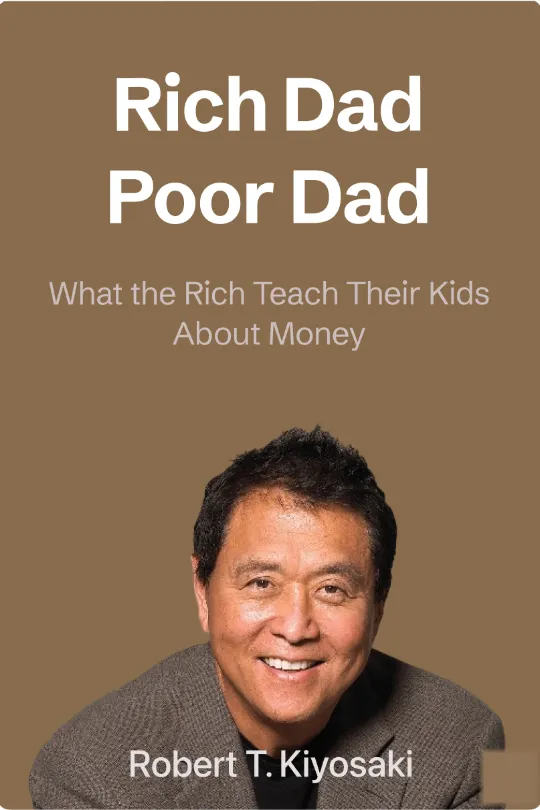
Rich Dad Poor Dad
What the Rich Teach Their Kids About Money—That the Poor and Middle Class Do Not!
Book Summary
Narrator: Ethan
Timeline
Summary Preview
Robert Kiyosaki had two fathers. One was his biological dad—a highly educated man with a PhD, a steady government job, and a deep belief in the traditional path: get good grades, find secure employment, work hard, save money, and you'll be fine. The other was the father of his best friend Mike—a man who never finished eighth grade, built businesses from nothing, and ended up one of the wealthiest people in Hawaii.
Here's the strange part: both men worked hard. Both were honest. Both paid their bills. But one died leaving tens of thousands of dollars in debt, while the other died a multimillionaire.
The difference wasn't intelligence. It wasn't luck. It wasn't even how much money they made. The difference was what they believed about money itself—and what they taught about it.
Kiyosaki's poor dad would say things like, "I'm not interested in money" and "Study hard so you can find a good company to work for." His rich dad said the opposite: "Money is power" and "Study hard so you can find a good company to buy ."
These aren't just different opinions. They're entirely different operating systems for how you navigate the financial world. And most of us, Kiyosaki argues, inherit the wrong one.
The Problem Nobody Talks About
Think about your own education. From kindergarten through college, how many classes did you take on money? How many taught you what an asset actually is, how taxes really work, or how to make your money grow without trading your time for it?
The answer is probably close to zero. Schools teach you to be a good employee. They teach you to follow rules, show up on time, and do what you're told. But they don't teach you to build wealth. They don't teach you to think like
Robert Kiyosaki had two fathers. One was his biological dad—a highly educated man with a PhD, a steady government job, and a deep belief in the traditional path: get good grades, find secure employment, work hard, save money, and you'll be fine. The other was the father of his best friend Mike—a man who never finished eighth grade, built businesses from nothing, and ended up one of the wealthiest people in Hawaii.
Here's the strange part: both men worked hard. Both were honest. Both paid their bills. But one died leaving tens of thousands of dollars in debt, while the other died a multimillionaire.
The difference wasn't intelligence. It wasn't luck. It wasn't even how much money they made. The difference was what they believed about money itself—and what they taught about it.
Kiyosaki's poor dad would say things like, "I'm not interested in money" and "Study hard so you can find a good company to work for." His rich dad said the opposite: "Money is power" and "Study hard so you can find a good company to buy."
These aren't just different opinions. They're entirely different operating systems for how you navigate the financial world. And most of us, Kiyosaki argues, inherit the wrong one.
The Problem Nobody Talks About
Think about your own education. From kindergarten through college, how many classes did you take on money? How many taught you what an asset actually is, how taxes really work, or how to make your money grow without trading your time for it?
The answer is probably close to zero. Schools teach you to be a good employee. They teach you to follow rules, show up on time, and do what you're told. But they don't teach you to build wealth. They don't teach you to think like an owner instead of a worker.
This isn't an accident. The system was designed for the industrial age, when you could work for one company for forty years and retire with a pension. That world doesn't exist anymore. But the mindset it created is still running in most people's heads.
The Two Mindsets in Action
Here's how these philosophies play out in real life:
Poor dad believed that your house is your biggest asset. Rich dad said your house is actually a liability—it takes money out of your pocket every month for taxes, maintenance, and mortgage payments, instead of putting money in.
Poor dad believed that job security was everything. Rich dad said the real security comes from what you know and your ability to spot opportunities.
Poor dad said, "I can't afford it"—and that was the end of the conversation. Rich dad asked, "How can I afford it?"—and that opened up a world of possibilities.
These aren't just different answers to the same question. They're different questions entirely. Poor dad asked, "How do I get a raise?" Rich dad asked, "How do I build an asset that pays me without working?"
The Rat Race
Kiyosaki uses a powerful metaphor to describe what happens when you live by poor dad's rules. He calls it the Rat Race.
Here's how it works: You're born, you go to school, you get good grades, you find a secure job. You start making money. Your expenses rise to match your income—maybe you buy a car, then a house, then nicer things. The more you make, the more you spend. You're running harder and harder, but you're not getting anywhere. You're on a treadmill. You're a rat on a wheel.
Fear keeps you on that wheel—fear of losing your job, fear of not paying bills, fear of falling behind. Greed keeps you on it too—the desire for more, for the next promotion, the next raise, the next purchase.
The rich escape this cycle. How? Not by working harder. Not by getting a better job. But by flipping the entire equation.
Work for Money vs. Have Money Work for You
This is the core distinction, and it's worth sitting with for a moment.
Most people spend their entire lives working for money. They trade their time, energy, and health for a paycheck. When they stop working, the money stops coming. They are the engine. If they break, the whole system stops.
Rich people build systems where money works for them. They acquire assets—things that generate income without their active labor. A rental property that pays you monthly. A business that runs without your daily involvement. Stocks that pay dividends. Royalties from intellectual property.
When you have money working for you, you don't have to trade your time for dollars. You can spend your time doing what you actually want. You're free.
The Real Takeaway
Here's what Kiyosaki wants you to understand: your financial future is not determined by your salary. It's not determined by your degree. It's not even determined by how smart you are.
It's determined by your mindset and your financial education.
Poor dad was brilliant. He had multiple advanced degrees. But he was trapped in a mindset that said, "Work hard, save money, play it safe." And that mindset kept him running on the wheel his entire life.
Rich dad was uneducated by formal standards. But he understood something that most people never learn: the path to wealth isn't about earning more. It's about keeping more of what you earn, and putting it to work.
So here's the question you need to ask yourself right now: which dad are you listening to? The one who tells you to get a safe job and climb the ladder? Or the one who tells you to build something that makes the ladder irrelevant?
Because the answer to that question will determine everything about your financial future.
About the Book
Robert Kiyosaki had two fathers: one highly educated but financially struggling, the other a wealthy entrepreneur who never finished eighth grade. This book reveals how your mindset about money—not your salary or education—determines your financial future. Through simple lessons on assets versus liabilities, escaping the rat race, and building passive income, Kiyosaki shows why the rich get richer and how you can too.
Key Takeaways
Shift from working for money to having money work for you
Stop trading your time for a paycheck and instead focus on acquiring assets that generate passive income. This fundamental mindset change breaks the cycle of the Rat Race, where fear and greed drive you to earn more and spend more without building lasting wealth.
Define assets and liabilities by cash flow, not by conventional labels
An asset puts money in your pocket, while a liability takes money out—ignore traditional labels like 'your house is an asset.' Apply this test to every purchase: if it costs you money monthly (mortgage, taxes, maintenance), it's a liability; if it generates income (rental property, dividend stock), it's an asset.
Build your asset column while keeping your day job
Treat your job as a funding source for your real business: your asset column. Redirect every extra dollar from raises or savings into income-producing assets like rental properties or dividend stocks, rather than upgrading your lifestyle, until your passive income covers your expenses.
Use corporate structures to legally minimize taxes and protect assets
Form an LLC or corporation to shift from the employee flow (earn, tax, spend) to the owner flow (earn, spend, tax). This allows you to deduct business expenses before taxation and shields personal assets from lawsuits, giving you the same advantages the wealthy use.
Invent money by finding and structuring deals, not by saving it
Professional investors create opportunities by finding motivated sellers, negotiating contracts with flexible terms, and using other people's money or partners to close. Instead of saying 'I can't afford it,' ask 'How can I afford it?' and look for undervalued assets others overlook.
Choose jobs based on what they teach, not what they pay
Optimize every role for skills that transfer to building wealth—leadership, sales, cash flow management, and systems thinking. Specialization traps you; being a generalist with sales and marketing skills lets you adapt to any opportunity and overcome fear of rejection.
Overcome the five psychological obstacles that block financial action
Fear, cynicism, laziness, bad habits, and arrogance keep you in the Rat Race. Combat them by taking small risks early, analyzing instead of criticizing, changing 'I can't afford it' to 'How can I afford it?', paying yourself first, and admitting what you don't know so you can learn.
Activate financial genius through daily discipline and a supportive network
Build wealth by finding a strong emotional purpose, surrounding yourself with people who talk about investing, paying yourself first before any bills, and hiring experts who have done what you want to do. Take one small action this week—make an offer, attend a seminar, or find a mentor—because knowledge without action is worthless.
Who Should Listen?
Middle-class professionals who feel trapped in a job and suspect there's a smarter way to build wealth beyond their paycheck.
Recent college graduates who were taught to 'get good grades for a secure job' but now realize that path may not lead to financial freedom.
Small business owners or freelancers who want to understand how to use corporate structures to legally minimize taxes and protect assets.
Anyone who has ever said 'I can't afford it' and wants to replace that mindset with 'How can I afford it?' to open up new financial possibilities.