Book Summary
Narrator: Ethan
Timeline
Summary Preview
The train station in Leipzig smelled of disinfectant. Anna Funder noticed it immediately—that chemical sharpness meant to mask human odors, but somehow worse than what it covered. She was on her way into what had once been East Germany, five years after the Berlin Wall fell, and already the past was pressing in through her senses.
In the restroom, the madam—a round woman with an official air—told Funder a curious story. Years ago, she had met a prince. A real prince, who invited her to see his palace. But she couldn't go. The Wall stood between them, and crossing from East to West Germany was impossible. The madam shrugged. She hadn't traveled much since the Wall came down, but she would like to see China one day. To see "that Wall of theirs."
This was the Germany Funder had come to understand. A place where ordinary lives had been bisected by concrete and barbed wire, where a bathroom attendant could have dined with royalty if not for the ideological fault line running through her country. The restroom madam's prince remained a fantasy, locked on the wrong side of history.
Funder had first visited Leipzig two years earlier, in 1994. She had gone to the Stasi museum, housed in the former headquarters of East Germany's Ministry for State Security. What she found there changed her. Rows of jars lined the shelves—not specimens in formaldehyde, but smell samples. The Stasi had collected the scents of their political opponents, bottling the very odor of dissent. They had catalogued everything: letters, photographs, the traces of lives lived under suspicion. Nothing was too small for their attention.
The Stasi were, as the German media called them after the Wall fell, "the most perfected surveillance state of all time." The numbers were staggering. In Hitler's Third
The train station in Leipzig smelled of disinfectant. Anna Funder noticed it immediately—that chemical sharpness meant to mask human odors, but somehow worse than what it covered. She was on her way into what had once been East Germany, five years after the Berlin Wall fell, and already the past was pressing in through her senses.
In the restroom, the madam—a round woman with an official air—told Funder a curious story. Years ago, she had met a prince. A real prince, who invited her to see his palace. But she couldn't go. The Wall stood between them, and crossing from East to West Germany was impossible. The madam shrugged. She hadn't traveled much since the Wall came down, but she would like to see China one day. To see "that Wall of theirs."
This was the Germany Funder had come to understand. A place where ordinary lives had been bisected by concrete and barbed wire, where a bathroom attendant could have dined with royalty if not for the ideological fault line running through her country. The restroom madam's prince remained a fantasy, locked on the wrong side of history.
Funder had first visited Leipzig two years earlier, in 1994. She had gone to the Stasi museum, housed in the former headquarters of East Germany's Ministry for State Security. What she found there changed her. Rows of jars lined the shelves—not specimens in formaldehyde, but smell samples. The Stasi had collected the scents of their political opponents, bottling the very odor of dissent. They had catalogued everything: letters, photographs, the traces of lives lived under suspicion. Nothing was too small for their attention.
The Stasi were, as the German media called them after the Wall fell, "the most perfected surveillance state of all time." The numbers were staggering. In Hitler's Third Reich, there was one Gestapo agent for every two thousand citizens. In Stalin's USSR, one KGB agent for every five thousand eight hundred thirty people. In East Germany? One Stasi officer or informant for every sixty-three citizens. If part-time informers were included, some estimates put the ratio at one informer for every six and a half people. Your neighbor, your colleague, your friend—any of them could be reporting your words back to the state.
At the museum, a woman who ran the place told Funder about someone else. A woman named Miriam, whose husband had died in a Stasi prison cell. The injustice lodged itself in Funder's mind. She couldn't shake it. So she moved to Berlin, took a part-time job in television, and began to seek the stories that had gone untold.
This book is an act of working against forgetting. Funder's boss at the television station had dismissed the idea. "No one is interested in these people," he said. They were, in his view, "just a bunch of downtrodden whingers." But a viewer from Argentina wrote in, demanding attention. It took twenty years after the war for Germans to even begin discussing the Nazi regime, he pointed out. The same process was repeating itself. "Will it be 2010 or 2020 before what happened there is remembered?"
Funder wanted to answer that question before the silence set in for good. She wanted to paint portraits of people who had lived through it all—the resisters, the victims, the perpetrators—before a generation passed and the memories faded into official records and museum displays.
The Stasi museum itself was full of ghosts. The cleaning woman showed Funder a smudge on the wall where Erich Mielke, the Minister for State Security, used to lean back and rest his head. "Won't come off," she said. And the smell—"we cleaned and cleaned and we just couldn't get rid of the smell." Of old men, of stale ideology, of a system that had seeped into the very walls.
Mielke himself had risen from street violence to power. In 1931, he shot and killed two German police officers, then fled to Moscow to work with Stalin's secret police. After the war, he returned to East Germany and eventually became the head of the Stasi, running the vast apparatus of surveillance alongside Erich Honecker, the Secretary-General. The "two Erichs," they were called. Between them, they turned a country into a laboratory of control.
The system they built didn't just watch people. It invaded their homes, their relationships, their dreams. It read love letters and catalogued personal secrets. It turned citizens against each other and made trust a dangerous luxury. When Miriam Weber, the woman from the museum's story, tried to escape over the Wall at sixteen, she fabricated an absurd story to end her interrogation. The Stasi believed it—not because it was plausible, but because in East Germany, the idea of confiding escape plans to strangers was unthinkable. Anyone could be an informer.
Funder's train pulled into Leipzig. The restroom madam's prince remained a ghost, the smell samples remained in their jars, and the stories remained waiting to be told. She had come to find Miriam, to hear the truth about a husband who died in custody, to understand what it meant to live in a place where the state could reach into every corner of your life.
But she also knew that the past doesn't stay in museums. It lingers in the air, in the disinfectant smell of train stations, in the smudge on the wall that won't come off. It waits for someone to ask the questions that everyone else has decided are no longer important.
What happens to a society when its surveillance state collapses? Do the wounds heal, or do they fester beneath the surface? And what does it mean to remember—truly remember—when forgetting is so much easier?
About the Book
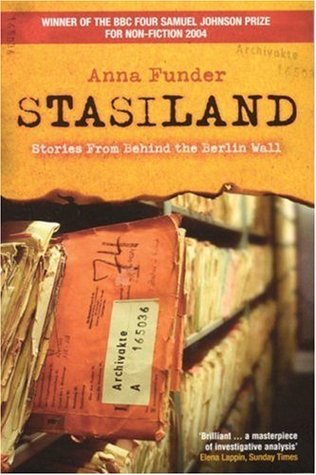
In Stasiland, Anna Funder uncovers the forgotten lives of East Germans under the Stasi—the most perfected surveillance state in history. Through intimate portraits of resisters, victims, and unrepentant perpetrators, she reveals how total surveillance invaded love, trust, and identity. A powerful act of memory against forgetting, this book asks what happens when a society must reckon with its own hidden wounds.
Key Takeaways
Surveillance destroys trust more completely than it controls behavior
When one in every six people might be an informant, the deepest damage is not the loss of privacy but the erosion of basic human trust—Miriam's escape plan was believed by Stasi interrogators precisely because the idea of confiding in strangers had become unthinkable in a society where anyone could be watching.
The past cannot be filed away—it breathes in the walls and waits to be heard
The smudge on Mielke's wall that 'won't come off' and the lingering smell of old ideology prove that history is not a museum exhibit but a living presence that seeps into architecture and memory, demanding acknowledgment long after regimes fall.
Resistance leaves invisible scars that outlast any prison sentence
Miriam removed the doors from her apartment and fled rooms during arguments because her body had learned a permanent flight instinct—the Stasi's torture of sleep deprivation and isolation had rewired her nervous system in ways that no amnesty could undo.
The most humane people can be the architects of inhuman systems
Erich Mielke, who began his career by murdering police officers and built the most pervasive surveillance state in history, was described by his propagandist friend as 'the most humane human being'—revealing how ideology can completely invert moral perception.
Survival requires living in two realities at once
East Germans learned to accept the state's fictions—that unemployment didn't exist, that the Lipsi dance was fun—while simultaneously knowing the truth, a double consciousness that Julia described as the only way to avoid going mad from constant cognitive dissonance.
The wound of surveillance is knowing exactly how far others will transgress your boundaries
Julia's deepest damage came not from losing her career or her Italian boyfriend, but from the 'terrible knowledge' that her love letters had been read, her private self invaded—a permanent awareness that there is no place where you are truly alone.
A mother's refusal to become bait is a quiet act of heroism that the state will punish as crime
Frau Paul chose four years of hard labor over betraying the student who helped East Germans escape, yet the Stasi succeeded in making her see herself as a criminal—the sorriest victory of a system that could steal not just years but a person's own self-image.
Telling your story does not set you free—but it keeps the silence from winning
Neither Herr Winz nor Miriam found liberation through confession; the former remained fettered by his pride, the latter by her grief—yet Charlie's poem, still screaming from the page years after his murder, proves that the human voice can rise against the silence that regimes depend on.
Who Should Listen?
Readers fascinated by Cold War history and the human cost of authoritarian surveillance systems.
Anyone interested in personal stories of resistance, survival, and the psychological toll of living under constant observation.
Journalists, historians, and activists who want to understand how state control erodes trust and intimacy in daily life.
Those who enjoyed *The Gulag Archipelago* or *The File* and seek a deeply human, narrative-driven exploration of oppression.