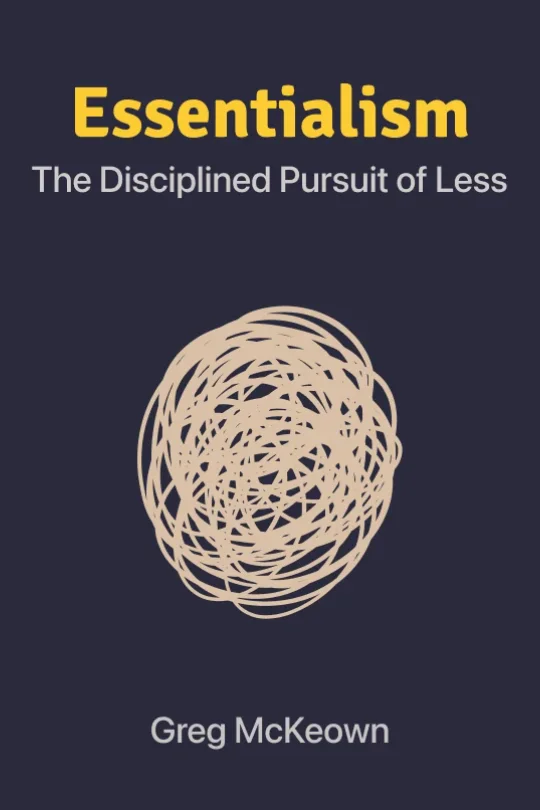
Essentialism
The Disciplined Pursuit of Less
Book Summary
Narrator: Ethan
Timeline
Summary Preview
Sam Elliot was a Silicon Valley executive who had everything—a prestigious job, a growing network, and more opportunities than he could count. He said yes to every request, attended every meeting, and chased every promising lead. His calendar was packed, his inbox overflowing, and his reputation for being available made him indispensable. But something was wrong. Despite being busier than ever, Sam felt like he was making less progress, not more. He was exhausted, stretched thin, and couldn't remember the last time he'd felt truly productive. His life had become a blur of activity without meaningful accomplishment.
Sam had fallen into the trap of nonessentialism—the belief that you can do everything, have everything, and be everything to everyone. It's not a philosophy anyone consciously adopts. It happens gradually, one yes at a time, until you wake up wondering why you're so busy yet so unfulfilled.
The modern world is engineered to overwhelm you. Consider the numbers: the average person receives hundreds of emails, dozens of notifications, and countless requests for their time every single day. The abundance of choices—what to work on, what to attend, what to pursue—creates what psychologists call the paradox of choice. More options don't liberate you; they paralyze you. They make you anxious about missing out on the better path, and they leave you dissatisfied with whatever you ultimately choose.
But there's another force at work here, one that Greg McKeown calls the paradox of success. It works like this: when you achieve some success in a particular area, that success creates more opportunities and options. Those opportunities demand your attention and energy. Before long, you're spread across so many fronts that you can't make meaningful progress on any of them. Your success becomes the very thing that undermines your effectiveness.
This is exactly what happened
Sam Elliot was a Silicon Valley executive who had everything—a prestigious job, a growing network, and more opportunities than he could count. He said yes to every request, attended every meeting, and chased every promising lead. His calendar was packed, his inbox overflowing, and his reputation for being available made him indispensable. But something was wrong. Despite being busier than ever, Sam felt like he was making less progress, not more. He was exhausted, stretched thin, and couldn't remember the last time he'd felt truly productive. His life had become a blur of activity without meaningful accomplishment.
Sam had fallen into the trap of nonessentialism—the belief that you can do everything, have everything, and be everything to everyone. It's not a philosophy anyone consciously adopts. It happens gradually, one yes at a time, until you wake up wondering why you're so busy yet so unfulfilled.
The modern world is engineered to overwhelm you. Consider the numbers: the average person receives hundreds of emails, dozens of notifications, and countless requests for their time every single day. The abundance of choices—what to work on, what to attend, what to pursue—creates what psychologists call the paradox of choice. More options don't liberate you; they paralyze you. They make you anxious about missing out on the better path, and they leave you dissatisfied with whatever you ultimately choose.
But there's another force at work here, one that Greg McKeown calls the paradox of success. It works like this: when you achieve some success in a particular area, that success creates more opportunities and options. Those opportunities demand your attention and energy. Before long, you're spread across so many fronts that you can't make meaningful progress on any of them. Your success becomes the very thing that undermines your effectiveness.
This is exactly what happened to Sam. His reputation for delivering results led to more requests, more projects, more commitments. And the more he tried to do everything, the less he actually accomplished. He was making a millimeter of progress in a million directions.
The alternative is essentialism. Not the idea of simply doing less—that's a common misunderstanding. Essentialism is about doing the right things, the things that truly matter. It's the disciplined pursuit of less, but better. And it requires grappling with trade-offs.
Here's the hard truth: you cannot have it all. Every yes is a no to something else. Nonessentialists try to avoid this reality. They say yes to everything, hoping to escape the discomfort of choosing. But trade-offs are inescapable. The only question is whether you make them deliberately or by default.
Sam learned this the hard way. When he finally hit his breaking point, he made a radical shift. He stopped trying to do everything and started asking one question: "What is essential?" He eliminated everything else. The result wasn't less productivity—it was more. By focusing his energy on the vital few tasks that actually moved the needle, he generated tremendous momentum toward what truly mattered.
Essentialism operates through three core steps, and understanding them now gives you the framework for everything that follows in this book.
Step one: Explore. Before you can eliminate, you must discern. This means creating space to think, to look, to listen, and to play. It means resisting the pressure to be constantly busy and instead giving yourself permission to discover what's truly important. Most people skip this step entirely—they're too busy doing to ever stop and evaluate what they should be doing.
Step two: Eliminate. Once you've identified the essential, you must cut out everything else. This is the hard part. It means saying no to good opportunities so you can say yes to great ones. It means uncommitting from past decisions that no longer serve you. It means editing your life with the same ruthless precision a film editor uses to cut scenes that don't advance the story.
Step three: Execute. Finally, you need a system for making the essential things happen almost effortlessly. This isn't about willpower or discipline in the traditional sense. It's about removing obstacles, creating buffers, and designing routines that automate your highest priorities.
The key insight here is that essentialism isn't a one-time decision. It's a continuous practice. Every day brings new choices, new requests, new opportunities. The nonessentialist responds reactively, saying yes to whatever comes along. The essentialist responds deliberately, constantly returning to the question: "What is essential?"
Sam's transformation didn't happen overnight. It required him to confront his own fears—the fear of disappointing others, the fear of missing out, the fear that saying no would close doors forever. But what he discovered was the opposite. By saying no to the nonessential, he created space for the essential. And in that space, he found not just productivity, but purpose.
So here's the question that this book will help you answer: What would change in your life if you stopped trying to do everything and instead focused only on what truly matters? What would you gain by finally grappling with the trade-offs you've been avoiding?
About the Book
Essentialism is a systematic discipline for discerning what is absolutely essential, then eliminating everything else so you can make the highest possible contribution. Greg McKeown reveals how to reclaim your power of choice, identify the vital few from the trivial many, and execute effortlessly. This is not about getting more done in less time—it's about getting only the right things done.
Key Takeaways
Reclaim your power to choose deliberately, not by default.
Every yes is a choice, and failing to choose is itself a choice made by inertia. Before applying any productivity tool, pause and remind yourself that you always have a choice, then deliberately decide whether a request aligns with what truly matters.
Focus on the vital 20% that produces 80% of your results.
Use the Pareto Principle to identify the minority of efforts that generate the majority of your outcomes. Each week, audit your activities, protect the top one or two needle-moving tasks, and aggressively ignore or eliminate the rest.
Embrace trade-offs by asking 'Which problem do I want?'
You cannot have it all; every yes is a no to something else. Instead of avoiding the pain of choosing, explicitly list what you're saying no to when you say yes, and deliberately select the path that aligns with your essential goals.
Create protected space to explore before you commit.
Schedule regular, non-negotiable time for solitude, journaling, and play without any agenda or devices. This quiet space allows you to discern what is truly essential before you act, preventing reactive busyness.
Protect your decision-making with sleep and the 90% Rule.
Treat eight hours of sleep as a performance enhancer for clarity and prioritization. Then, when evaluating any opportunity, score it against your single most important criterion—if it's not a clear 90 or above, reject it without hesitation.
Clarify one Essential Intent to make a thousand decisions effortless.
Define a single, concrete, and inspiring statement that captures your top priority for the next 6–12 months. This sharp decision replaces constant deliberation—when a new request arises, simply ask if it serves your Essential Intent.
Say no gracefully and uncommit from past decisions that no longer serve you.
A clear, respectful no is kinder than a vague yes. Overcome sunk-cost bias by asking, 'If I weren't already committed, would I say yes today?' Then apply zero-based budgeting to your commitments and cut anything that doesn't align with your Essential Intent.
Remove obstacles and add buffers to make execution effortless.
Instead of pushing harder, identify the single biggest constraint blocking your progress and remove it. Also, add a 50% buffer to your time estimates to absorb the unexpected, so essential work proceeds smoothly without burnout.
Who Should Listen?
The overwhelmed executive who says yes to every meeting, request, and opportunity, yet feels like they're making no real progress on what matters most.
The ambitious entrepreneur drowning in endless possibilities, unable to choose which direction to focus their limited time and energy.
The burned-out professional who works longer hours than ever but can't remember the last time they felt truly productive or fulfilled.
The chronic overcommitter who constantly takes on new projects and obligations, then struggles to deliver on any of them with quality.