Book Summary
Narrator: Ethan
Timeline
Summary Preview
On May 21, 1921, a thirty four year old Osage woman named Anna Brown disappeared. She had been seen last at her sister Mollie Burkhart's home in Gray Horse, a small town in the Osage territory of Oklahoma. Anna was recently divorced, and she'd developed a taste for bootleg whiskey—a dangerous habit in the era of Prohibition. She'd shown up at Mollie's house drunk that afternoon, causing a scene that embarrassed her more proper sister.
A week passed. Then hunters found Anna's body by the edge of a creek. Her corpse was so badly decomposed that identification came only from the gold fillings in her teeth. When doctors examined her, they discovered a bullet hole in the back of her skull. Someone had shot her execution style.
Anna Brown was not the first Osage person to die mysteriously. She wouldn't be the last.
To understand why, you need to understand the oil. In the early 1870s, the Osage Nation had been pushed off their ancestral lands in Kansas and forced onto a rocky, barren reservation in northeastern Oklahoma. The land was considered worthless—the soil too poor for farming, the terrain too rough for settlement. White settlers didn't want it. That was exactly why the Osage had chosen it.
But beneath that worthless land lay one of the largest oil deposits in the United States.
When the oil boom began in the early twentieth century, the Osage Nation became, almost overnight, the wealthiest people per capita in the world. Registered tribe members received quarterly checks that could amount to tens of thousands of dollars. They built mansions, bought chauffeured cars, hired servants. The Osage, one contemporary account noted, "were considered the wealthiest people per capita in the world."
Here's the crucial detail: the rights to that oil—called "headrights"—could not be bought
On May 21, 1921, a thirty-four-year-old Osage woman named Anna Brown disappeared. She had been seen last at her sister Mollie Burkhart's home in Gray Horse, a small town in the Osage territory of Oklahoma. Anna was recently divorced, and she'd developed a taste for bootleg whiskey—a dangerous habit in the era of Prohibition. She'd shown up at Mollie's house drunk that afternoon, causing a scene that embarrassed her more proper sister.
A week passed. Then hunters found Anna's body by the edge of a creek. Her corpse was so badly decomposed that identification came only from the gold fillings in her teeth. When doctors examined her, they discovered a bullet hole in the back of her skull. Someone had shot her execution-style.
Anna Brown was not the first Osage person to die mysteriously. She wouldn't be the last.
To understand why, you need to understand the oil. In the early 1870s, the Osage Nation had been pushed off their ancestral lands in Kansas and forced onto a rocky, barren reservation in northeastern Oklahoma. The land was considered worthless—the soil too poor for farming, the terrain too rough for settlement. White settlers didn't want it. That was exactly why the Osage had chosen it.
But beneath that worthless land lay one of the largest oil deposits in the United States.
When the oil boom began in the early twentieth century, the Osage Nation became, almost overnight, the wealthiest people per capita in the world. Registered tribe members received quarterly checks that could amount to tens of thousands of dollars. They built mansions, bought chauffeured cars, hired servants. The Osage, one contemporary account noted, "were considered the wealthiest people per capita in the world."
Here's the crucial detail: the rights to that oil—called "headrights"—could not be bought or sold. They could only be inherited. This was a protection written into the law to keep the mineral wealth under tribal control. But it created a terrible, murderous logic. If you wanted an Osage person's headright, there was only one way to get it: you had to wait for them to die. And if you were impatient, you could help them along.
What followed became known as the "Reign of Terror." Throughout the 1920s, dozens of Osage tribe members were shot, poisoned, blown up, or killed in suspicious accidents. The local authorities did almost nothing. Sheriffs lost evidence. Coroners failed to perform proper autopsies. Private detectives hired by the Osage were killed or intimidated. The conspiracy seemed to reach into every level of society—the doctors, the lawyers, the undertakers, even the elected officials.
Anna Brown's murder was just the entry point. Over the next several years, her mother Lizzie died under mysterious circumstances. Her sister Rita was killed when her house exploded. Rita's husband Bill survived the blast for a few days, burned and in agony, before he too died. Mollie, Anna's remaining sister, watched her family vanish one by one. She herself began to feel sick—she had diabetes, and the doctors treating her seemed only to make her worse. She secretly sent word to a priest that she feared she was being poisoned.
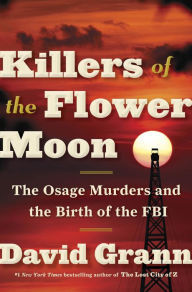
This book, Killers of the Flower Moon, follows three threads. First, the murders themselves—the brutal, systematic elimination of wealthy Osage people for their oil headrights. Second, the investigation by the fledgling FBI, led by a former Texas Ranger named Tom White, who risked his life and career to bring the killers to justice. And third, the author's own research, decades later, which uncovered a conspiracy far larger and more terrifying than the official record ever revealed.
The title comes from an Osage term for May—the "flower-killing moon"—when taller plants creep over smaller blooms, stealing their light and water, breaking their necks, burying them underground. It's a fitting metaphor for what happened to the Osage people in the 1920s, when a more powerful force moved in to take everything they had.
Anna Brown's body was found near a creek in Gray Horse. Her killer was never convicted at the time—not for lack of evidence, but because the legal system was stacked against her people. The question that haunted the investigation was a simple one, but nobody wanted to ask it aloud: would a jury of twelve white men ever punish another white man for killing an American Indian?
As you listen to this story unfold, you'll find yourself asking another question: how far does the conspiracy actually reach?
About the Book
In 1920s Oklahoma, the Osage Nation became the wealthiest people per capita after oil was discovered on their land. Then they started dying—shot, poisoned, or bombed. Local authorities did nothing. Enter the fledgling FBI and agent Tom White, who uncovered a vast conspiracy of murder for headrights. But the full horror, author David Grann reveals, was far worse than anyone knew.
Key Takeaways
Wealth Without Power Is a Death Sentence
The Osage became the wealthiest people per capita in the world, but because they were denied legal and social power—forced into guardianship, stripped of financial control—their riches made them targets rather than protectors, proving that material wealth without the authority to defend it invites predation.
The Most Dangerous Enemy Wears a Friendly Face
William Hale, the 'King of the Osage Hills,' publicly posed as a benefactor who donated to Osage hospitals and pledged to find Anna Brown's killer, while secretly orchestrating the systematic murder of her family—a chilling reminder that the greatest betrayals often come from those who have earned our trust.
Justice Requires Not Just Evidence, but a System Willing to See It
Despite overwhelming proof of murder, the first trials ended in hung juries because the legal system was built on racism—the unspoken question was whether a jury of white men would ever convict another white man for killing an Osage, revealing that justice is impossible when the system itself is the obstacle.
Silence Is the Conspiracy's Strongest Weapon
The Reign of Terror flourished not only because of the killers themselves, but because sheriffs lost evidence, coroners failed to perform autopsies, undertakers buried truth with bodies, and entire communities looked away—showing that complicity through inaction is as destructive as the act of murder.
The Hunted Must Become the Hunter to Survive
Mollie Burkhart, sick and watching her family die one by one, secretly contacted a priest to report her fear of poisoning—a desperate act of self-preservation that ultimately helped break the case, demonstrating that when institutions fail, survival depends on the courage of the vulnerable to speak.
History Is Written by the Victor, But the Blood Still Cries Out
The FBI declared victory by convicting William Hale, but Grann's research revealed a far wider conspiracy involving doctors, lawyers, bankers, and guardians that continued for decades—proving that official narratives often serve to bury the truth, while the wounds of the oppressed remain unhealed across generations.
Genocide Is Not Always a Single Explosion—It Is a Slow, Systematic Drowning
The Osage were not killed in a single massacre but through decades of poisonings, bombings, hit-and-runs, and suspicious 'natural' deaths, each one made possible by a network of corrupt professionals—a reminder that the most thorough destruction of a people often happens quietly, case by case, until a community is erased.
The Land Remembers What the Records Forget
Nearly a century later, Osage descendants still carry the trauma of murdered relatives whose killers were never charged, and the land itself is described as 'saturated with blood'—a testament that true justice is not a verdict in a courtroom, but a reckoning that must be passed down through memory and truth-telling.
Who Should Listen?
True crime readers who devour meticulously researched stories of systemic corruption and cold-blooded murder.
History buffs fascinated by the early FBI, the American West, and the dark underbelly of the Jazz Age.
Anyone interested in Indigenous rights and the untold stories of Native American exploitation and resilience.
Fans of investigative journalism who appreciate a modern-day reporter uncovering a century-old cover-up.