Book Summary
Narrator: Ethan
Timeline
Summary Preview
Tehran, 1980. A classroom full of ten year old girls, all wearing veils for the first time. Some of them don't understand why they're wearing them. Others don't like it. A few use the long fabric to play: they knot the veils together to make jump ropes, or pretend they're holding reins for a horse. The scene is chaotic, confused, almost playful. But the meaning is serious. One year after the Islamic Revolution, Iran's new regime has declared that women must cover their hair in public. And Marjane Satrapi, the ten year old at the center of this story, is trying to make sense of it all.
This is where Persepolis begins—not with a history lesson, but with a disorienting image. A girl in a veil, staring at the reader, her face caught between childhood innocence and the weight of political change. The book that follows is Satrapi's graphic memoir of growing up in Tehran before, during, and after the revolution. It's a coming of age story, a family history, and a political document all at once.
Satrapi opens her book with a brief introduction to Iran's history. She explains that the name "Iran" comes from "Aryan Vaejo," meaning the origin of the Aryans, a group of semi nomadic people who settled the land. Over centuries, Persian language and culture survived wave after wave of outside attack. Invaders came, but they often ended up assimilating into Persian culture rather than destroying it. This resilience is key to understanding what Satrapi is trying to do with her memoir.
In the twentieth century, oil was discovered, bringing enormous wealth. Reza Shah founded a new dynasty and attempted to modernize the country. But with oil came British influence and control. During World War II, Reza Shah declared Iran neutral, which led to Allied
Tehran, 1980. A classroom full of ten-year-old girls, all wearing veils for the first time. Some of them don't understand why they're wearing them. Others don't like it. A few use the long fabric to play: they knot the veils together to make jump ropes, or pretend they're holding reins for a horse. The scene is chaotic, confused, almost playful. But the meaning is serious. One year after the Islamic Revolution, Iran's new regime has declared that women must cover their hair in public. And Marjane Satrapi, the ten-year-old at the center of this story, is trying to make sense of it all.
This is where Persepolis begins—not with a history lesson, but with a disorienting image. A girl in a veil, staring at the reader, her face caught between childhood innocence and the weight of political change. The book that follows is Satrapi's graphic memoir of growing up in Tehran before, during, and after the revolution. It's a coming-of-age story, a family history, and a political document all at once.
Satrapi opens her book with a brief introduction to Iran's history. She explains that the name "Iran" comes from "Aryan Vaejo," meaning the origin of the Aryans, a group of semi-nomadic people who settled the land. Over centuries, Persian language and culture survived wave after wave of outside attack. Invaders came, but they often ended up assimilating into Persian culture rather than destroying it. This resilience is key to understanding what Satrapi is trying to do with her memoir.
In the twentieth century, oil was discovered, bringing enormous wealth. Reza Shah founded a new dynasty and attempted to modernize the country. But with oil came British influence and control. During World War II, Reza Shah declared Iran neutral, which led to Allied occupation. His son, Mohammed Reza Pahlavi—the shah—took power. In the 1950s, the Iranian prime minister was ousted with help from the CIA and British Intelligence, allowing the shah to consolidate his rule. He remained in power until 1979, when the Islamic Revolution finally forced him to flee.
Satrapi writes that in recent times, her home country has been discussed "mostly in connection with fundamentalism, fanaticism, and terrorism." She knows this image is far from the truth. She lived more than half her life in Iran. She remembers a different country—one with modern families, progressive ideas, and a rich cultural life that had nothing to do with extremism. Persepolis is her attempt to correct that picture.
But she's not just trying to defend Iran against stereotypes. She also wants to remember the people who died fighting for freedom. The political prisoners who were tortured and executed. The soldiers who died in the war against Iraq. The families who were forced to leave their homeland. These people, she says, should not be forgotten. Her book is a way of preserving their memory.
This is a deeply personal mission. Satrapi's own family was part of Iran's political history. Her grandfather was a prince who served as prime minister and was later imprisoned and tortured by the shah. Her parents were progressive intellectuals who attended demonstrations and risked their safety to photograph protests. Her uncle Anoosh was a political activist who spent years in prison and was eventually executed. The revolution was not an abstract event for Satrapi—it happened to her family, in her home, and shaped her childhood in ways she is still trying to understand.
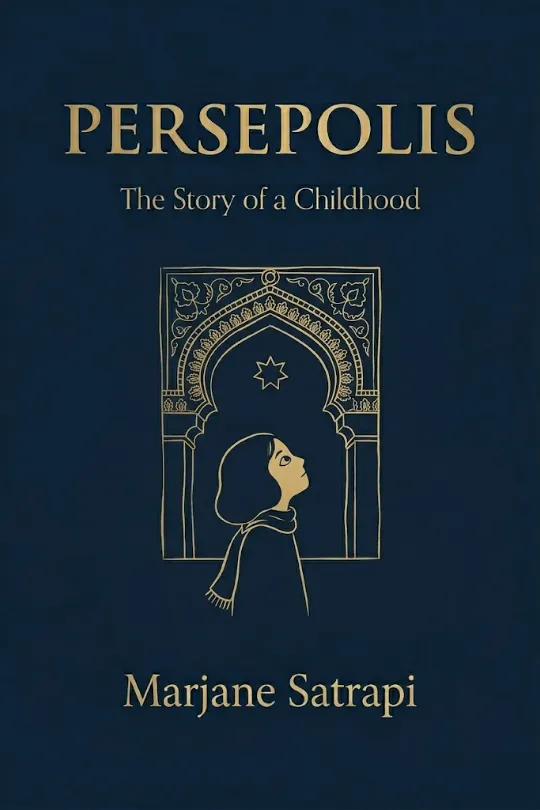
The book's title, Persepolis, comes from the ancient capital of the Persian Empire, a city that symbolized Iran's long and glorious history. By choosing this name, Satrapi connects her personal story to a much larger narrative. She is not just telling the story of one girl growing up in Tehran. She is telling the story of a civilization that has endured for thousands of years, through invasions, occupations, and revolutions. And she is insisting that this civilization cannot be reduced to the actions of a few extremists.
The opening scene with the veils captures this tension perfectly. The girls in Satrapi's classroom are not political symbols. They are children who don't understand why their lives are changing. Some of them are religious, some are not. Some come from traditional families, others from modern ones like Satrapi's. They are all being forced into a new reality that they did not choose. The veil, for them, is not a statement of faith. It is a rule they have to follow, whether they like it or not.
Satrapi writes that she "really didn't know what to think about the veil." Deep down, she was very religious, but her family was "very modern and avant-garde." She was born with religion—at age six, she was already sure she was the last prophet. She created her own holy book, based on Zarathustra and Persian holidays, and talked to God every night before bed. But that was before the revolution. Now, the same religion that once felt personal and innocent was being used to control her.
This confusion is central to the book. Satrapi is trying to understand what it means to be Iranian, what it means to be religious, and what it means to grow up in a country that is changing faster than she can keep up with. She is looking for heroes, for meaning, for a way to make sense of the violence and chaos around her. And she is finding those things in her family's stories—stories of resistance, of sacrifice, of love.
The memoir is also a way for Satrapi to preserve those stories. When her uncle Anoosh tells her about his time in prison, he says something that becomes the book's guiding principle: "Our family memory must not be lost. Even if it's not easy for you, even if you do not understand it all." This is exactly what Satrapi is doing with Persepolis. She is passing on the memory of her family, her culture, and her country to readers who might otherwise never know them.
As the book unfolds, Satrapi's childhood innocence gives way to a more complicated understanding of the world. She learns about politics, about class, about the difference between heroes and ordinary people. She watches her parents struggle to keep their family safe while staying true to their values. She loses people she loves. And eventually, she is forced to leave Iran altogether.
But the book is not just a story of loss. It is also a story of joy—of parties where people dance to illegal music, of grandmothers who hide jasmine flowers in their bras, of children who find ways to laugh even when the bombs are falling. Satrapi is determined to show that Iran was never just a place of fanaticism and oppression. It was also a place where people loved, laughed, and lived fully, even in the darkest times.
The question at the heart of this book is simple but profound: How do you hold onto who you are when everything around you is changing? How do you preserve your family's memory, your culture's history, and your own sense of self in the face of revolution, war, and exile? Satrapi's answer is Persepolis—a book that captures both the horror and the beauty of growing up in a country that was, and still is, so much more than the world sees.
What would it mean to tell your own story—not as a political statement, but as an act of love?
About the Book
Marjane Satrapi’s graphic memoir captures the Iranian Revolution through the eyes of a rebellious young girl. As her family’s progressive world collides with fundamentalist rule, she navigates torture, class divides, and the execution of loved ones. Equal parts heartbreak and humor, Persepolis is a fierce act of memory—preserving a culture that refuses to be erased.
Key Takeaways
Innocence is the first casualty of revolution, but the impulse for justice survives.
Satrapi's childhood belief that she was a prophet, born from witnessing inequality and suffering, represents a pure, untainted desire for fairness. While the revolution shatters this innocence and her faith in God, the core drive to understand and fight injustice never dies—it merely transforms into political awareness and the act of remembering.
True empathy requires the courage to feel another's pain, not just understand it.
When Satrapi learns her grandfather was tortured in a water cell, she doesn't just listen to the story—she fills a bathtub with cold water and sits in it until she shivers, trying to physically share his suffering. This act shows that honoring those who came before us means actively connecting with their experience, even when it's uncomfortable.
Class divides are the deepest trenches, surviving even the most radical revolutions.
Satrapi's progressive parents, who march for equality, still forbid the family maid from marrying a neighbor because of social class. This painful contradiction reveals that political revolutions can topple governments but cannot easily dismantle the invisible walls of privilege and poverty that separate human hearts.
Heroism is not glamorous; it is the quiet endurance of unbearable suffering.
The torture survivors who sit in Satrapi's living room recounting their experiences with calm voices teach her that real heroes don't wear capes—they are ordinary people who survive the pulling of fingernails and the burning of cigarettes, and then return to tell the story without seeking applause.
Family memory is a sacred trust, passed from one generation to the next as a lifeline.
Uncle Anoosh's final words to Satrapi—'Our family memory must not be lost'—transform her from a curious child into a keeper of stories. This mission becomes the foundation of her memoir, proving that remembering is itself an act of resistance against those who would erase history.
The loss of God can be as devastating as the loss of a loved one, leaving only darkness.
When Uncle Anoosh is executed, Satrapi screams at God to leave her forever, and the illustration shows her floating alone in infinite black space. This moment marks the death of her childhood faith, revealing that political disillusionment can destroy not just trust in institutions but the very structure of meaning in a young life.
The poor are always the first to die for causes the rich will abandon.
While Satrapi dances at parties wearing a punk necklace, boys her age from poor families march to the front lines with plastic 'keys to paradise' around their necks. The regime cynically exploits poverty, proving that martyrdom is a luxury the wealthy never have to afford.
Saying goodbye to your homeland is a little like dying—and a little like being born.
Satrapi's departure from Iran, with her mother collapsed on the airport floor, is both an ending and a beginning. She leaves behind her country, her family, and her childhood, carrying only her education, her stories, and the smell of jasmine—the raw materials from which she will later build a new self in exile.
Who Should Listen?
Readers who loved *Maus* or *Fun Home* and want another powerful graphic memoir that uses art to process historical trauma.
History enthusiasts who want an intimate, first-person account of the Iranian Revolution beyond Western news headlines.
Immigrants and children of immigrants who have felt torn between two cultures and need a story that validates that fractured identity.
Teachers and librarians seeking a compelling, accessible text to spark classroom discussions about propaganda, resistance, and the human cost of political upheaval.