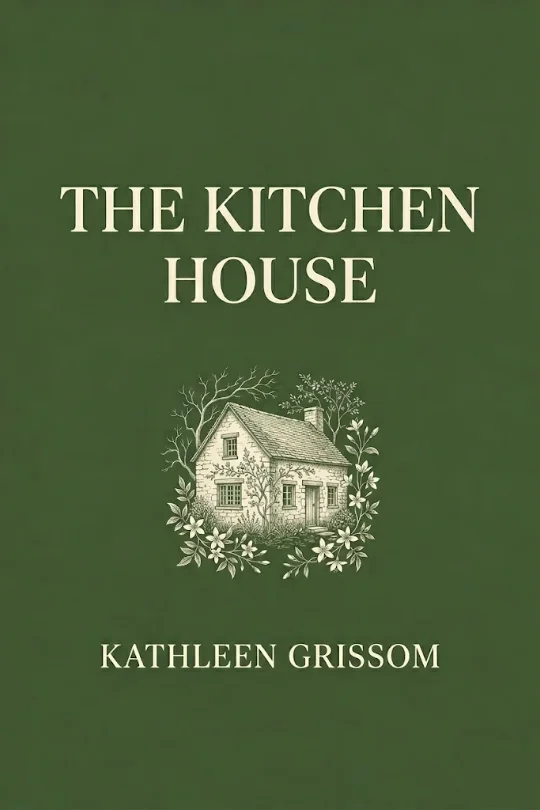
The Kitchen House
Book Summary
Narrator: Ethan
Timeline
Summary Preview
A woman runs through the Virginia woods, her daughter struggling to keep up behind her. They've been hiding at a neighbor's house, hoping to escape from a husband whose violence has become unbearable. Now they're racing back home, desperate and terrified. When they reach the clearing, Lavinia stops cold. A body hangs from the old oak tree. She forces herself to look up, then immediately wishes she hadn't. The green headscarf is unmistakable. So are the handmade shoes, pointing downward in the morning light.
This is where Kathleen Grissom's novel The Kitchen House begins—not at the start of the story, but near its end. The prologue drops us into a mystery: who is hanging from that tree, and how did these two women end up in this nightmare? The rest of the novel will answer those questions, taking us back nearly twenty years to 1791, when Lavinia first arrived at Tall Oaks plantation as a seven year old Irish orphan.
The novel unfolds through alternating first person chapters, switching between Lavinia and a woman named Belle. Two voices, two perspectives, two women trapped between worlds they never chose.
Lavinia is white. She's also an indentured servant, bound to work for Captain James Pyke until she comes of age. Her parents died on the ship crossing from Ireland, and the captain took her in—not as a daughter, but as property. She's placed in the kitchen house, the small building where the house slaves live and work. She's the only white person there, but she's not free.
Belle is mixed race, the daughter of Captain James Pyke and one of his slaves. She grew up in the big house, taught to read and write by her white grandmother. But when James married Martha, Belle was moved to the kitchen house. Now she's
A woman runs through the Virginia woods, her daughter struggling to keep up behind her. They've been hiding at a neighbor's house, hoping to escape from a husband whose violence has become unbearable. Now they're racing back home, desperate and terrified. When they reach the clearing, Lavinia stops cold. A body hangs from the old oak tree. She forces herself to look up, then immediately wishes she hadn't. The green headscarf is unmistakable. So are the handmade shoes, pointing downward in the morning light.
This is where Kathleen Grissom's novel The Kitchen House begins—not at the start of the story, but near its end. The prologue drops us into a mystery: who is hanging from that tree, and how did these two women end up in this nightmare? The rest of the novel will answer those questions, taking us back nearly twenty years to 1791, when Lavinia first arrived at Tall Oaks plantation as a seven-year-old Irish orphan.
The novel unfolds through alternating first-person chapters, switching between Lavinia and a woman named Belle. Two voices, two perspectives, two women trapped between worlds they never chose.
Lavinia is white. She's also an indentured servant, bound to work for Captain James Pyke until she comes of age. Her parents died on the ship crossing from Ireland, and the captain took her in—not as a daughter, but as property. She's placed in the kitchen house, the small building where the house slaves live and work. She's the only white person there, but she's not free.
Belle is mixed-race, the daughter of Captain James Pyke and one of his slaves. She grew up in the big house, taught to read and write by her white grandmother. But when James married Martha, Belle was moved to the kitchen house. Now she's a slave in public, though her father still treats her like a daughter in private. She lives between two worlds: too white to be fully accepted by the field slaves, too black to be acknowledged as the captain's child.
The central conflict of the novel is simple and brutal: How do you navigate a world built on race, gender, and power when you belong nowhere? Lavinia and Belle both must answer this question every day. Lavinia is white but lives among slaves. Belle is the master's daughter but sleeps in the kitchen house. Neither fits where society says she should.
The plantation itself is divided into strict territories. The big house sits at the top of the hill, where the captain, his wife Martha, and their children live in comfort. The kitchen house sits close enough to serve the big house, but far enough to mark its occupants as separate. And far below, the quarters house the field slaves in rough-hewn cabins with mud chinking, where children eat from wooden troughs like pigs.
Between these worlds, Lavinia and Belle must find their way. The prologue shows us where that journey ends: with a body swinging from an oak tree, a green headscarf, and handmade shoes. But how did they get there? What choices, what secrets, what betrayals led to that moment?
That's the question that drives the novel forward, and the answer will take us through nearly two decades of love and loss, violence and survival, hope and despair.
About the Book
In 1791 Virginia, seven-year-old Irish orphan Lavinia is taken in as an indentured servant on a tobacco plantation. Placed in the kitchen house with the slaves, she forms an unbreakable bond with Belle, the master's hidden mixed-race daughter. As they grow up trapped between the big house and the quarters, both women must confront abuse, secrets, and the impossible choice between survival and freedom.
Key Takeaways
Belonging is not given by society, but forged in the spaces between worlds.
Lavinia, a white indentured servant living among slaves, and Belle, the mixed-race daughter of the master, both exist in the liminal spaces of a rigid plantation hierarchy. Their profound bond and survival come not from fitting in, but from creating their own family and identity in the kitchen house, the place that rejects them both.
The deepest wounds are passed down like an inheritance, unless someone dares to break the cycle.
Marshall, abused by his tutor, grows into a rapist and tyrant, perpetuating the violence inflicted upon him. The novel shows that unhealed trauma does not die with the abuser; it metastasizes, destroying the next generation until a conscious, often costly, act of resistance or sacrifice intervenes.
Silence is a cage built by the powerful, but it can also be a shield for the powerless.
The slaves' collective silence about the tutor's murder protects Marshall and Dory, but it also traps them in a web of complicity and fear. Belle's silence about her rape is a desperate act of self-preservation, yet it isolates her and allows Marshall's monstrous nature to fester unchecked.
Freedom is not a document; it is the ability to choose one's own name and one's own home.
Belle's free papers are never signed, yet she finds a form of liberation in refusing to leave the only home she knows. Lavinia, legally free, becomes enslaved by marriage and addiction until she reclaims her agency by choosing to rebuild on the ashes of the plantation, defining her own freedom.
Love can be a dangerous blindness, making us see redemption where there is only ruin.
Lavinia falls in love with the polished, kind version of Marshall she meets in Williamsburg, willfully ignoring the broken boy she once found in the privy. This romantic idealization blinds her to his true nature until his violence becomes inescapable, proving that hope for another's salvation can be a trap.
Addiction is a slow suicide of the spirit, a retreat from a pain too great to bear.
Lavinia turns to laudanum not for pleasure, but to numb the horror of her husband's abuse and her own complicity. Her descent into addiction mirrors Martha's, showing how the plantation system consumes its mistresses as surely as it consumes its slaves, leaving them hollow ghosts in their own lives.
The ultimate act of love is not to save someone, but to bear witness to their truth.
Mama Mae sacrifices her life not to stop Marshall's violence, but to finally speak the truth of Belle's parentage. Her hanging is a brutal testament that some truths are worth dying for, and that the greatest gift one can give another is to acknowledge their full, hidden identity in the face of a world that denies it.
Justice is not a verdict from the powerful; it is a reckoning forged by the broken.
The novel's justice is not delivered by law or the master's court, but by Jamie, a thirteen-year-old boy who shoots his own father to end his reign of terror. This violent, tragic act underscores that when systems of power fail, the oppressed must reclaim justice themselves, even at the cost of their own innocence.
Who Should Listen?
Readers of historical fiction who loved 'The Help' or 'The Book of Negroes' and want a gripping story of race, class, and female resilience in the antebellum South.
Book club members seeking a deeply emotional, discussion-worthy novel about moral complexity, family secrets, and the brutal realities of slavery.
Fans of dual-perspective narratives like 'The Poisonwood Bible' who appreciate alternating voices that reveal hidden truths and challenge assumptions.
Anyone interested in the untold stories of indentured servitude and mixed-race identity in early America, told through intimate, character-driven storytelling.