Book Summary
Narrator: Ethan
Timeline
Summary Preview
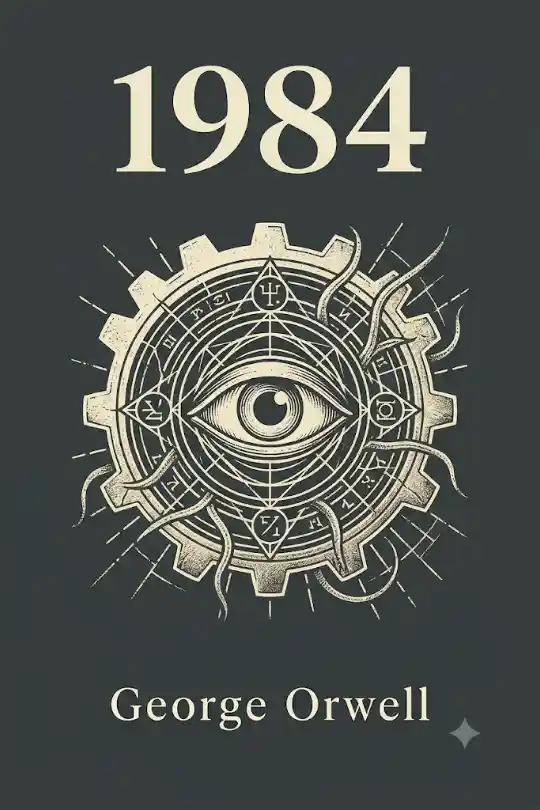
The year is 1984. Winston Smith, a 39 year old Outer Party member, stands alone in the small alcove of his seventh floor flat at Victory Mansions. His leg aches from a varicose ulcer. The smell of boiled cabbage and cheap gin hangs in the air. And in his hands, he holds a forbidden object: a blank diary.
He knows what possessing this diary means. The Party forbids private writing. It's a thoughtcrime, and thoughtcrimes are punishable by death. Yet here he is, sitting down, uncapping his pen, and preparing to write.
Winston pauses for a moment. He listens to the telescreen mounted on the wall—a two way television that cannot be turned off, only turned down. It blares military music. Somewhere, perhaps, a Thought Police officer watches him through that screen. Or maybe not. That's the terror of it: you never know. The uncertainty is as crushing as certainty would be.
He writes the date: April 4, 1984.
That simple act—recording a date—is an act of rebellion. The Party controls history, and it controls the present. To write something down, to create your own record of events, is to challenge that control. Winston knows this. He's been working at the Ministry of Truth for years, where his job involves exactly the opposite: destroying records, altering documents, erasing people from existence until they become "unpersons" who never existed at all.
The diary sits open before him. He's not sure why he started it. Maybe it's the vague, nagging feeling that the world wasn't always like this. Maybe it's the memory of a photograph he once saw—concrete evidence of the Party's lies. Or maybe it's just the unbearable weight of living in a world where every word, every gesture, every thought is monitored and judged.
The Party's goal is total control.
The year is 1984. Winston Smith, a 39-year-old Outer Party member, stands alone in the small alcove of his seventh-floor flat at Victory Mansions. His leg aches from a varicose ulcer. The smell of boiled cabbage and cheap gin hangs in the air. And in his hands, he holds a forbidden object: a blank diary.
He knows what possessing this diary means. The Party forbids private writing. It's a thoughtcrime, and thoughtcrimes are punishable by death. Yet here he is, sitting down, uncapping his pen, and preparing to write.
Winston pauses for a moment. He listens to the telescreen mounted on the wall—a two-way television that cannot be turned off, only turned down. It blares military music. Somewhere, perhaps, a Thought Police officer watches him through that screen. Or maybe not. That's the terror of it: you never know. The uncertainty is as crushing as certainty would be.
He writes the date: April 4, 1984.
That simple act—recording a date—is an act of rebellion. The Party controls history, and it controls the present. To write something down, to create your own record of events, is to challenge that control. Winston knows this. He's been working at the Ministry of Truth for years, where his job involves exactly the opposite: destroying records, altering documents, erasing people from existence until they become "unpersons" who never existed at all.
The diary sits open before him. He's not sure why he started it. Maybe it's the vague, nagging feeling that the world wasn't always like this. Maybe it's the memory of a photograph he once saw—concrete evidence of the Party's lies. Or maybe it's just the unbearable weight of living in a world where every word, every gesture, every thought is monitored and judged.
The Party's goal is total control. Not just over what people do, but over what they think. The Party slogans say it plainly: "WAR IS PEACE. FREEDOM IS SLAVERY. IGNORANCE IS STRENGTH." These aren't contradictions to the Party. They're truths. The Party wants citizens to hold two contradictory ideas in their heads at the same time and believe both—a mental gymnastics called doublethink. This is how they maintain power: by making lies feel true and truth feel impossible.
Big Brother, the Party's symbolic leader, watches from posters on every landing. His eyes follow you as you move. The telescreen broadcasts propaganda, exercises, and hate sessions. The Thought Police can arrest you for a wrong look, a wrong word, a wrong dream. People disappear. Their names are erased from history. Their children are told they never existed.
Winston begins to write. His hand moves across the page, recording his hatred for the Party, his longing for a past he can barely remember, his suspicion that a dark-haired girl from work might be spying on him. He writes about O'Brien, an Inner Party member who glanced at him during the Two Minutes Hate that morning—a daily propaganda session designed to whip up fury against the Party's enemies. In that glance, Winston thought he saw something. A flicker of recognition. A shared understanding. Maybe O'Brien is part of the Brotherhood, the secret resistance. Or maybe Winston is imagining things. He's been wrong before.
The telescreen blares on. The music shifts. Winston keeps writing.
He knows this diary could be his death warrant. The Party searches homes randomly. Children report their parents. Neighbors inform on neighbors. There's no privacy, no safe space. "Nothing was your own," Winston thinks, "except the few cubic centimeters inside your skull." And even that sanctuary might be an illusion. The Party is working on Newspeak—a stripped-down language designed to make unorthodox thoughts impossible. When there are no words for rebellion, there can be no rebellion.
But for now, Winston still has words. He still has thoughts. And he still has this diary.
He writes faster. The words spill out: his disgust with the Party's lies, his hatred for the endless war, his longing for something real, something human. He writes about the proles—the 85% of the population who live in poverty and ignorance, who the Party keeps deliberately uneducated and disorganized. Winston believes the proles are the only hope. But they don't know they're oppressed, so they don't rebel. And they can't become conscious until they rebel. It's a trap.
A knock at the door.
Winston freezes. His heart pounds. The Thought Police? He's been caught already? His mind races through the possibilities: the diary, the ink on his fingers, the words he's written. "DOWN WITH BIG BROTHER" he wrote, over and over, without even realizing it.
He answers the door. It's only Mrs. Parsons, his neighbor, asking him to fix a clogged drain. Winston breathes again. But the fear lingers. It always lingers.
This is the world of 1984: a nightmare of total control, where even the smallest act of rebellion carries the weight of death. Winston Smith has begun his journey—a journey that will take him from this dingy flat to a rented room, from a love affair to a torture chamber, from secret hopes to complete surrender. He has committed his first thoughtcrime. There is no going back.
But here's the question that drives everything forward: In a system designed to crush every spark of individuality, every whisper of dissent, every human connection—what happens to someone who refuses to stop fighting? What happens when the Party demands not just your obedience, but your love?
About the Book
In the totalitarian state of Oceania, Winston Smith rebels against the Party's absolute control by writing a forbidden diary. His journey from secret defiance to a doomed love affair with Julia leads to betrayal, torture in Room 101, and the ultimate test of his humanity. A chilling warning about surveillance, propaganda, and the erasure of truth.
Key Takeaways
The most profound rebellion is the refusal to surrender your inner world.
Winston's diary is not just a record of events; it is a declaration that his mind belongs to himself, not to the Party. The act of writing, of preserving a private thought, becomes the ultimate act of defiance in a system that demands total surrender of the self.
Power does not seek to control your actions—it seeks to own your love.
The Party's goal is not mere obedience but the complete re-engineering of the human heart, so that you not only submit to oppression but actively love the oppressor. This reveals that the deepest tyranny is not physical but psychological, aiming to make you complicit in your own destruction.
Language is the first battlefield of freedom; when words vanish, thoughts follow.
Newspeak is designed not to forbid ideas but to make them unthinkable by eliminating the words needed to express them. This insight warns that the erosion of language is the most insidious form of control, because it attacks the very foundation of human consciousness and resistance.
The past is not a fixed truth—it is a weapon that can be rewritten to serve the present.
The Ministry of Truth shows that history is not an objective record but a malleable tool for power. When the past can be erased and remade at will, the present becomes a prison with no escape, because no one can remember what was lost.
Love and desire are revolutionary acts when the state demands you give up your body.
Winston and Julia's affair is not just a personal escape but a political rebellion, because the Party fears the energy of human connection more than it fears open dissent. To reclaim your body, your pleasure, and your intimacy is to strike at the heart of a system that wants to own every part of you.
The worst betrayal is not of your cause, but of the one you love to save yourself.
In Room 101, Winston's ultimate defeat is not confessing his thoughts but screaming for Julia to take the rats in his place. This reveals that the deepest wound the Party inflicts is not physical pain but the destruction of your capacity for loyalty and love, leaving you hollow and alone.
Hope survives not in grand revolutions, but in the small, fragile truths we hold against the dark.
The glass paperweight with its suspended coral represents a tiny, useless piece of reality that the Party cannot touch. It is a reminder that even in a world of total lies, there are fragments of beauty and truth that can sustain us, however briefly, until they shatter.
The victory of tyranny is never final; the past tense of its language whispers of its end.
The appendix written in the past tense suggests that even the most absolute system of control eventually crumbles. This offers no guarantee of a happy ending, but it insists that the nightmare is not eternal—and that the act of remembering, of telling the story, is itself a seed of future freedom.
Who Should Listen?
Readers who are fascinated by dystopian fiction and want to understand the blueprint for modern surveillance states.
Professionals in journalism, media, or academia who grapple with the manipulation of facts and historical revisionism.
Anyone concerned about government overreach, data privacy, and the psychological effects of constant monitoring.
Students of political science or philosophy who want to explore the limits of power and the fragility of individual freedom.