Gift from the Sea
Book Summary
Narrator: Ethan
Timeline
Summary Preview
In 1955, Anne Morrow Lindbergh sat down to write a book she never intended to publish. She wrote, she said, "to think out my own particular pattern of living, my own individual balance of life, work and human relationships." Writing was how she processed things. It was her way of untangling knots. So she began putting words on paper, not for an audience, but for herself.
What she discovered surprised her.
As she started talking to other women—women of different ages, different backgrounds, different circumstances—she found she wasn't alone. "Many women are content with their lives as they are," she wrote. She had assumed this. She assumed most women had sorted out their own patterns, found their own balance. But the conversations told a different story.
Even the women who looked perfectly put together, whose lives appeared to be running smoothly, were secretly searching. Lindbergh described them as having "smiling clock faces." On the surface, everything ticked along just fine. They seemed content, even enviable. But beneath that polished exterior, something else was stirring. "Even those whose lives had appeared to be ticking imperturbably under their smiling clock faces were often trying, like me, to evolve another rhythm."
That phrase—"another rhythm"—captures the book's central concern. These women weren't rejecting their lives. They weren't unhappy with their husbands or children or homes. They were yearning for something more fluid, more natural, more human than the mechanical tempo their days had become. Their lives had been reduced to schedules and obligations, one task clicking into the next like gears in a machine. They wanted space to breathe.
Lindbergh saw this longing in women she spoke with at dinner parties, at community events, in casual encounters. They would confess to her quietly, almost guiltily, that they felt something was missing. The "porcelain perfection"
In 1955, Anne Morrow Lindbergh sat down to write a book she never intended to publish. She wrote, she said, "to think out my own particular pattern of living, my own individual balance of life, work and human relationships." Writing was how she processed things. It was her way of untangling knots. So she began putting words on paper, not for an audience, but for herself.
What she discovered surprised her.
As she started talking to other women—women of different ages, different backgrounds, different circumstances—she found she wasn't alone. "Many women are content with their lives as they are," she wrote. She had assumed this. She assumed most women had sorted out their own patterns, found their own balance. But the conversations told a different story.
Even the women who looked perfectly put together, whose lives appeared to be running smoothly, were secretly searching. Lindbergh described them as having "smiling clock-faces." On the surface, everything ticked along just fine. They seemed content, even enviable. But beneath that polished exterior, something else was stirring. "Even those whose lives had appeared to be ticking imperturbably under their smiling clock-faces were often trying, like me, to evolve another rhythm."
That phrase—"another rhythm"—captures the book's central concern. These women weren't rejecting their lives. They weren't unhappy with their husbands or children or homes. They were yearning for something more fluid, more natural, more human than the mechanical tempo their days had become. Their lives had been reduced to schedules and obligations, one task clicking into the next like gears in a machine. They wanted space to breathe.
Lindbergh saw this longing in women she spoke with at dinner parties, at community events, in casual encounters. They would confess to her quietly, almost guiltily, that they felt something was missing. The "porcelain perfection" of their smoothly ticking days left no room for stillness, no room for themselves. They were performing their lives, not living them.
This realization transformed Lindbergh's private reflections into something larger. She understood now that her questions were universal. Women everywhere were trying to carve out a different way of being—a way that allowed for deeper relationships with themselves and with others. They wanted to stop being pulled along by the current and instead learn to swim in it.
So Lindbergh wrote her book, not as an instruction manual, but as an exploration. She would think out loud, on paper, about what a different rhythm might look like. She would use the tools she had: her own experience, her observations, and the natural world around her.
She began by going to the beach.
Not just any beach. Lindbergh traveled to Captiva Island, off Florida's Gulf Coast, a place quiet enough to hear herself think. There she found something essential. The beach, she discovered, was not a place to work or read or write. It was a place to let go. The sound of waves, the wind in the pines, the slow flapping of herons across sand dunes—these natural rhythms could "drown out the hectic rhythms of city and suburb, time tables and schedules."
But the beach offered more than escape. It offered a new way of thinking. After a week of simply resting, Lindbergh found her mind beginning to awaken again. Fresh thoughts arrived "like shells tossed up by the sea on the smooth white sand of the conscious mind." The key was patience. You couldn't force these thoughts or dig for them. You had to wait, open and receptive, for the gifts to come to you.
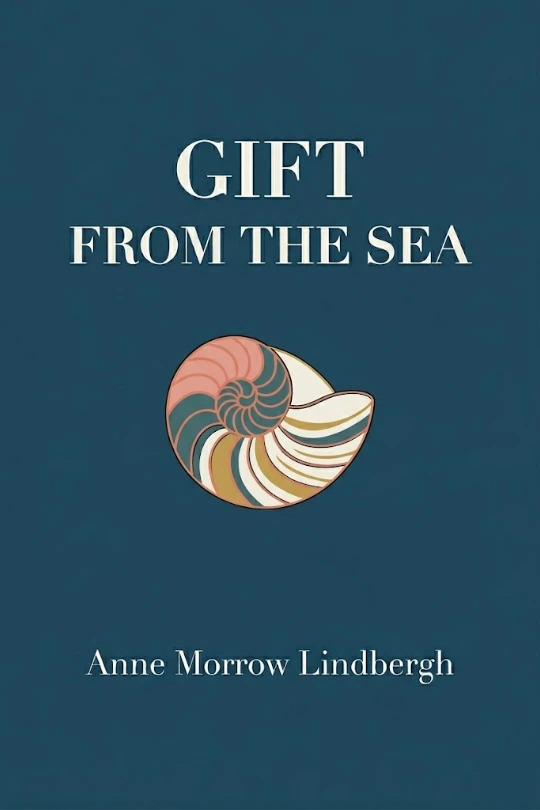
This became the book's method. Lindbergh would walk the beach, collect shells, and let each one teach her something about life. The shells became metaphors—physical objects that held spiritual lessons. The channelled whelk would teach her about simplicity. The moon shell would teach her about solitude. The double-sunrise, the oyster bed, the rare argonauta—each one revealed a stage of relationship, a phase of living, a truth about what it means to be human.
But she wasn't writing a shell-collecting guide. She was writing about the quiet desperation she saw in women's faces, the unspoken longing for something more. She was writing about the exhaustion of playing multiple roles—wife, mother, homemaker, community member—without ever having time to just be herself. She was writing about the fear that if you stopped moving, even for a moment, you might collapse.
The women she met were tired. Not physically tired, though that too. They were soul-tired. They had given so much of themselves to others that they had lost track of who they were when no one was watching. They had become all function, no essence.
Lindbergh wanted to change that. Not by telling women to abandon their responsibilities—she never advocated for that. She loved her husband and children. She valued her home and community. But she believed there had to be a way to live fully without being consumed. There had to be a rhythm that allowed for both engagement and retreat, both giving and replenishing.
The book she wrote became a phenomenon. It sold millions of copies and stayed on bestseller lists for months. Women read it in book clubs and alone in their bedrooms. They passed it to friends and sisters and mothers. They found in Lindbergh's honest, confessional voice a permission slip to ask their own hard questions.
Twenty years later, Lindbergh wrote a postscript reflecting on the book's enduring relevance. She expressed astonishment that it continued to be read. So much had changed since the 1950s—technology, politics, women's roles. Yet the questions remained. Women were still searching for that different rhythm. They were still trying to evolve something more natural beneath their smiling faces.
What Lindbergh offered was not answers but direction. She showed women that their longing was legitimate, that their desire for solitude and simplicity was not selfish but necessary. She gave them language for what they felt but couldn't name. And she pointed them toward the beach—not literally, but symbolically—toward any place where they could slow down enough to hear their own thoughts.
The book begins with a question. It's a question Lindbergh asked herself and that she invites every reader to ask: What would it mean to live by a different rhythm? What would it feel like to stop performing contentment and start actually experiencing it? And if you could find that rhythm, even for a moment, would you recognize it as the gift it truly is?
About the Book
Anne Morrow Lindbergh's classic meditation on simplicity, solitude, and relationships uses shells found on a Florida beach as metaphors for life's stages. Written as a personal exploration, it reveals the universal longing for balance beneath women's 'smiling clock-faces' and offers gentle wisdom for reclaiming inner peace.
Key Takeaways
Stillness is not emptiness but a preparation for meaningful action.
Lindbergh discovered that true inner peace and clarity do not come from doing more, but from stopping, being still, and waiting receptively—like a beach waiting for gifts from the sea. This stillness is not a retreat from responsibility but the foundation of all responsible action, as one cannot pour from an empty vessel.
Simplicity is not deprivation but the art of making room for what matters.
Through the channelled whelk shell, Lindbergh learned that stripping life down to essentials—shedding physical and mental clutter—creates space for inner grace and harmony. The goal is not to renounce the world but to alternate between engagement and retreat, so that complexity does not consume the soul.
Solitude is not loneliness but the replenishment of the self.
The moon shell taught Lindbergh that women, as eternal nourishers of others, must carve out time alone to refill their creative and emotional reserves. Solitude, far from being a sign of rejection, is a necessary practice for returning to relationships whole and present.
The ecstatic beginning of a relationship is precious precisely because it is fleeting.
The double-sunrise shell represents the pure, self-enclosed stage of love that must inevitably give way to life's practical demands. Lindbergh warns against clinging to this first perfection or abandoning it entirely; instead, couples must accept the change and periodically reconnect from a foundation of renewed selfhood.
Middle age is not a decline but a second flowering.
The rough, encrusted oyster shell symbolizes the middle years of marriage—messy, practical, and bond-forming. Lindbergh reframes the discontent of midlife not as a sign of approaching death but as growing pains akin to adolescence, offering freedom from external ambition and the chance for inner adventure and spiritual growth.
The highest relationship is a meeting of two solitudes, not two halves.
The argonauta shell, a temporary cradle abandoned after its purpose is served, represents an ideal where two whole, fully developed persons support each other's growth without possessing or clinging. This dance of mutual self-realization requires independence and conscious attunement, allowing intimacy without demand.
True discrimination is the art of choosing less to see more.
Lindbergh's realization that a single shell is more beautiful than a pile of them taught her that limitation and conscious selection—saying no more often than yes—create the contrast needed for meaning. Like a candle that flowers only in the space of night, beauty requires emptiness around it.
Caring for the whole world can be a way of caring for no one.
Lindbergh warns that 'planetal awareness'—feeling compassion for all humanity—often becomes an abstraction that evades the immediate, present suffering of a single person. True ethics begin by redeeming the sanctity of the present moment and one's own inner grounding, not by escaping into grand, distant causes.
Who Should Listen?
The over-scheduled mother who feels guilty for wanting time alone and needs permission to prioritize her own replenishment.
The mid-career professional who senses her life has become a mechanical routine and yearns for a more natural, meaningful rhythm.
The woman in a long-term marriage who feels the relationship has lost its spark and seeks guidance for navigating the middle years.
The creative person who struggles to find stillness and focus amid constant digital distractions and social obligations.