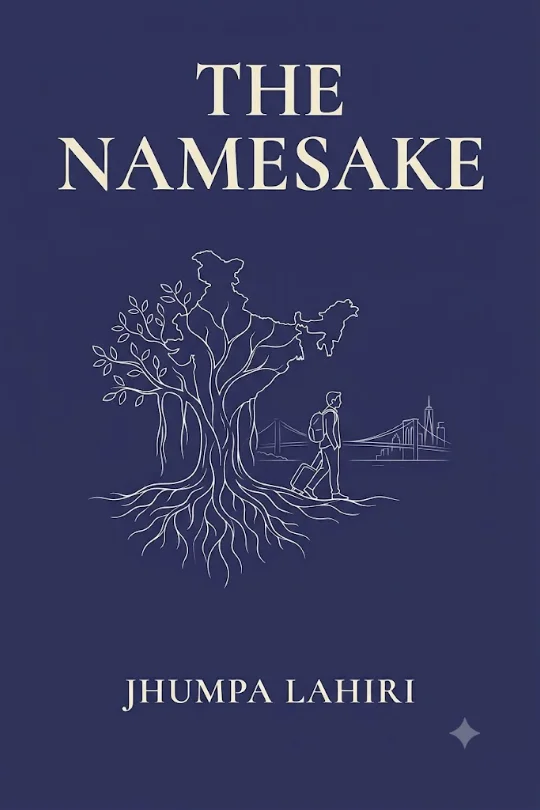
The Namesake
Book Summary
Narrator: Ethan
Timeline
Summary Preview
The novel opens with Ashima Ganguli in labor.
She is eight and a half months pregnant, alone in a Cambridge hospital, waiting to deliver her first child. Her husband Ashoke sits in the waiting room, but she might as well be by herself. In India, this moment would have been surrounded by her mother, her aunts, her grandmother—generations of women who would have held her hand, brought her food, shared the burden. Here, there is no one. Just fluorescent lights and strangers and the slow crawl of hours.
This is 1968. Ashima has been in America for eighteen months.
She remembers her first real glimpse of the country. It was winter. She stepped outside wearing Ashoke's socks under her thin slippers, and the cold pierced her ears and jaw. Bare trees with ice covered branches. Dog urine and excrement frozen into snowbanks. Not a soul on the street. That was her America—silent, frozen, empty. Nothing like the crowded, warm, noisy Calcutta she had left behind.
And now she is about to bring a child into this world.
The novel that follows, Jhumpa Lahiri's The Namesake , traces the Ganguli family across three decades. It begins with Ashima and Ashoke's arrival as young Bengali immigrants and follows their son Gogol from birth through childhood, adolescence, and adulthood. But the book is not really about events. It is about the space between cultures—that strange, unsettled territory where immigrants and their children live, neither fully here nor fully there.
The central conflict belongs to Gogol. He is born in America to Indian parents, but he carries a name that belongs to neither world. Gogol. The name of a Russian writer. A pet name that, through a series of accidents, became his official name. For years, this name feels like a prison. It marks
The novel opens with Ashima Ganguli in labor.
She is eight and a half months pregnant, alone in a Cambridge hospital, waiting to deliver her first child. Her husband Ashoke sits in the waiting room, but she might as well be by herself. In India, this moment would have been surrounded by her mother, her aunts, her grandmother—generations of women who would have held her hand, brought her food, shared the burden. Here, there is no one. Just fluorescent lights and strangers and the slow crawl of hours.
This is 1968. Ashima has been in America for eighteen months.
She remembers her first real glimpse of the country. It was winter. She stepped outside wearing Ashoke's socks under her thin slippers, and the cold pierced her ears and jaw. Bare trees with ice-covered branches. Dog urine and excrement frozen into snowbanks. Not a soul on the street. That was her America—silent, frozen, empty. Nothing like the crowded, warm, noisy Calcutta she had left behind.
And now she is about to bring a child into this world.
The novel that follows, Jhumpa Lahiri's The Namesake, traces the Ganguli family across three decades. It begins with Ashima and Ashoke's arrival as young Bengali immigrants and follows their son Gogol from birth through childhood, adolescence, and adulthood. But the book is not really about events. It is about the space between cultures—that strange, unsettled territory where immigrants and their children live, neither fully here nor fully there.
The central conflict belongs to Gogol. He is born in America to Indian parents, but he carries a name that belongs to neither world. Gogol. The name of a Russian writer. A pet name that, through a series of accidents, became his official name. For years, this name feels like a prison. It marks him as different, as foreign, as someone who does not quite belong anywhere. He will spend much of his life trying to escape it—changing it, hiding it, pretending it belongs to someone else.
But the book is not just about names. It is about what it means to live between two worlds. Ashima never fully adjusts to America, even after thirty years. She builds a life, makes friends, learns to drive, gets a job at the library. But she never stops longing for India. Her children, meanwhile, feel no such longing. America is their home. Yet they are never quite American enough. They are always the children of immigrants, carrying their parents' accents and customs and expectations wherever they go.
The novel moves through the decades with a quiet, observant eye. We watch Gogol grow from a baby who refuses to choose between soil, pen, and dollar bill at his rice ceremony into a teenager who hates his name, then a young man who changes it, then an adult who must finally confront what it means. We watch Ashima transform from a frightened young bride into a widow who has learned to live alone. We watch Ashoke, the quiet father, carry the secret of his son's name for years before finally revealing it.
But the question that haunts every page is this: Can you ever really belong to two cultures at once? Or are you doomed to be a stranger in both?
For Ashima, the answer is complicated. She never feels fully American. But by the end of the novel, she realizes she no longer feels fully Indian either. She has become something else—someone who carries both worlds inside her, even if neither fits quite right.
For Gogol, the question is even harder. He was born in America. He speaks English without an accent. He dates American women, works at an American firm, lives in New York. But his name, his face, his family—they all mark him as different. He cannot escape his heritage any more than he can escape his skin.
The novel gives no easy answers. It simply watches, with compassion and clarity, as these characters try to find their place in a world that was never designed for them. It shows the small moments—a mother cooking Bengali food in an American kitchen, a father reading Russian stories to his son, a young man standing in a cemetery tracing the names on old gravestones—that make up a life lived between cultures.
And it begins with that hospital room, with Ashima alone in labor, wondering what kind of world her child will inherit. She has never known anyone to enter the world so alone, so deprived. She pities him before he is even born.
But the novel will show that his aloneness is also his inheritance. It is the gift and burden of every immigrant child: to carry two worlds inside you, and to never fully belong to either.
What happens when a name meant to honor your father's past becomes a burden you cannot shake? And what does it take to finally make peace with who you are?
About the Book
Jhumpa Lahiri's The Namesake follows the Ganguli family across three decades, tracing the immigrant experience through the eyes of Gogol, a boy caught between Bengali heritage and American identity. His unusual name—accidentally given at birth—becomes a symbol of his struggle to belong. A quietly devastating novel about love, loss, and the stories that define us.
Key Takeaways
Identity is forged in the space between worlds, not within them.
The immigrant's true self emerges not from fully belonging to either culture, but from the painful, creative tension of living between two—a third space where neither world fits quite right, yet both are carried inside.
A name is not a label but a living bridge between past and future.
Gogol's name, born from his father's survival of a train wreck, reveals that what seems like a burden is often a silent inheritance—a connection to history that only reveals its meaning when we stop running from it.
The stories we refuse to read become the prisons we cannot escape.
Gogol's rejection of his namesake's book mirrors his rejection of himself; only when he finally opens the pages does he understand that the story he feared was the very thing that could set him free.
Love cannot be built on escape—it requires the courage to be seen fully.
Both Gogol's relationship with Maxine and his marriage to Moushumi fail because they were attempts to flee identity rather than embrace it; true intimacy demands showing the parts of ourselves we most want to hide.
Grief strips away the illusions we build around ourselves.
Ashoke's death shatters Gogol's fantasy of a weightless American life, forcing him back into the rituals and obligations he had abandoned—and revealing that belonging is not a choice but a recognition of what was always there.
The inheritance of displacement is both wound and gift.
Ashima's journey from frightened bride to a woman who moves between continents shows that the pain of never fully belonging can transform into a kind of freedom—the ability to carry two worlds without being crushed by either.
We marry our unresolved conflicts, not our partners.
Gogol and Moushumi's marriage was an attempt to solve their individual identity crises through shared culture, but they only succeeded in magnifying each other's unhealed wounds—proving that no relationship can fill the void of self-understanding.
Acceptance arrives not when we find ourselves, but when we stop searching.
Gogol's peace comes not from resolving the tension between Gogol and Nikhil, but from sitting in his childhood room, finally reading his father's book—understanding that his name was never a problem to solve, but a story to inhabit.
Who Should Listen?
First- or second-generation immigrants who have ever felt torn between their family's culture and the world they grew up in.
Anyone who has struggled with their own name or identity and wondered if they could ever truly belong.
Readers who love character-driven literary fiction that explores family dynamics, grief, and the quiet moments that shape a life.
Parents who have made sacrifices for their children and wonder if those sacrifices will ever be understood.