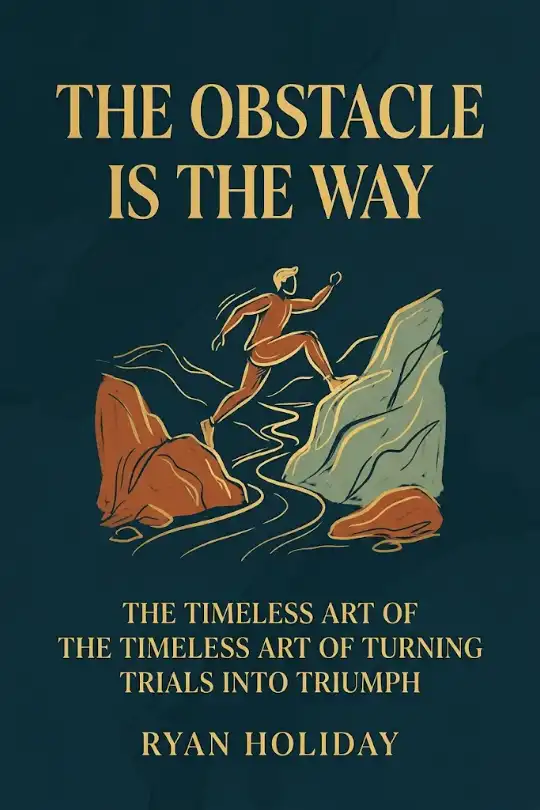
The Obstacle Is the Way
The Timeless Art of Turning Trials into Triumph
Book Summary
Narrator: Ethan
Timeline
Summary Preview
In 1857, the American economy collapsed. Banks failed. Railroads went bankrupt. Thousands of businesses shut their doors. For a young commodities trader named John D. Rockefeller, just starting his career, this looked like a catastrophe.
But Rockefeller didn't see it that way. He called this period his "school of adversity and stress." While his competitors panicked, sold off assets at fire sale prices, and fled the market, Rockefeller studied. He watched how the crash worked. He learned which businesses survived and why. He paid attention to patterns that others missed in their panic. When the economy recovered, Rockefeller didn't just survive—he dominated. Within decades, he controlled 90% of America's oil market.
What set Rockefeller apart wasn't luck. It wasn't genius. It was a specific mental framework for handling obstacles—a framework this book breaks down into three practical disciplines.
Here's the core problem the book addresses: We all face obstacles. Every day. In business, relationships, health, and personal goals. The question isn't whether obstacles will come—they will. The question is what you do with them.
Most people treat obstacles as stop signs. They hit a problem and stop moving. They complain. They wait for conditions to improve. They hope someone will save them. They treat the obstacle as a wall that blocks their path.
This book offers a radically different view: The obstacle is the way.
That phrase isn't just inspiration. It's a practical framework with three parts. Think of them as three gears that work together to transform any problem into progress.
The first gear is Perception . This is how you see the obstacle. Most people see problems through a lens of fear, frustration, or victimhood. They exaggerate the danger. They imagine worst case scenarios. They waste energy on what they can't control. The discipline of perception teaches you
In 1857, the American economy collapsed. Banks failed. Railroads went bankrupt. Thousands of businesses shut their doors. For a young commodities trader named John D. Rockefeller, just starting his career, this looked like a catastrophe.
But Rockefeller didn't see it that way. He called this period his "school of adversity and stress." While his competitors panicked, sold off assets at fire-sale prices, and fled the market, Rockefeller studied. He watched how the crash worked. He learned which businesses survived and why. He paid attention to patterns that others missed in their panic. When the economy recovered, Rockefeller didn't just survive—he dominated. Within decades, he controlled 90% of America's oil market.
What set Rockefeller apart wasn't luck. It wasn't genius. It was a specific mental framework for handling obstacles—a framework this book breaks down into three practical disciplines.
Here's the core problem the book addresses: We all face obstacles. Every day. In business, relationships, health, and personal goals. The question isn't whether obstacles will come—they will. The question is what you do with them.
Most people treat obstacles as stop signs. They hit a problem and stop moving. They complain. They wait for conditions to improve. They hope someone will save them. They treat the obstacle as a wall that blocks their path.
This book offers a radically different view: The obstacle is the way.
That phrase isn't just inspiration. It's a practical framework with three parts. Think of them as three gears that work together to transform any problem into progress.
The first gear is Perception. This is how you see the obstacle. Most people see problems through a lens of fear, frustration, or victimhood. They exaggerate the danger. They imagine worst-case scenarios. They waste energy on what they can't control. The discipline of perception teaches you to see clearly—objectively, without emotional distortion. You learn to separate what's actually happening from the story your scared brain tells you about what's happening.
The second gear is Action. Once you see clearly, you must move. Not wait for perfect conditions. Not plan endlessly. Not hope for rescue. Action means taking responsibility, starting where you are, and persisting through failure. It means breaking big problems into small steps and executing each one well.
The third gear is Will. This is your inner engine. When perception and action aren't enough—when the obstacle truly is bigger than you—will keeps you going. It's the ability to endure, to accept what you cannot change, and to find meaning even in suffering.
These three disciplines form a complete system. You start with perception: see the obstacle for what it really is. Then action: do something about it, however small. Then will: sustain yourself through the process.
Let's see how this worked for Rockefeller.
The 1857 crash wasn't just a financial event—it was a psychological test. Most traders responded with fear. They saw the crash as a disaster that would destroy them. They made panicked decisions: selling low, hoarding cash, retreating from the market entirely.
Rockefeller's perception was different. He saw the crash as a rare learning opportunity. While others panicked, he stayed calm and watched. He noticed that panicked sellers were creating bargains. He saw that the businesses that survived the crash would emerge stronger. He understood something his competitors missed: economic crises don't destroy value—they transfer it from the fearful to the calm.
This is the perception shift at the heart of the book. The obstacle itself doesn't change. What changes is how you see it. And how you see it determines what you can do with it.
In practice, this means asking three questions when you face any obstacle:
First, what's actually happening here? Strip away your emotional reactions. Remove the story you're telling yourself about what this means for your future. Just describe the facts. Rockefeller's fact was: the market is crashing, prices are falling, people are selling. That's it. Not "this will destroy me" or "I'm unlucky" or "the world is unfair." Just the facts.
Second, what can I control? Most of what you're worried about is outside your control. You can't control the economy. You can't control what other people do. You can't control the past. But you can control your attention, your actions, your choices. Rockefeller controlled where he focused his observation. He controlled his response to the panic around him.
Third, what opportunity does this create? This is the key move. Every obstacle carries within itself the seeds of an advantage. The crash created bargains for those with cash. The panic created opportunities for those who stayed calm. The chaos created openings for those who paid attention. Your job is to find the opportunity hiding inside the problem.
This framework transforms obstacles from roadblocks into raw material. Instead of something that stops you, the obstacle becomes something that teaches you, strengthens you, and moves you forward.
Think about a problem you're facing right now. A project that's stalled. A conflict at work. A financial setback. A health issue. Notice how your mind immediately labels it: "This is bad. This is unfair. This shouldn't be happening."
Now try the Rockefeller frame. What if this problem is actually your school of adversity and stress? What if it's teaching you something you couldn't learn any other way? What if the obstacle isn't blocking your path—it is your path?
The rest of this book shows you exactly how to apply each discipline. How to see clearly when your emotions are screaming at you. How to act effectively when you feel stuck. How to find the will to keep going when everything seems hopeless.
But the foundation starts here: obstacles are not the enemy. They are the raw material of growth. The question isn't whether you'll face problems—you will. The question is whether you'll treat them as stop signs or as the way forward.
Rockefeller didn't succeed despite the crash. He succeeded because of it. The crash forced him to develop skills, insights, and habits that served him for decades. His school of adversity and stress produced the most successful businessman of his era.
What might your current obstacle produce in you if you approached it the same way?
About the Book
Drawing on ancient Stoic wisdom and modern case studies, this book reveals a three-part framework—Perception, Action, and Will—to transform any problem into progress. From Rockefeller’s market crash to Gandhi’s peaceful rebellion, learn how to see clearly, act decisively, and find hidden advantages in life’s toughest moments. The obstacle isn’t blocking your path; it is your path.
Key Takeaways
See obstacles as raw material, not roadblocks
Instead of treating problems as stop signs, reframe them as opportunities for growth and learning. Ask yourself what the obstacle can teach you, what hidden advantage it contains, and how it can make you stronger.
Separate facts from emotional stories to see clearly
When facing a setback, strip away your automatic fear, frustration, or victimhood narrative. Use the 'observing eye' to identify only the plain facts, then ask what you can control and what opportunity the situation creates.
Train your nerves through deliberate exposure to stress
Build emotional steadiness by repeatedly facing the situations that trigger panic—public speaking, difficult conversations, or high-pressure deadlines. With practice, the unfamiliar becomes familiar, and fear loses its power to control your actions.
Take immediate action—even imperfect action—to build momentum
Don't wait for perfect conditions or a complete plan. Start with the smallest possible step right now, because movement creates momentum, and momentum opens up new opportunities that analysis alone never will.
Focus on the process, not the outcome
Break overwhelming goals into the smallest immediate task and execute it with full attention. Success comes from consistent excellence in each small step, not from obsessing over distant results you cannot control.
Use indirect strategies to turn an obstacle's strength against itself
When a direct confrontation fails, identify where your opponent or obstacle is strongest, then refuse to engage there. Attack the vulnerability created by that strength—like letting a fast-moving competitor expose its flanks.
Channel negative emotions into productive fuel
Instead of suppressing frustration or anger, acknowledge the energy they generate and redirect it into focused action. Use the intensity of the emotion to sharpen your performance rather than letting it derail you.
Persist relentlessly while accepting what you cannot change
Combine defiance against the obstacle with acceptance of reality. Keep taking action despite failure and discomfort, but stop wasting energy on things outside your control—focus only on what you can influence right now.
Who Should Listen?
Entrepreneurs and business leaders facing a stalled project, market downturn, or competitive threat who need a practical system to turn crisis into advantage.
Anyone stuck in a career rut or personal setback (like a missed promotion, job loss, or failed venture) who wants to stop feeling victimized and start taking action.
High-performers in high-pressure roles—such as athletes, executives, or public speakers—who need to maintain calm and focus when everything around them screams panic.
Students or young professionals entering a competitive field who feel overwhelmed by the size of their goals and need a step-by-step process to break down obstacles into manageable wins.