Book Summary
Narrator: Ethan
Timeline
Summary Preview
In the beginning of the year of our Lord 1963, two children stood at the edge of American history. A boy from Harlem. A girl from Birmingham. They were young, poor, and black in a nation that had promised freedom but delivered only delay. They looked around them and asked a simple, devastating question: Why?
Why did their people live in such misery? Had their ancestors done some tragic injury to the nation? Had they failed to fight for liberty during the country's founding? The history books told them one story—pale, thin accounts that mentioned the Civil War and the Emancipation Proclamation but somehow never explained why equality remained a hundred years late.
These children knew a different story. They knew about Crispus Attucks, the first man to die in the American Revolution. They knew about Benjamin Banneker, who helped design the nation's capital. They knew about the nameless slaves who built the White House, the Capitol, the roads and railways that made America wealthy. Wherever there was hard work, dirty work, dangerous work—in the mines, on the docks, in the blistering foundries—Negroes had done more than their share.
And yet, in 1963, the boy from Harlem still lived in a cramped tenement. The girl from Birmingham still couldn't sit at a lunch counter. Both of them still faced "Whites Only" signs, job discrimination, and the daily humiliation of being told they were less than human.
Then something shifted. In 1963, these two children—representing millions—joined hands, took a firm, forward step, and rocked the richest, most powerful nation to its foundation.
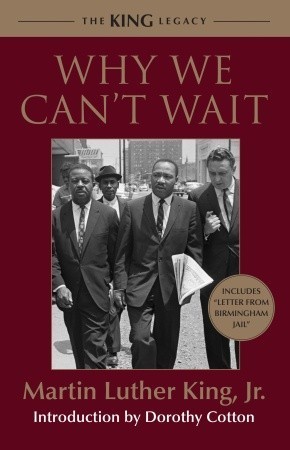
This is the story Martin Luther King Jr. sets out to tell in Why We Can't Wait . It is a history of the Birmingham protests that erupted that year. But it is also a justification—a moral, political, and
In the beginning of the year of our Lord 1963, two children stood at the edge of American history. A boy from Harlem. A girl from Birmingham. They were young, poor, and black in a nation that had promised freedom but delivered only delay. They looked around them and asked a simple, devastating question: Why?
Why did their people live in such misery? Had their ancestors done some tragic injury to the nation? Had they failed to fight for liberty during the country's founding? The history books told them one story—pale, thin accounts that mentioned the Civil War and the Emancipation Proclamation but somehow never explained why equality remained a hundred years late.
These children knew a different story. They knew about Crispus Attucks, the first man to die in the American Revolution. They knew about Benjamin Banneker, who helped design the nation's capital. They knew about the nameless slaves who built the White House, the Capitol, the roads and railways that made America wealthy. Wherever there was hard work, dirty work, dangerous work—in the mines, on the docks, in the blistering foundries—Negroes had done more than their share.
And yet, in 1963, the boy from Harlem still lived in a cramped tenement. The girl from Birmingham still couldn't sit at a lunch counter. Both of them still faced "Whites Only" signs, job discrimination, and the daily humiliation of being told they were less than human.
Then something shifted. In 1963, these two children—representing millions—joined hands, took a firm, forward step, and rocked the richest, most powerful nation to its foundation.
This is the story Martin Luther King Jr. sets out to tell in Why We Can't Wait. It is a history of the Birmingham protests that erupted that year. But it is also a justification—a moral, political, and historical argument for why African Americans could no longer wait for justice to arrive on its own schedule.
The book opens with a question that cuts to the bone: Why 1963? Why not earlier? Why not later? The answer, King argues, lies in the convergence of four forces that made the summer of 1963 the most explosive and transformative moment in the modern struggle for civil rights.
First, Southern states had spent nearly a decade subverting the Supreme Court's 1954 ruling that school segregation was unconstitutional. They created elaborate legal schemes—Pupil Placement Laws, token integration—that allowed them to claim compliance while maintaining segregation in practice. For African Americans, this was not progress. It was a cruel game of delay dressed up as reform.
Second, both political parties had failed them. In the 1960 election, Democrats and Republicans made grand promises about civil rights. Once in office, both parties found reasons to postpone action. President Kennedy issued an executive order on housing discrimination but left the discriminatory lending practices that made it meaningless untouched. African Americans watched and waited. Their patience wore thin.
Third, the world was changing. Across Africa, nations were throwing off colonial rule and taking their seats at the United Nations. African leaders looked at America and asked: How can you preach freedom abroad while denying it at home? The Cold War made this contradiction dangerous. The United States was willing to threaten nuclear war to defend freedom in Berlin, but it would not guarantee the right to vote for its own black citizens.
Finally, 1963 marked the one hundredth anniversary of the Emancipation Proclamation. The nation planned celebrations. But for African Americans, the anniversary was a bitter reminder of how little had changed. Lincoln had granted them only physical freedom—and even that was incomplete. They remained trapped on what King called "a lonely island of economic insecurity in the midst of a vast ocean of material prosperity."
The statistics told the story. Unemployment for African Americans was double that of whites. Black women worked outside the home at higher rates, not from choice but from necessity. Automation was destroying the few jobs that had been available. Segregation and poverty formed two concentric circles that imprisoned African Americans—one based on color, the other on economic deprivation.
These four forces—legal subversion, political betrayal, international pressure, and the hollow anniversary of emancipation—created the conditions for explosion. But they alone do not explain what happened in 1963. Something else was needed: a method, a weapon, a way to channel the fury into constructive change.
That weapon was nonviolent direct action.
King devotes much of the early book to explaining why nonviolence was not merely a moral choice but the only effective response to centuries of oppression. He traces the history of African American resistance—Booker T. Washington's accommodation, W.E.B. Du Bois's "talented tenth," Marcus Garvey's back-to-Africa movement, the NAACP's legal strategy. Each had its strengths. Each was ultimately insufficient.
Violent resistance was rejected because African Americans were unarmed, untrained, and psychologically unprepared for bloodshed. More importantly, they understood that violence would only confirm the racist stereotypes used to justify their oppression.
Nonviolence offered something different. It focused on systems, not individuals. It forced oppressors to confront their own brutality in the full light of national attention. It aligned with Christian morality, which ran deep in African American culture. And it healed the psychological wounds of participants, giving them a sense of pride and power they had never known.
The children who joined hands in 1963 were not simply protesting. They were reclaiming their humanity. They were saying, for the first time, that they would no longer be silent, no longer be patient, no longer wait for freedom to be granted by those who had no intention of granting it.
King's book is the story of how they did it—how ordinary people, armed with nothing but courage and discipline, faced down the most powerful forces of segregation and won.
But the question remains: Could they have done it any other way? And what made Birmingham the place where the revolution would finally find its voice?
About the Book
In 1963, a boy from Harlem and a girl from Birmingham joined hands and took a step that shook America. Martin Luther King Jr. tells the story of the Birmingham protests, explaining why African Americans could no longer wait for justice. He defends nonviolent direct action as the only moral and effective response to centuries of oppression, and offers a vision for a future of true equality.
Key Takeaways
Injustice Anywhere is a Threat to Justice Everywhere
King’s moral philosophy asserts that no community is isolated; allowing oppression in one place corrupts the foundation of justice for all, making every person responsible for confronting wrongs wherever they occur.
The Sword That Heals: Nonviolence as Transformative Power
Nonviolent direct action is not passive waiting but a disciplined, strategic force that exposes systemic brutality, heals the psychological wounds of the oppressed, and forces oppressors to confront their own shame in the full light of public attention.
Waiting is a Form of Violence
King dismantles the call for patience by showing that delay inflicts daily humiliation, economic deprivation, and spiritual death on the oppressed; freedom delayed for a century is not a virtue but a cruel denial of humanity.
The Silence of Good People is the Real Tragedy
The ultimate tragedy of Birmingham was not the cruelty of the wicked but the complicity of moderates who chose comfort over justice, providing cover for brutality and prolonging the suffering of millions.
Ordinary People Become Their Own Liberators
The deepest victory of the movement was psychological: when children and adults marched into dogs and firehoses without retaliation, they buried the psychology of servitude and proved that freedom is not granted by heroes but claimed by the courageous.
Freedom Cannot Be Priced or Bargained
King rejects the transactional view of justice, arguing that human dignity is not a commodity to be traded for gradual concessions; true equality requires immediate, uncompensated recognition of full personhood.
Compensatory Justice is Required to Balance Centuries of Theft
After three hundred years of deliberate deprivation, equality demands more than legal neutrality; a Bill of Rights for the Disadvantaged, including poor whites, is necessary to repair the structural damage of slavery and segregation.
Nonviolence is the Answer to Humanity’s Most Desperate Need
The same discipline that faced Bull Connor’s dogs can confront nuclear annihilation; King envisions nonviolence as a global ethic capable of transforming international conflict and securing peace for all humanity.
Who Should Listen?
History enthusiasts who want a firsthand account of the 1963 Birmingham protests and the strategic thinking behind the Civil Rights Movement.
Activists and organizers seeking a philosophical and practical defense of nonviolent direct action as a tool for social change.
Students of political science and ethics interested in King's arguments about just and unjust laws, civil disobedience, and the moral duty to confront injustice.
Readers who feel impatient with slow progress on racial or social justice issues and need a powerful reminder that waiting is not an option.