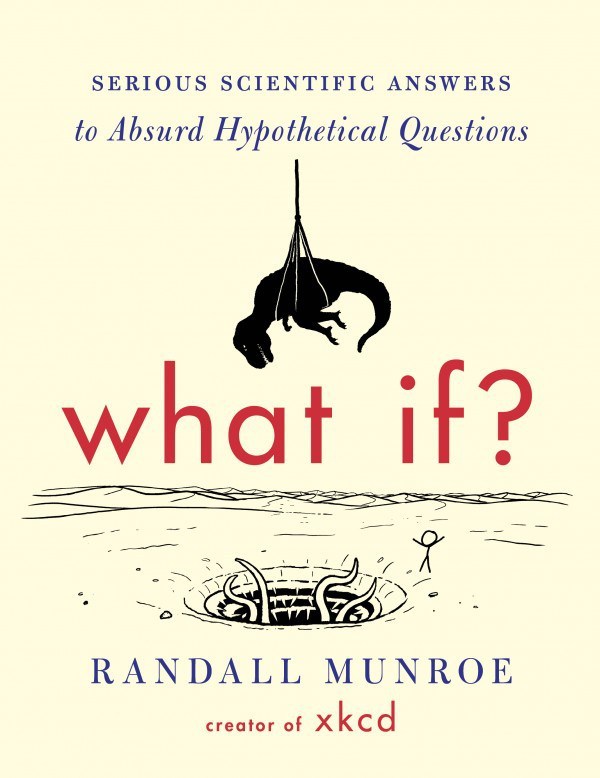
What If?
Serious Scientific Answers to Absurd Hypothetical Questions
Book Summary
Narrator: Ethan
Timeline
Summary Preview
The book opens with a warning. Not the usual disclaimer about copyright or reproduction rights. Something far more honest: "Do not try any of this at home. The author of this book is an Internet cartoonist, not a health or safety expert. He likes it when things catch fire or explode, which means he does not have your best interests in mind."
That disclaimer tells you everything you need to know about What If? before you've read a single question. Randall Munroe is a physicist who worked at NASA on robotics. He's also the creator of xkcd, the wildly popular webcomic known for its stick figure drawings and sharp observations about science, technology, and human nature. But in this book, he insists on introducing himself first as a cartoonist. The message is clear: take the science seriously, but don't take him too seriously.
The book's core premise is deceptively simple. Readers submit absurd hypothetical questions. Munroe answers them with real physics, real math, and real research. The result is a collection that sits somewhere between textbook and comedy album. Each chapter begins with a question that sounds like something a sleep deprived college student might ask at 3 AM: "What would happen if you tried to hit a baseball pitched at 90 percent the speed of light?" "If everyone on Earth aimed a laser pointer at the Moon simultaneously, would it change color?" "How many LEGO bricks would it take to build a bridge from London to New York?"
Munroe doesn't dismiss these questions. He embraces them. And then he does the math.
The technique that drives the entire book is scaling. Take something ordinary—a hair dryer, a baseball, a laser pointer—and imagine it at an extreme scale. What happens when you multiply its power by a million? A billion?
The book opens with a warning. Not the usual disclaimer about copyright or reproduction rights. Something far more honest: "Do not try any of this at home. The author of this book is an Internet cartoonist, not a health or safety expert. He likes it when things catch fire or explode, which means he does not have your best interests in mind."
That disclaimer tells you everything you need to know about What If? before you've read a single question. Randall Munroe is a physicist who worked at NASA on robotics. He's also the creator of xkcd, the wildly popular webcomic known for its stick-figure drawings and sharp observations about science, technology, and human nature. But in this book, he insists on introducing himself first as a cartoonist. The message is clear: take the science seriously, but don't take him too seriously.
The book's core premise is deceptively simple. Readers submit absurd hypothetical questions. Munroe answers them with real physics, real math, and real research. The result is a collection that sits somewhere between textbook and comedy album. Each chapter begins with a question that sounds like something a sleep-deprived college student might ask at 3 AM: "What would happen if you tried to hit a baseball pitched at 90 percent the speed of light?" "If everyone on Earth aimed a laser pointer at the Moon simultaneously, would it change color?" "How many LEGO bricks would it take to build a bridge from London to New York?"
Munroe doesn't dismiss these questions. He embraces them. And then he does the math.
The technique that drives the entire book is scaling. Take something ordinary—a hair dryer, a baseball, a laser pointer—and imagine it at an extreme scale. What happens when you multiply its power by a million? A billion? A trillion? The answers are almost always catastrophic, often hilarious, and surprisingly educational. By pushing familiar things to their limits, Munroe reveals the underlying physics that governs our world. You learn about nuclear fusion not from a dry textbook explanation but from the image of a baseball turning into a mushroom cloud. You understand radiation shielding not through equations but through the surprising fact that swimming at the surface of a spent nuclear fuel pool might actually expose you to less radiation than walking down the street.
The book's structure reflects its origins. Munroe ran a question-and-answer blog on his website where fans submitted their weirdest hypotheticals. The most popular answers became chapters. Interspersed between these longer responses are sections titled "Weird (and Worrying) Questions from the What If? Inbox"—collections of queries so bizarre that Munroe doesn't attempt to answer them. "What if everyone in Great Britain went to one of the coasts and started paddling? Could they move the island at all?" "If you saved a whole life's worth of kissing and used all that suction power on one single kiss, how much suction force would that single kiss have?" These unanswered questions serve as a reminder that some curiosities are best left unexplored.
The xkcd stick figures appear throughout, adding visual commentary that ranges from helpful diagrams to deadpan jokes. In one illustration, a stick figure stands next to a chalkboard covered in equations. The caption reads: "Wait. I'm pretty sure nothing in that last sentence was in any way rigorous." Munroe knows when he's making assumptions. He's careful to label his guesses, acknowledge his uncertainties, and warn readers when his calculations rely on shaky ground. This honesty is part of what makes the book work. He's not pretending to be infallible. He's just a curious person with a physics degree and an internet connection, trying to figure out what would happen if you dropped a steak from space.
The disclaimer at the beginning isn't just a joke. It's a genuine warning. Many of the scenarios Munroe describes involve massive destruction, gruesome injury, or both. The book is filled with descriptions of explosions, radiation, hypersonic winds, and other hazards that would kill anyone foolish enough to attempt them. But that's precisely the point. You don't need to actually build a bridge out of LEGO bricks to understand the engineering principles involved. You don't need to pitch a baseball at relativistic speeds to grasp the relationship between energy and mass. The thought experiment is enough.
So here's the question that sets the stage for everything that follows: What happens when you take a curious mind, give it rigorous training in physics, and point it at the strangest questions the internet can produce? The answer is this book. A collection of serious answers to absurd questions, written by someone who genuinely wants to know what would happen if you gathered a mole of moles in one place. And who has the skills to figure it out.
What would you ask if you knew someone would actually try to answer it?
About the Book
What would happen if everyone on Earth aimed a laser pointer at the Moon? Or if you pitched a baseball at 90% the speed of light? Randall Munroe, a former NASA physicist and creator of xkcd, uses real physics and dark humor to answer the internet's most ridiculous hypotheticals. The result is a surprisingly educational journey through catastrophic explosions, nuclear physics, and the sheer scale of the universe—all without leaving your armchair.
Key Takeaways
The Universe's Scale Humiliates Our Collective Power
When eight billion people aim laser pointers at the moon simultaneously, the combined light is utterly invisible against the sun's reflection—the sun delivers two megawatts of light per person, while each laser contributes only five milliwatts, revealing that human collective action is cosmically negligible.
Destruction Is the Price of Understanding Scale
By scaling ordinary objects to extreme limits—a baseball at 90% light speed becomes a nuclear explosion, a mole of moles forms a moon-sized sphere of frozen flesh—Munroe reveals that the same physics governing everyday life also dictates planetary annihilation, making catastrophe a teacher.
What We Fear Most Often Protects Us
Swimming in a spent nuclear fuel pool exposes you to less radiation than walking down a street because water is an extraordinary shield—every seven centimeters halves radiation, turning a terrifying death trap into a safer environment than ordinary background radiation.
The Last Light of Civilization Will Be Its Waste
After humanity vanishes, all artificial lights die within hours except for the blue Cherenkov glow from buried nuclear waste, which persists for two centuries—our most enduring monument is not art or architecture but the unwanted byproduct of our most dangerous technology.
Intelligence Is Not Processing Speed—It's Storytelling
A 1994 computer can out-calculate every human on Earth combined, yet no machine can look at a photo of a kid with a whip, a broken vase, and a cat and instantly grasp the story—meaning, context, and narrative remain uniquely human domains that raw computation cannot replicate.
Gravity Can Kill You Without Touching You
A neutron-star-density bullet the size of a thumb weighs as much as the Empire State Building, and its gravity alone would crush your fingers, pool your blood, and kill you from ten meters away—demonstrating that a force we experience as gentle can become monstrous at extreme densities.
The Same Laws That Destroy Worlds Also Describe Dust Motes
The Richter scale that measures planet-shattering magnitude 15 earthquakes also registers a feather landing as magnitude -7 and a dust mote settling as magnitude -15—revealing that the physical laws governing cosmic catastrophe are identical to those governing the gentlest, most ordinary events.
Curiosity Thrives When We Take Absurdity Seriously
By answering ridiculous questions—like whether everyone paddling in Britain could move the island—with rigorous physics and honest acknowledgment of uncertainty, Munroe shows that the scientific mindset is not about being solemn but about following logic wherever it leads, even into hilarious or terrifying territory.
Who Should Listen?
Curious minds who love asking 'what if?' and want rigorous, physics-based answers to absurd hypothetical questions.
Fans of xkcd or anyone who appreciates deadpan humor mixed with genuine scientific explanations.
Science teachers and educators looking for engaging, memorable examples to explain complex concepts like nuclear fusion, radiation shielding, and Avogadro's number.
Readers who enjoy post-apocalyptic scenarios and want to understand the exact physics behind how the world could end (and why you shouldn't try it at home).