Book Summary
Narrator: Ethan
Timeline
Summary Preview
Roughly two hundred thousand years ago, a new species emerged on Earth. It had no name at first—not yet. But it had something remarkable: the capacity to name things. This species was slow, physically unremarkable, and reproduced at a modest rate. By all conventional measures, it should have remained a minor player in the story of life.
Instead, it spread across continents, crossed oceans, and adapted to every environment the planet could offer. It survived ice ages, outcompeted rivals, and multiplied until its numbers swelled beyond anything the world had ever seen. And then, this species—Homo sapiens—began to change the biosphere itself.
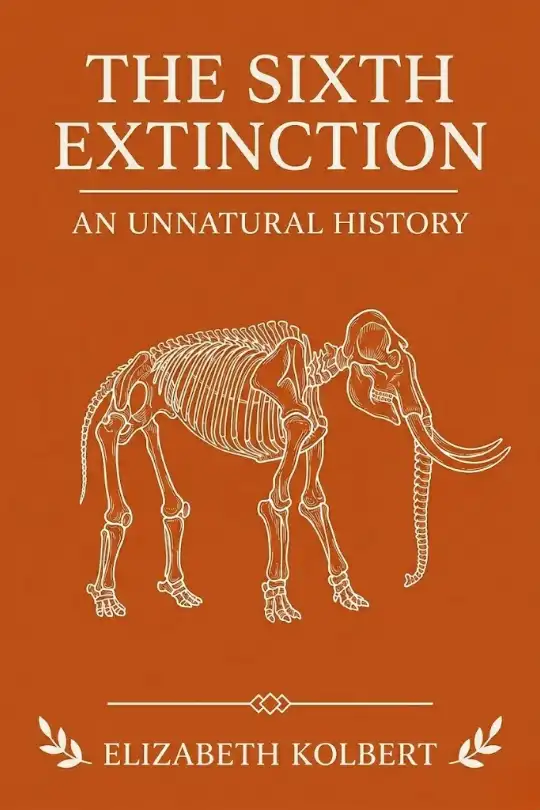
This is where Elizabeth Kolbert's The Sixth Extinction: An Unnatural History begins. Not with a distant threat, but with a species that, in the process of succeeding so spectacularly, has set in motion something unprecedented: a sixth mass extinction event, this one caused not by asteroids or volcanic eruptions, but by human activity.
Kolbert, a journalist and Pulitzer Prize winner, spent years traveling the globe to understand what was happening. She visited rainforests in Panama, coral reefs off Australia, caves in New York, and ancient rock formations in Scotland. She interviewed scientists who were watching species disappear in real time. What she found was a pattern that connected all these far flung places: human beings were reshaping the planet at a speed and scale that had no precedent in the three and a half billion year history of life.
The book examines the five previous mass extinctions—the Big Five—that scientists have identified in the geological record. The end Ordovician, the late Devonian, the end Permian, the end Triassic, and the end Cretaceous. Each one wiped out a significant portion of life on Earth. Each one was caused by catastrophic events: climate change, volcanic eruptions, asteroid impacts. But the
Roughly two hundred thousand years ago, a new species emerged on Earth. It had no name at first—not yet. But it had something remarkable: the capacity to name things. This species was slow, physically unremarkable, and reproduced at a modest rate. By all conventional measures, it should have remained a minor player in the story of life.
Instead, it spread across continents, crossed oceans, and adapted to every environment the planet could offer. It survived ice ages, outcompeted rivals, and multiplied until its numbers swelled beyond anything the world had ever seen. And then, this species—Homo sapiens—began to change the biosphere itself.
This is where Elizabeth Kolbert's The Sixth Extinction: An Unnatural History begins. Not with a distant threat, but with a species that, in the process of succeeding so spectacularly, has set in motion something unprecedented: a sixth mass extinction event, this one caused not by asteroids or volcanic eruptions, but by human activity.
Kolbert, a journalist and Pulitzer Prize winner, spent years traveling the globe to understand what was happening. She visited rainforests in Panama, coral reefs off Australia, caves in New York, and ancient rock formations in Scotland. She interviewed scientists who were watching species disappear in real time. What she found was a pattern that connected all these far-flung places: human beings were reshaping the planet at a speed and scale that had no precedent in the three-and-a-half-billion-year history of life.
The book examines the five previous mass extinctions—the Big Five—that scientists have identified in the geological record. The end-Ordovician, the late Devonian, the end-Permian, the end-Triassic, and the end-Cretaceous. Each one wiped out a significant portion of life on Earth. Each one was caused by catastrophic events: climate change, volcanic eruptions, asteroid impacts. But the sixth extinction is different. It's happening now, and it's being driven by a single species.
Kolbert's central argument is direct and unsettling. We are not just witnessing an extinction event. We are causing it. The golden frogs of Panama, the great auk of the North Atlantic, the ammonites of ancient seas—these are not isolated stories. They are chapters in a larger narrative, one that links the spread of humans across the globe to the disappearance of countless other species.
The prologue of the book sets the stage with a powerful image. Homo sapiens, a species with the capacity to name things, has also become a species with the capacity to alter the entire biosphere. We have burned fossil fuels, deforested continents, introduced invasive species to new environments, and acidified the oceans. In doing so, we have triggered changes that are happening faster than most species can adapt.
Kolbert doesn't just present the science. She takes readers along on her journey, introducing the researchers who are on the front lines of this crisis. She describes the moment she first saw a golden frog in Panama, not in its natural habitat, but in a disinfected glass tank—the only place it could survive. She recounts the story of a scientist who spent years trying to save a species that had already been doomed by human activity.
The book is structured around thirteen chapters, each focused on a different species or ecosystem under threat. From the chytrid fungus killing amphibians worldwide to the ocean acidification dissolving coral reefs, each case study builds the case that we are living through a mass extinction event. And unlike the previous five, this one has a name: the Anthropocene, the age of humans.
But Kolbert's goal is not simply to alarm. She wants readers to understand the scale of what is happening, and to recognize that we are both the cause and the only possible solution. The book ends with a reflection on human responsibility—on what it means to be the species that changes the world, and what kind of legacy we will leave behind.
As we begin this journey through The Sixth Extinction, one question hangs in the air: If we are the species with the power to name things, do we also have the power to save them?
About the Book
In The Sixth Extinction, Elizabeth Kolbert travels the globe to reveal how human activity—from spreading invasive fungi to burning fossil fuels—is driving a mass extinction event unprecedented in 65 million years. Blending gripping science, history, and on-the-ground reporting, she shows that we are both the architects of this crisis and the only species that can choose to act.
Key Takeaways
To Name Is to Bear Responsibility
Humanity's unique capacity to name and categorize the world carries an implicit duty to protect what we have identified. The very act of naming a species, from the golden frog to the great auk, binds us to its fate—we cannot claim ignorance of our power to destroy what we have learned to recognize.
Extinction Is Not Gradual—It Is a Door That Closes Forever
Georges Cuvier's discovery that species can vanish entirely, not through slow competition but through sudden catastrophe, reveals a fundamental truth: the line between thriving and oblivion can be crossed in a single generation, and no amount of future adaptation can reopen what has been lost.
The Greatest Traveler Is Also the Greatest Destroyer
Human mobility, from ships crossing oceans to boots entering caves, has created a New Pangaea where species meet without evolutionary preparation. The chytrid fungus and the bat-killing pathogen spread not by nature's design but by our footsteps, proving that our freedom to move comes at the cost of others' survival.
Evolution Cannot Prepare for the Unprecedented
The ammonites thrived for 300 million years only to be obliterated by an asteroid they could not have evolved to survive—just as today's corals and amphibians face chemical changes faster than any species can adapt, revealing that fitness means nothing against forces that have never existed in a creature's history.
The Smallest Creatures Hold the Largest Lessons
Graptolites no longer than a fingernail, golden frogs weighing ounces, and polyps invisible to the naked eye are the canaries in the coal mine of planetary collapse. Their disappearance signals shifts in ocean chemistry and ecosystem health that will eventually reach the largest organisms, including ourselves.
Heroic Rescue Cannot Replace Prevention
The spectacle of scientists performing ultrasounds on Sumatran rhinos and preserving cells of extinct birds in vials is both noble and tragic—a desperate attempt to undo what could have been avoided. These acts of last-minute salvation reveal the absurdity of a species that destroys with one hand while trying to resurrect with the other.
The Anthropocene Is Not an Epoch—It Is a Verdict
When a single species becomes a geological force capable of altering the atmosphere, oceans, and climate, it has moved beyond being a mere inhabitant of Earth to become its primary shaper. This transformation makes every extinction, every acidified reef, every bleached coral a judgment on how we have used our unprecedented power.
Hope Lies Not in Innocence but in Awareness
We cannot return to a state of ignorance about our impact, nor can we undo the extinctions already set in motion. But the very capacity that allowed us to name the crisis—our ability to understand cause and effect across time and space—is also what allows us to choose a different legacy, one written not in extinction but in conscious stewardship.
Who Should Listen?
Environmental scientists and conservation biologists who want a vivid, narrative-driven account of the extinction crisis they study in data.
Policy makers and environmental activists seeking compelling, real-world examples to communicate the urgency of climate and biodiversity action.
Curious general readers who enjoy narrative nonfiction like *Sapiens* or *The Immortal Life of Henrietta Lacks* and want to understand humanity's role in shaping the planet.
Students and educators in ecology, geology, or environmental studies who need an accessible yet authoritative introduction to the Anthropocene and mass extinction.