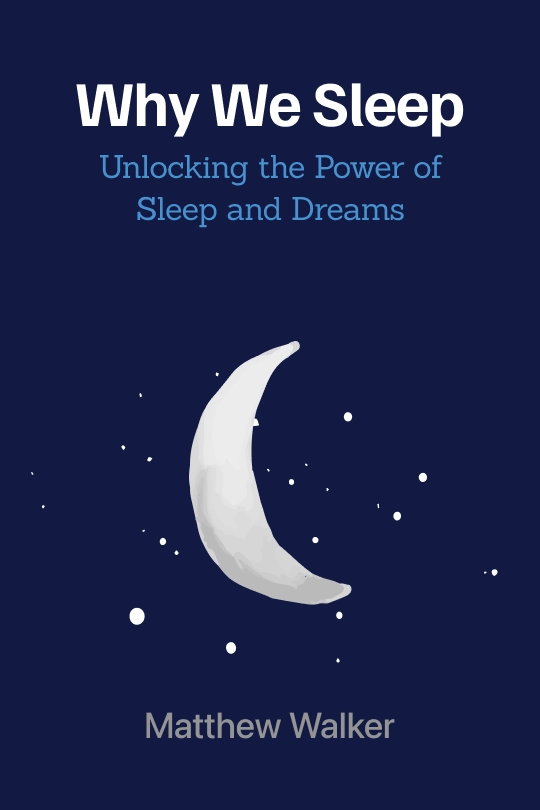
Why We Sleep
Unlocking the Power of Sleep and Dreams
Book Summary
Narrator: Ethan
Timeline
Summary Preview
Here's a disturbing fact: adults in developed nations are not getting the recommended eight hours of nightly sleep. Not even close. And most of us have no idea how catastrophic this is for our health.
Matthew Walker, a neuroscientist who has spent over twenty years studying sleep, calls this the greatest public health challenge of the twenty first century. But here's the strange part—we're not treating it like one. We don't have public service campaigns about sleep the way we do about smoking or drunk driving. Doctors don't routinely ask about sleep during checkups. And most people wear their ability to function on five or six hours like a badge of honor.
Why? According to Walker, the problem isn't that people don't want to sleep. The problem is that scientists, government officials, and policymakers have failed to explain why we need it. They've told us sleep is important, but they haven't shown us the evidence. They haven't made the case compelling enough to change behavior. And so we continue to treat sleep as optional, as something we can sacrifice for productivity, entertainment, or simply because we've convinced ourselves we're fine on less.
But we're not fine. And the evidence is overwhelming.
The Scope of the Problem
Let's start with the numbers. The vast majority of adults in developed nations sleep less than seven hours per night. Some sleep six. Some sleep five. Some brag about sleeping four. The recommended amount for adults is between seven and nine hours, with eight being the sweet spot for most people. Anything less than seven hours, and the damage begins to accumulate.
Walker is emphatic about this: the percentage of the population that can genuinely function on six hours or less without impairment is essentially zero. Less than one percent. There is a rare
Here's a disturbing fact: adults in developed nations are not getting the recommended eight hours of nightly sleep. Not even close. And most of us have no idea how catastrophic this is for our health.
Matthew Walker, a neuroscientist who has spent over twenty years studying sleep, calls this the greatest public health challenge of the twenty-first century. But here's the strange part—we're not treating it like one. We don't have public service campaigns about sleep the way we do about smoking or drunk driving. Doctors don't routinely ask about sleep during checkups. And most people wear their ability to function on five or six hours like a badge of honor.
Why? According to Walker, the problem isn't that people don't want to sleep. The problem is that scientists, government officials, and policymakers have failed to explain why we need it. They've told us sleep is important, but they haven't shown us the evidence. They haven't made the case compelling enough to change behavior. And so we continue to treat sleep as optional, as something we can sacrifice for productivity, entertainment, or simply because we've convinced ourselves we're fine on less.
But we're not fine. And the evidence is overwhelming.
The Scope of the Problem
Let's start with the numbers. The vast majority of adults in developed nations sleep less than seven hours per night. Some sleep six. Some sleep five. Some brag about sleeping four. The recommended amount for adults is between seven and nine hours, with eight being the sweet spot for most people. Anything less than seven hours, and the damage begins to accumulate.
Walker is emphatic about this: the percentage of the population that can genuinely function on six hours or less without impairment is essentially zero. Less than one percent. There is a rare genetic mutation that allows some people to thrive on short sleep, but if you think you're one of them, you're almost certainly wrong. You've simply forgotten what fully rested feels like.
The problem is that sleep deprivation is insidious. It doesn't feel like an emergency. You don't collapse. You don't feel dramatically different. You just slowly, quietly lose your edge. Your memory weakens. Your judgment gets worse. Your immune system falters. Your emotions become unstable. And you don't notice any of it because you've never experienced the alternative.
The Self-Deception Problem
This is where the real danger lies. Walker's research shows that sleep-deprived individuals consistently underestimate how impaired they are. You might feel a bit tired, but you don't realize that your brain is functioning as poorly as if you were legally drunk. You might think you're getting by just fine, but your reaction times, your decision-making, your ability to learn new information—all of it is compromised.
The question Walker wants you to ask yourself is simple but uncomfortable: if you didn't set an alarm clock, would you wake up at the same time? If the answer is no, you're not getting enough sleep. If you need caffeine to function before noon, you're not getting enough sleep. If you find yourself re-reading things or struggling to concentrate, you're not getting enough sleep.
These are not signs of a busy life. They are signs of a chronic sleep deficit.
Why This Matters
Walker's opening argument is not just about statistics. It's about a fundamental failure of communication. For decades, scientists have known that sleep is critical, but they've failed to translate that knowledge into public understanding. They've failed to make the case compelling enough to change policy, to change workplace culture, to change individual behavior.
The result is a society that systematically undervalues sleep. We equate sleep with laziness. We praise people who work long hours and sacrifice rest. We design school start times that deprive teenagers of the sleep their developing brains desperately need. We create work schedules that punish night owls and reward early risers. We build homes with bright lights and warm temperatures that disrupt our natural sleep rhythms.
And we do all of this without understanding the consequences.
The Takeaway
Here's what you need to know from this first section: sleep loss is a silent epidemic with catastrophic health consequences. Most adults in developed nations do not get the recommended eight hours of nightly sleep. And most of them don't realize how much damage they're doing.
The good news is that this is preventable. But the first step is recognizing that there is a problem. So here's a question to sit with: when was the last time you truly felt fully rested—not just not tired, but genuinely alert, clear-headed, and energized throughout the entire day? If you can't remember, you might be more sleep-deprived than you think. And in the sections that follow, we'll explore exactly what that deprivation is doing to your brain and body.
About the Book
Neuroscientist Matthew Walker reveals why sleep deprivation is the greatest public health crisis of the 21st century. Drawing on decades of research, he explains how sleep controls memory, emotional stability, creativity, and disease prevention—and how modern life systematically destroys it. This urgent, evidence-based guide offers practical solutions to reclaim your sleep and transform your health.
Key Takeaways
Prioritize 7-9 Hours of Sleep as a Non-Negotiable Health Requirement
Adults in developed nations are chronically sleep-deprived, with less than 1% of the population able to function on 6 hours or less without impairment. Treat sleep as essential as diet and exercise, setting a consistent bedtime and wake time to ensure you get the full 8-hour window for optimal cognitive and physical health.
Stop Using Caffeine After Noon to Protect Your Sleep Quality
Caffeine has a 5-7 hour half-life, meaning a 2 PM coffee still blocks adenosine receptors at midnight, degrading sleep quality even if you fall asleep. Cut all caffeine by midday to allow your natural sleep pressure to build and ensure deep, restorative sleep.
Cool Your Bedroom to 65°F (18.3°C) for Deeper Sleep
Your core body temperature must drop to initiate and maintain sleep; a warm room fights this natural process. Set your thermostat to 65°F and consider a hot bath 90 minutes before bed to trigger a rapid temperature drop that can increase deep NREM sleep by 10-15%.
Eliminate Alcohol Before Bed to Preserve REM Sleep and Emotional Health
Alcohol is a sedative that fragments sleep and powerfully suppresses REM sleep, which is critical for emotional regulation, memory consolidation, and creativity. Avoid alcohol for at least 3-4 hours before bedtime to protect the dream stage that provides overnight therapy.
Use the 'Last Two Hours' Rule for Learning and Skill Mastery
The final two hours of an 8-hour night contain the richest sleep spindles for motor skill consolidation, boosting performance by 15-35%. If you cut sleep short, you lose this critical window; schedule practice sessions before a full night's sleep to cement new skills and knowledge.
Apply Dream Incubation to Solve Complex Problems Creatively
REM sleep forges novel connections between unrelated information, boosting creative problem-solving by 15-35% compared to waking or NREM sleep. Before bed, clearly state a problem you want to solve, write it down, and keep a notebook by your bed to capture dream insights immediately upon waking.
Adopt Cognitive Behavioral Therapy for Insomnia (CBT-I) Instead of Sleeping Pills
Sleeping pills are sedatives that suppress natural sleep architecture and are linked to a 3.6-4.6 times higher mortality risk, even with occasional use. CBT-I, a structured program that breaks insomnia habits and rebuilds sleep confidence, is more effective long-term with zero side effects.
Maintain a Consistent Sleep Schedule 7 Days a Week as Your Top Sleep Hygiene Practice
A consistent bedtime and wake time—including weekends—anchors your circadian rhythm and builds optimal sleep pressure at the right times. This single habit is more effective than any other sleep hygiene tip for improving sleep quality and overall health.
Who Should Listen?
Chronic short sleepers who regularly get less than seven hours and believe they function fine, but haven't measured their cognitive decline.
Parents of teenagers who struggle with early school start times and want scientific backing to advocate for later schedules.
Professionals in high-stakes fields like medicine, aviation, or law enforcement whose performance and safety depend on optimal cognitive function.
Insomniacs or occasional sleeping pill users seeking a non-pharmacological, evidence-based alternative to restore natural sleep.