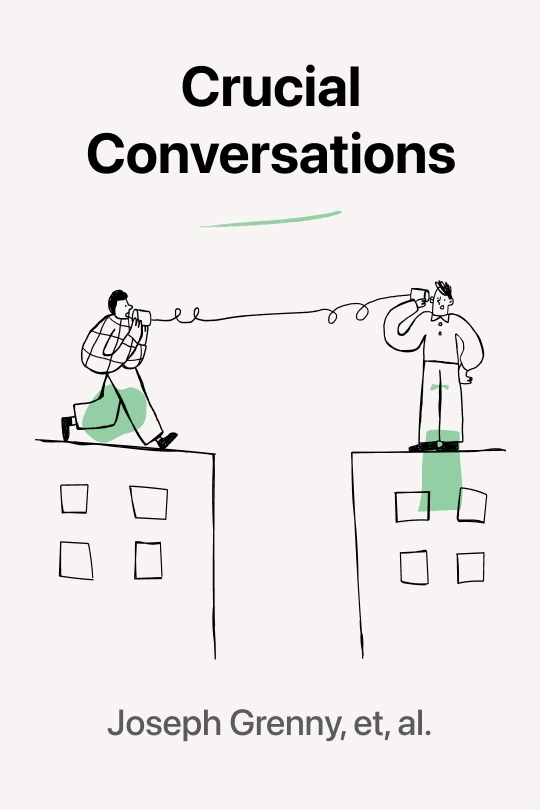
Crucial Conversations
Tools for Talking When Stakes are High
Book Summary
Narrator: Ethan
Summary Preview
You know the feeling. Your stomach tightens. Your mouth goes dry. Someone says something that crosses a line, and suddenly you're in a conversation you didn't prepare for, with no script and no exit. Maybe it's a colleague taking credit for your work. A partner who keeps spending money you agreed to save. A boss who's about to fire you. Or a friend whose drinking has become impossible to ignore.
These are crucial conversations. The authors define them by three conditions that must all be present: varied opinions, high stakes, and strong emotions. If you're deciding where to eat dinner, that's not crucial. But when you're confronting someone about a broken promise, asking for a raise, or discussing end of life care with aging parents—that's crucial. And the outcome of that single conversation can reshape your career, your marriage, or your health.
Here's the problem. Human biology works against us. When we sense threat—and make no mistake, social rejection feels like physical danger to our brains—adrenaline floods our system. Blood flows to our large muscles and away from our frontal cortex. We're literally dumber in the moments we need to be smartest. Our ancestors needed fight or flight to survive predators. But when your boss questions your competence, punching them or running away won't help. Yet that's exactly what our bodies prepare us to do.
So we lash out. Or we clam up. Or we double down on our position. We do anything except have the productive conversation we need. And then we suffer the consequences.
The authors spent twenty five years researching what separates people who succeed in these moments from those who fail. They studied thousands of individuals across hundreds of organizations. And they found something remarkable: the ability to hold crucial conversations well is not a personality
You know the feeling. Your stomach tightens. Your mouth goes dry. Someone says something that crosses a line, and suddenly you're in a conversation you didn't prepare for, with no script and no exit. Maybe it's a colleague taking credit for your work. A partner who keeps spending money you agreed to save. A boss who's about to fire you. Or a friend whose drinking has become impossible to ignore.
These are crucial conversations. The authors define them by three conditions that must all be present: varied opinions, high stakes, and strong emotions. If you're deciding where to eat dinner, that's not crucial. But when you're confronting someone about a broken promise, asking for a raise, or discussing end-of-life care with aging parents—that's crucial. And the outcome of that single conversation can reshape your career, your marriage, or your health.
Here's the problem. Human biology works against us. When we sense threat—and make no mistake, social rejection feels like physical danger to our brains—adrenaline floods our system. Blood flows to our large muscles and away from our frontal cortex. We're literally dumber in the moments we need to be smartest. Our ancestors needed fight-or-flight to survive predators. But when your boss questions your competence, punching them or running away won't help. Yet that's exactly what our bodies prepare us to do.
So we lash out. Or we clam up. Or we double down on our position. We do anything except have the productive conversation we need. And then we suffer the consequences.
The authors spent twenty-five years researching what separates people who succeed in these moments from those who fail. They studied thousands of individuals across hundreds of organizations. And they found something remarkable: the ability to hold crucial conversations well is not a personality trait you're born with. It's a learnable skill set.
The evidence is concrete. The authors' research shows that corporations where employees mastered crucial conversation skills outperformed their peers on nearly every measurable dimension. Safety records improved—because people could speak up about hazards without fear. Productivity climbed—because teams could address problems directly instead of letting them fester. Diversity initiatives actually worked—because people could discuss sensitive topics openly. Quality metrics rose—because honest feedback flowed freely instead of being sugarcoated or withheld.
These weren't small differences. The gap between organizations with strong dialogue skills and those without was dramatic enough that the authors could predict which companies would thrive simply by observing how people handled disagreements.
The same pattern holds in personal life. Research on marriage shows that couples who can discuss difficult topics openly have divorce rates a fraction of those who avoid conflict or escalate it. Studies on longevity reveal that people with strong social connections—built through honest communication—live longer, healthier lives. Communities where people can talk about hard things solve problems faster and create more trust.
This is the book's central premise: crucial conversations are not optional skills. They are the single most powerful leverage point for improving your life. Master them, and everything gets better. Avoid them or botch them, and you pay the price in missed promotions, broken relationships, and accumulated resentment.
Yet most of us have never been taught how to do this. Our parents modeled whatever they modeled. Our schools taught us algebra, not how to tell a colleague their body odor is affecting the team. So we improvise. And improvisation under adrenaline usually fails.
The authors discovered that the most effective communicators don't rely on natural talent. They use specific, repeatable techniques. The rest of this book lays out those techniques one by one. But before we get to the tools, ask yourself: what crucial conversation are you avoiding right now? The one you've been putting off for weeks, months, maybe years. The one that keeps you up at night. The one that, if handled well, could change everything.
That conversation is not optional. It's waiting for you. And the only question is whether you'll face it with skill or with silence and fists.
Who Should Listen?
A mid-level manager who dreads giving critical feedback to underperforming team members and wants to stop avoiding these conversations.
A married person who frequently argues with their spouse about money or parenting and wants to break the cycle of silence and resentment.
A young professional who stays quiet in meetings when they disagree with senior colleagues and wants to speak up without damaging their career.
A team leader whose direct reports avoid raising problems until they become crises, and needs tools to create psychological safety on their team.