Book Summary
Narrator: Ethan
Timeline
Summary Preview
Peter Frankopan had a problem with the history he was taught. As a young historian at Oxford, he kept noticing something strange about the way the story of civilization was told. The textbooks, the lectures, the popular narratives—they all placed Europe at the center. The Greeks invented democracy. The Romans built the empire. The Renaissance revived learning. The Age of Discovery spread progress. It was a clean, familiar story, one that generations had accepted without much question.
But Frankopan couldn't shake the feeling that this story was wrong. Not just incomplete—actively misleading. The more he studied the ancient world, the more he realized that the places dismissed as "backwaters" in the standard narrative were actually the places that mattered most. The lands of Central Asia, Mesopotamia, and Persia weren't peripheral to world history. They were its beating heart.
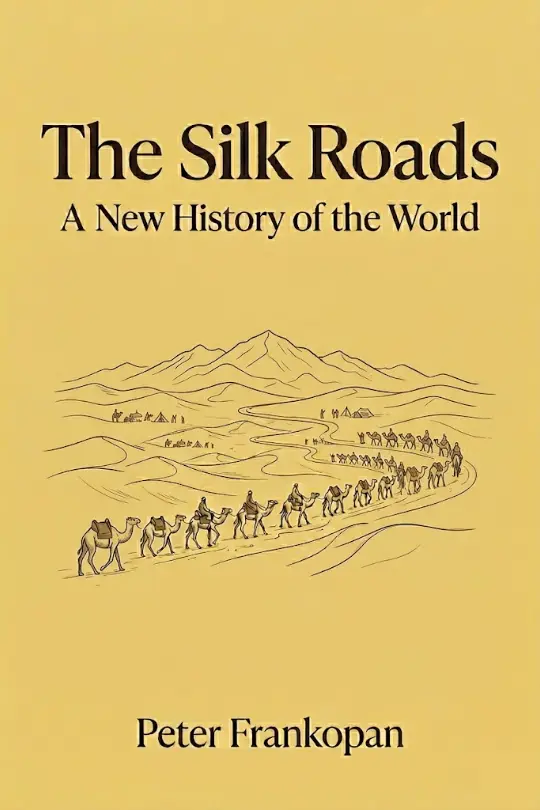
This realization became the driving force behind Frankopan's book, The Silk Roads: A New History of the World . In the preface, he lays out his challenge directly. The "accepted and lazy history of civilisation," he writes, has blinded us to a fundamental truth: "the bridge between East and West is the very crossroads of civilisation." Far from being on the fringe of global affairs, these countries "lie at its very centre—as they have done since the beginning of history."
It's a bold opening, and it sets the stage for everything that follows. Frankopan isn't just offering a different perspective on world history. He's arguing that the entire framework we've used to understand it needs to be flipped.
The book's central idea is simple but revolutionary. For most of human history, the action wasn't happening in Europe. It was happening along the vast network of trade routes that connected China, India, Persia, and the Mediterranean—what the 19th century German geographer Ferdinand von
Peter Frankopan had a problem with the history he was taught. As a young historian at Oxford, he kept noticing something strange about the way the story of civilization was told. The textbooks, the lectures, the popular narratives—they all placed Europe at the center. The Greeks invented democracy. The Romans built the empire. The Renaissance revived learning. The Age of Discovery spread progress. It was a clean, familiar story, one that generations had accepted without much question.
But Frankopan couldn't shake the feeling that this story was wrong. Not just incomplete—actively misleading. The more he studied the ancient world, the more he realized that the places dismissed as "backwaters" in the standard narrative were actually the places that mattered most. The lands of Central Asia, Mesopotamia, and Persia weren't peripheral to world history. They were its beating heart.
This realization became the driving force behind Frankopan's book, The Silk Roads: A New History of the World. In the preface, he lays out his challenge directly. The "accepted and lazy history of civilisation," he writes, has blinded us to a fundamental truth: "the bridge between East and West is the very crossroads of civilisation." Far from being on the fringe of global affairs, these countries "lie at its very centre—as they have done since the beginning of history."
It's a bold opening, and it sets the stage for everything that follows. Frankopan isn't just offering a different perspective on world history. He's arguing that the entire framework we've used to understand it needs to be flipped.
The book's central idea is simple but revolutionary. For most of human history, the action wasn't happening in Europe. It was happening along the vast network of trade routes that connected China, India, Persia, and the Mediterranean—what the 19th-century German geographer Ferdinand von Richthofen called the "Silk Road." These routes weren't just conduits for luxury goods like silk and spices. They were the arteries through which ideas, religions, technologies, and diseases flowed. They were where empires rose and fell. They were, in short, the engine of world civilization.
Frankopan's argument challenges the Eurocentric worldview that has dominated Western thinking for centuries. That worldview, he shows, is largely a product of the 16th century, when European powers first gained access to the wealth of the Americas and began rewriting history to justify their newfound dominance. Before that, Europe was a relatively unimportant peninsula on the western edge of a world whose center lay far to the east.
The book uses the Silk Roads as a unifying framework to tell a new story of global history. From the ancient Persian empires to the rise of Islam, from the Mongol conquests to the Age of Discovery, from the World Wars to the modern struggle for oil, Frankopan traces how the struggle for control of these trade routes has shaped the destiny of nations. His goal is nothing less than to reframe our understanding of the past—and, in doing so, to help us make sense of the present.
So why does this matter? Why should we care about trade routes that date back thousands of years? Because, Frankopan argues, the patterns of history are still playing out today. The conflicts in the Middle East, the rise of China, the tensions between Russia and the West—all of these are echoes of ancient struggles for control of the same strategic territory. The "Silk Roads" aren't a relic of the past. They're rising up once more.
The question Frankopan leaves us with is this: If the accepted history of civilization has been so fundamentally wrong about where the center of the world lies, what else have we been getting wrong? And what happens when that center shifts back to where it always was?
About the Book
Peter Frankopan rewrites global history from the perspective of the East, arguing that the Silk Roads of Central Asia, not Europe, have been the true center of civilization for millennia. From ancient Persia to modern oil politics, he reveals how trade, faith, and war along these routes shaped empires, sparked world wars, and are now shifting the world's center of gravity back to where it always was.
Key Takeaways
History's Center Has Always Been the East, Not the West
The standard Eurocentric narrative of civilization is a recent invention, not an eternal truth; for millennia, the true engine of global history was the network of trade routes connecting Asia, Persia, and the Mediterranean, where empires rose, ideas spread, and wealth accumulated.
Trade Routes Are the Arteries of Power and Faith
The Silk Roads were never merely conduits for luxury goods like silk and spices; they were the living pathways through which religions, technologies, and diseases traveled, making control of these routes the ultimate source of geopolitical and cultural influence.
Empires Rise by Building Bridges, Not Walls
From the Persians' roads to the Mongols' unified currency, the most enduring empires understood that investing in infrastructure and connectivity—rather than mere conquest—created the conditions for lasting wealth, cultural exchange, and global dominance.
Prosperity and Catastrophe Travel the Same Roads
The Mongol Peace created an unprecedented era of global connection, but the same networks that carried silk and porcelain also carried the Black Death, revealing a profound truth: globalization's greatest gifts are inseparable from its deadliest risks.
Violence, Not Genius, Drove Europe's Rise to Power
Europe's sudden centrality after the 1490s was not a 'Renaissance' of classical wisdom but a brutal 'Naissance'—a birth powered by advanced military technology, ruthless exploitation of the Americas, and a willingness to enslave and destroy on an unprecedented scale.
Resource Wars Are the Hidden Engine of Modern Conflict
The great wars of the twentieth century were not primarily about ideology or nationalism; they were driven by desperate struggles for Eastern resources—Persian oil, Ukrainian wheat—with the Holocaust itself emerging as a direct consequence of Germany's failed campaign to secure grain.
Trust, Once Broken, Cannot Be Repaired by Force
The 1953 CIA coup in Iran and decades of Western support for dictators created a reservoir of resentment that no amount of military power could overcome, culminating in the Iranian Revolution and a permanent breakdown of trust that continues to shape global politics.
The World's Center of Gravity Is Returning to Where It Always Was
The current turmoil in the Middle East, the rise of China, and the construction of new pipelines and railways across Asia are not signs of chaos but 'birthing pains'—the convulsions of a world order shifting back to the East, reclaiming the central role it held for millennia before Europe's brief dominance.
Who Should Listen?
History buffs tired of Eurocentric narratives who want a fresh, Asia-centered perspective on the rise and fall of empires.
Global economics professionals seeking to understand how ancient trade routes still influence modern oil politics, supply chains, and China's Belt and Road Initiative.
Geopolitics enthusiasts curious about the historical roots of current conflicts in the Middle East, Russia, and Central Asia.
Readers of popular history like Sapiens or Guns, Germs, and Steel who enjoy sweeping, revisionist takes on world civilization.