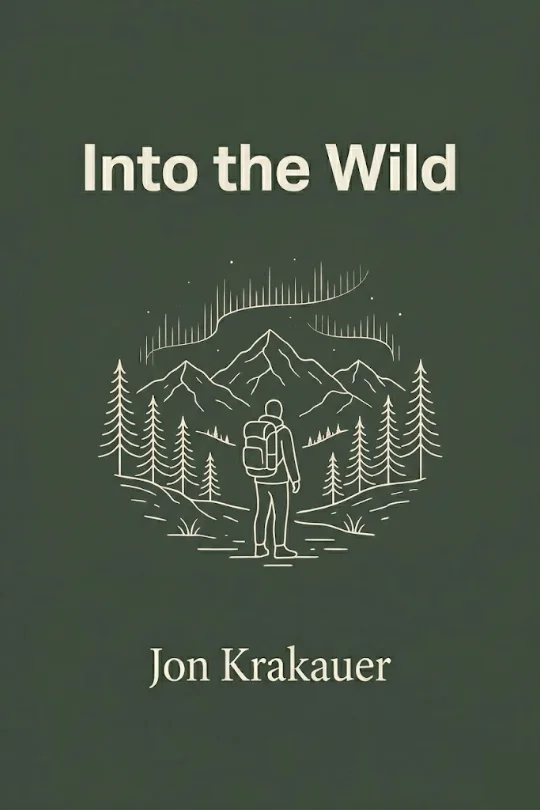
Into the Wild
Book Summary
Narrator: Ethan
Summary Preview
In September 1992, a young man's decomposed body was found inside an abandoned bus in the Alaskan wilderness. He had starved to death. His name was Christopher Johnson McCandless, and he was twenty four years old.
When journalist Jon Krakauer wrote an article about McCandless for Outside magazine in 1993, the response was explosive. Readers were polarized. Some saw McCandless as a heroic idealist, a modern day Thoreau who had the courage to abandon society's comforts and test himself against nature. Others saw him as a reckless fool—an arrogant, ill prepared kid who got exactly what he deserved.
Krakauer found himself caught in the middle of this debate. And he had a problem. The more he learned about McCandless, the more personally he felt the story. In the Author's Note to Into the Wild , he makes this confession upfront: "McCandless's strange tale struck a personal note that made a dispassionate rendering of the tragedy impossible."
He then delivers a warning to the reader. He will not be an impartial biographer. He cannot be. The story has gotten under his skin.
This is an unusual move for a journalist. Krakauer was a respected writer for Outside and Smithsonian , known for his climbing journalism and adventure reporting. The standard journalistic stance is objectivity—present the facts, let the reader decide. But Krakauer announces from the start that he's abandoning that posture. He has an argument to make, and he's going to make it.
His argument is this: Christopher McCandless was not a fool. He was not suicidal. He was not simply a naive kid who wandered into the wilderness and died because he didn't know better. His death was a tragedy, yes—but a tragedy worth studying, grieving, and reflecting on. And the people who dismiss him as ignorant or arrogant are
In September 1992, a young man's decomposed body was found inside an abandoned bus in the Alaskan wilderness. He had starved to death. His name was Christopher Johnson McCandless, and he was twenty-four years old.
When journalist Jon Krakauer wrote an article about McCandless for Outside magazine in 1993, the response was explosive. Readers were polarized. Some saw McCandless as a heroic idealist, a modern-day Thoreau who had the courage to abandon society's comforts and test himself against nature. Others saw him as a reckless fool—an arrogant, ill-prepared kid who got exactly what he deserved.
Krakauer found himself caught in the middle of this debate. And he had a problem. The more he learned about McCandless, the more personally he felt the story. In the Author's Note to Into the Wild, he makes this confession upfront: "McCandless's strange tale struck a personal note that made a dispassionate rendering of the tragedy impossible."
He then delivers a warning to the reader. He will not be an impartial biographer. He cannot be. The story has gotten under his skin.
This is an unusual move for a journalist. Krakauer was a respected writer for Outside and Smithsonian, known for his climbing journalism and adventure reporting. The standard journalistic stance is objectivity—present the facts, let the reader decide. But Krakauer announces from the start that he's abandoning that posture. He has an argument to make, and he's going to make it.
His argument is this: Christopher McCandless was not a fool. He was not suicidal. He was not simply a naive kid who wandered into the wilderness and died because he didn't know better. His death was a tragedy, yes—but a tragedy worth studying, grieving, and reflecting on. And the people who dismiss him as ignorant or arrogant are wrong.
This sets up the central tension of the book. Krakauer is not just telling a story. He's building a case. Every chapter, every interview, every journal entry he uncovers becomes evidence in his defense of McCandless.
But why does Krakauer care so much? Why can't he be impartial?
The answer lies in something he reveals only later, in the middle of the book. In 1977, when Krakauer was twenty-three years old—one year younger than McCandless when he entered the Alaskan bush—he attempted a solo climb of a notoriously dangerous mountain called the Devils Thumb. He went alone. He had minimal supplies. He nearly died. He kept climbing anyway.
Krakauer understands something about McCandless that many of his critics don't. He understands the pull of wild places. He understands the desire to test yourself against something bigger than you are. He understands that for some people, the risk is not a bug—it's a feature. And he understands that wanting to push your limits is not the same as wanting to die.
This personal connection shapes every page of Into the Wild. Krakauer is not neutral. He is a advocate, a defender, a man trying to make sense of a death that could easily have been his own.
The book that emerges from this personal investment is remarkable in its structure. Krakauer weaves together multiple narrative threads: McCandless's two-year journey across the American West and Mexico, his final months in Alaska, the discovery of his body, the grief of his family, the stories of the people he met along the way, and Krakauer's own parallel experience on the Devils Thumb. The result is not a straightforward biography but a collage—part journalism, part memoir, part detective story, part elegy.
Krakauer's central question drives everything: Who was Christopher McCandless? What was he looking for? And why did he have to die?
To answer these questions, Krakauer had to retrace McCandless's steps. He spent a year tracking down everyone who had met him—the truck driver who gave him a ride to the trailhead, the drifters who befriended him in the California desert, the old man who offered to adopt him, the grain elevator operator who gave him work in South Dakota, the woman who ran a book stall at a place called The Slabs. He read McCandless's journals, studied his marginalia in the books he carried, examined the photographs found in his camera. He even traveled to the abandoned bus where McCandless died, crossing the same swollen river that had trapped him there.
What Krakauer found challenged the easy judgments people had made. McCandless was not a clueless suburban kid who had never spent a night outdoors. He had spent two years living on the road, sleeping under the stars, surviving on whatever he could hunt or gather. He had paddled a canoe down the Colorado River into Mexico, living for a month on rice and marine life. He had worked hard at difficult jobs, made friends everywhere he went, and left a powerful impression on nearly everyone he met.
He was also stubborn, idealistic to a fault, and sometimes reckless. He refused help when he needed it. He rejected warm clothing and better gear. He walked into the Alaskan wilderness with a ten-pound bag of rice, a .22 caliber rifle, and no map. He made mistakes. And those mistakes killed him.
But Krakauer insists that calling him foolish misses the point. The same qualities that led to his death—his intensity, his refusal to compromise, his hunger for authentic experience—were the qualities that made him remarkable. You cannot separate the two. You cannot celebrate the passion without accepting the risk.
This is the heart of Krakauer's defense. McCandless was not a suicide. He was not an accident. He was a young man who wanted to live fully, who believed that a life of comfort and security was not worth living, and who took that belief to its logical conclusion. His death was not the point of his story. His life was.
Into the Wild is Krakauer's attempt to make us see that life. To show us the person behind the headlines. To argue that Christopher McCandless deserves more than our easy condemnation or our shallow admiration. He deserves to be understood.
But understanding is hard. It requires looking at the evidence, considering the complexity, and grappling with questions that have no easy answers. Why do some people feel compelled to leave everything behind? What drives a person to risk everything for a moment of beauty? And when does passion cross the line into self-destruction?
These are the questions Krakauer wrestles with in the pages ahead. And he knows that the answers will be different for every reader. Because at the end of the day, how you judge Christopher McCandless says as much about you as it does about him.
Who Should Listen?
Outdoor adventurers and backpackers who have ever questioned whether their own risk-taking is passion or recklessness.
Parents of idealistic young adults who want to understand what drives children to reject comfort and security.
Anyone who has ever felt trapped by society's expectations and fantasized about walking away from it all.
True crime and narrative nonfiction fans who appreciate deep character studies and the moral ambiguity of tragic deaths.