A Monster Calls
Book Summary
Narrator: Ethan
Timeline
Summary Preview
Conor O'Malley is thirteen years old, and his mother is dying.
That's the simple truth at the heart of this story, but nothing else about it is simple. Conor's mother has been sick for over a year, undergoing treatments for an unnamed illness. And Conor has been holding things together—the household chores, the laundry, the dishes, the brave face. He wakes up each morning, makes his own breakfast, and gets himself to school. He does all of this because his mother is too tired from her treatments, and because he believes that if he just keeps everything running smoothly, maybe things will be okay.
But every night, Conor has the same nightmare. The one with the darkness and the wind and the screaming. The one he has told no one about. Not his mother, not his father who lives in America, not his grandmother, not a single person at school. This nightmare is his deepest secret, a source of shame so powerful that he carries it alone.
Then one night, everything changes.
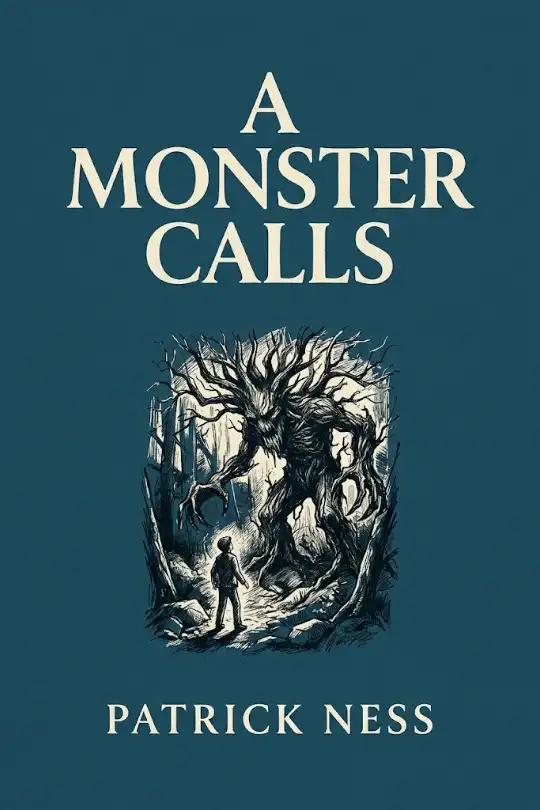
Conor wakes at exactly 12:07 am. He hears someone calling his name. Looking out his window, he sees the ancient yew tree on the hill behind his house begin to transform. The tree twists and reshapes itself into a humanoid monster, ancient and wild, with "a monstrous quality, wild and untamed." The monster walks to Conor's bedroom window, smashes through the wall, and opens its mouth to eat Conor alive.
Here's the strange thing: Conor isn't afraid. When the monster demands to know why, Conor simply says, "I've seen worse." The monster promises that Conor will learn to be afraid of him in time.
This monster claims to be an ancient being who "does not often come walking... only for matters of life and death." It tells Conor
Conor O'Malley is thirteen years old, and his mother is dying.
That's the simple truth at the heart of this story, but nothing else about it is simple. Conor's mother has been sick for over a year, undergoing treatments for an unnamed illness. And Conor has been holding things together—the household chores, the laundry, the dishes, the brave face. He wakes up each morning, makes his own breakfast, and gets himself to school. He does all of this because his mother is too tired from her treatments, and because he believes that if he just keeps everything running smoothly, maybe things will be okay.
But every night, Conor has the same nightmare. The one with the darkness and the wind and the screaming. The one he has told no one about. Not his mother, not his father who lives in America, not his grandmother, not a single person at school. This nightmare is his deepest secret, a source of shame so powerful that he carries it alone.
Then one night, everything changes.
Conor wakes at exactly 12:07 am. He hears someone calling his name. Looking out his window, he sees the ancient yew tree on the hill behind his house begin to transform. The tree twists and reshapes itself into a humanoid monster, ancient and wild, with "a monstrous quality, wild and untamed." The monster walks to Conor's bedroom window, smashes through the wall, and opens its mouth to eat Conor alive.
Here's the strange thing: Conor isn't afraid. When the monster demands to know why, Conor simply says, "I've seen worse." The monster promises that Conor will learn to be afraid of him in time.
This monster claims to be an ancient being who "does not often come walking... only for matters of life and death." It tells Conor that it will share three stories with him. After those three tales, Conor must tell the monster a fourth story: the truth of what happens in his nightmare.
Conor refuses. The monster eats him alive again.
When Conor wakes the next morning, he finds his bedroom floor covered in yew tree leaves. The monster, it seems, is real.
This is the framework of Patrick Ness's novel A Monster Calls—a story about a boy, a monster, and the painful truth that lies buried beneath grief, anger, and shame. The book was originally conceived by the late Siobhan Dowd, who passed away from breast cancer in 2007, and Ness wrote it in her memory. It won both the Carnegie Medal and the Greenway Medal in 2012, the first book ever to win both awards simultaneously.
But what kind of story is this really? On the surface, it's a fantasy about a mythical creature visiting a troubled boy. But the monster isn't here to destroy or to punish. It's here to guide Conor through something he cannot face alone: the messy, terrifying, contradictory process of losing someone you love.
The novel explores terminal illness, grief, anger, guilt, and acceptance through a child's eyes, weaving in elements of English mythology. The yew tree itself carries deep meaning—in England, yew trees are called "graveyard trees" because they grow on burial grounds, but they're also used in modern medicine to treat cancer. The tree that could heal can also kill. The monster that terrifies can also comfort.
Conor's world is already cracking before the monster arrives. At school, he's isolated. His only friend Lily told everyone about his mother's illness, and now the other students treat him like he's made of glass—or worse, like he's invisible. A bully named Harry torments him, and Conor takes the abuse without fighting back. His father lives in America with a new family and barely visits. His grandmother, who Conor views as fussy and controlling, keeps hovering, hinting at a future Conor refuses to imagine: life after his mother.
The monster's first appearance shatters Conor's carefully maintained denial. When it smashes through his wall and eats him alive, Conor feels no fear because he's already living in a nightmare. But the monster sees something Conor cannot—that the real nightmare isn't the one with darkness and screaming. The real nightmare is the truth Conor refuses to speak: that his mother is dying, and part of him wants the pain to end.
The monster promises three tales. Each one will challenge everything Conor believes about good and evil, fairness and punishment, love and letting go. Each one will push him closer to the confession he dreads most.
And after the third tale, Conor must tell the fourth.
The truth of what happens in his nightmare.
What could be so terrible that a thirteen-year-old boy would rather be eaten alive than speak it?
About the Book
Thirteen-year-old Conor’s mother is dying. Each night, a monster visits him, demanding the truth of his nightmare. Through three twisted tales and one devastating confession, this story explores grief, guilt, and the healing power of facing what we fear most. A raw, beautiful journey about letting go by holding on.
Key Takeaways
Stories are wild creatures that refuse to obey our expectations
The monster's first tale about the wicked queen and the prince deliberately subverts the classic fairy-tale structure, teaching Conor that truth is rarely simple and that people cannot be neatly categorized as heroes or villains—a lesson that prepares him for the complexity of his own grief.
Belief is half of all healing, but only when it is genuine
The second tale reveals that the parson was punished not for his doubts but for abandoning his beliefs when they became inconvenient, showing Conor that authentic conviction—whether in a cure, a person, or oneself—is more powerful than empty righteousness.
Visibility without connection is a deeper form of isolation
After Conor violently makes himself seen by beating Harry, he discovers that being noticed through fear and pity creates an even greater distance from others, teaching him that true human connection requires vulnerability rather than aggression.
You do not write your life with words, but with actions
When Conor finally confesses his darkest secret—that he wished for his mother's suffering to end—the monster reveals that his thoughts do not define him; what matters is that he stayed, held her hand, and loved her through every difficult moment.
Holding on and letting go can be the same sacred act
In the final moments with his mother, Conor discovers that true letting go is not abandonment but acceptance—by holding her hand until the very end and telling her the truth, he gives her permission to leave while keeping his love intact.
Shame is not the same as guilt, and both can be healed by truth
The monster's entire purpose is to guide Conor from shame-ridden silence into honest speech, demonstrating that speaking the unspeakable truth does not destroy us but rather frees us from the poison of carrying it alone.
Grief shared is grief halved, even between unlikely allies
Conor and his grandmother, who have always clashed, find common ground in their shared love for his mother, proving that reconciliation becomes possible when we recognize that others carry the same weight of loss we do.
The monsters that terrify us can also be the ones that heal us
The yew tree monster—ancient, destructive, and frightening—turns out to be the only force capable of guiding Conor through his grief, illustrating that what we fear most may hold the key to our transformation and peace.
Who Should Listen?
Teens and adults who have experienced the loss of a loved one and struggle with guilt or complicated grief.
Parents or caregivers supporting a child through a parent’s terminal illness, seeking a story that mirrors that painful reality.
Readers who love emotionally powerful, myth-infused fiction like The Book Thief or The Ocean at the End of the Lane.
Grief counselors, teachers, or librarians looking for a compassionate, honest tool to help young people discuss death and acceptance.