Perelandra
Book Summaries
Hosts: Ethan
Timeline
Summary Preview
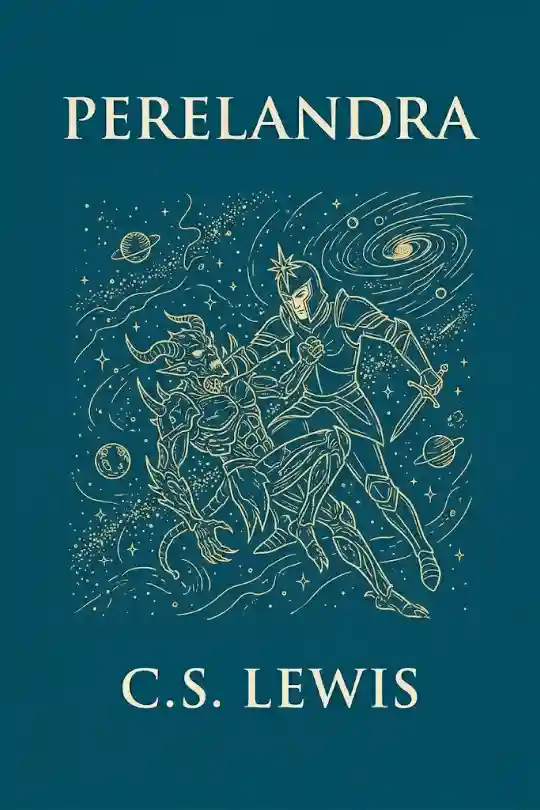
C.S. Lewis published *Perelandra* in 1943, the second book in his Space Trilogy. It came during the darkest years of World War II, when the question of evil—its nature, its power, and whether it could be defeated—pressed on every mind. Lewis answered with a story that traveled far from Earth, to a world untouched by sin.
The novel's hero is Elwin Ransom, a Cambridge philologist who had already visited Mars in the first book, *Out of the Silent Planet*. Now he receives a new mission. The eldila—angelic beings who serve Maleldil, the Christ figure of Lewis's universe—send Ransom to Perelandra, which humans call Venus. His task: prevent a new fall of innocence. On Earth, humanity had already chosen disobedience. On Perelandra, the drama might play out differently—if Ransom could stop it.
The stakes could not be higher. Earth, the eldila explain, is Thulcandra, the Silent Planet. Its Oyarsa, its ruling spirit, rebelled long ago and cut off the planet from the rest of the solar system. That dark lord now seeks to extend his reach. Venus, a young world still in its paradise state, stands in his path. If he can corrupt its King and Queen, the fall that happened on Earth will repeat itself—and the consequences will echo across the Field of Arbol, the solar system itself.
Ransom travels to Perelandra in a coffin-shaped ship. The symbolism is deliberate: he must die to his old self before he can enter this new world. When he arrives, he finds himself soaring over an ocean planet. The water stretches in every direction, gold and silver under an unfamiliar sky. Floating islands drift across the surface like living continents, their geography shifting with every wave. The only fixed point is a single landmass in the distance, crowned by a green pillar. This is the Fixed Land, and it is forbidden.
Ransom learns to navigate this strange world. The floating islands rise and fall beneath his feet, and he stumbles at first, then finds his balance. The trees bear fruit unlike anything on Earth—yellow globes that burst with pleasure so intense that Ransom thinks wars would be fought for them back home. Yet he feels no urge to gorge himself. On Perelandra, satisfaction comes naturally. The desire for excess, that root of so much human evil, simply does not exist here.
He meets the planet's animals: a small golden dragon that follows him like a pet, fish that carry riders on their backs, birds with songs that seem to speak. Everything on Perelandra lives in harmony. No creature hunts another. No fear disturbs the peace.
Then Ransom sees her. A woman rides a fish toward his island, surrounded by animals that swim and fly beside her. She is naked and unashamed, her skin green in the golden light. When she speaks, her voice carries a music that Ransom has never heard. She calls herself the Mother, and she is looking for the King, her husband. They are the only humanoids on Perelandra, the first of their kind.
Ransom feels the weight of his mission immediately. This woman is innocence itself—not the innocence of ignorance, but something deeper, a purity that has never known the possibility of wrong. She lives in perfect obedience to Maleldil. She has never questioned His commands. She has never felt the pull of a forbidden thing.
The Queen shows Ransom her world. She takes him to the edge of the Fixed Land, that mysterious continent where she is forbidden to live. From its heights, they see something fall from the sky—a ship, black against the blue. Ransom's blood runs cold. He recognizes the vessel. It belongs to Edward Weston.
Weston is a physicist, a man of science who sees the universe as raw material for human ambition. In the first book, he kidnapped Ransom and tried to deliver him to the inhabitants of Mars. Now he has come to Perelandra, and he has brought something worse than himself. Something has taken possession of his body. The Weston who steps onto the floating islands is no longer entirely human. He has become the Un-Man, a vessel for the dark lord of Earth, a Satanic figure bent on destroying this new Eden.
The battle lines are drawn. Ransom must protect the Queen from Weston's temptation. He must prevent the fall that nearly destroyed his own world. And he must do it armed only with truth, against an enemy who can twist every argument, who never sleeps, who has nothing but time.
Perelandra is a world of pure delight, but evil has entered it. The question that drives the novel forward is simple and terrifying: Will innocence survive? Or will the pattern of Earth repeat itself, as the Queen faces the same choice that Eve faced—and as Ransom discovers, the outcome is not predetermined. Free will is real. The fall can happen again. Everything depends on what happens next.
How do you defend paradise against a serpent who never stops whispering?
About the Book
In C.S. Lewis's Perelandra, philologist Elwin Ransom is sent to Venus—a pristine Eden untouched by sin—to prevent a new fall of innocence. There, he must confront a possessed physicist who twists obedience into temptation, awakening self-regard in the planet's Eve. A cosmic battle of wits and violence unfolds, testing whether free will can choose good when evil speaks in reasonable tones.
Key Takeaways
Innocence is not armor—it is a door that must be guarded by choice.
The Green Lady's perfect innocence does not protect her from temptation; rather, her curiosity becomes the crack through which evil enters, revealing that true strength lies not in ignorance of evil but in the conscious rejection of it.
The serpent's most cunning lie is to disguise disobedience as a higher form of obedience.
The Un-Man does not command the Queen to reject Maleldil but instead convinces her that breaking the one command is itself a deeper act of love and maturity, showing how evil often corrupts by redefining virtue rather than attacking it directly.
Pleasure and moderation are not enemies—they are the same thing when the soul is whole.
On Perelandra, Ransom experiences fruit that satisfies completely, leaving no room for excess, revealing that the human problem is not desire itself but a brokenness that can never be filled, a condition unknown in a world untouched by sin.
The mirror of self-regard is the first step toward the fall.
When the Green Lady sees her own beauty for the first time, she begins to split into two selves—the one who looks and the one who is looked at—demonstrating that self-objectification is the seed of pride and the beginning of separation from God.
True courage is not the absence of fear but the acceptance of a role in a story greater than oneself.
Ransom accepts his mission to fight the Un-Man not because he is fearless but because he understands that he is the 'ransom'—a willing participant in Maleldil's eternal plan, where predestination and free will become identical in the act of surrender.
Evil can wound, but it cannot win—the wound becomes the proof of victory.
Ransom's bleeding heel, a permanent mark from the battle, mirrors the ancient promise that the serpent will bruise the heel but the head will be crushed, teaching that suffering is not defeat but the very currency of redemption.
The Great Dance includes every note—even the dark ones serve the melody.
The King and Queen learn of evil without committing it, and even the Un-Man's temptation becomes the instrument of their growth, revealing that Maleldil's plan is not a rigid map but a living dance that incorporates all choices into a greater harmony.
The battle for paradise is never won in a single moment—it is won in the daily choice to remain in the Dance.
Perelandra's salvation is not a dramatic rescue but a sustained refusal to step outside the rhythm of obedience, teaching that the real war against evil is fought not in grand gestures but in the quiet, continuous alignment with the will of the Creator.
Who Should Listen?
Readers who loved *Paradise Lost* and want a modern, imaginative retelling of temptation and the Garden of Eden.
Fans of philosophical science fiction who enjoy deep debates about free will, evil, and divine purpose woven into an adventure.
C.S. Lewis enthusiasts seeking the second book in the Space Trilogy, especially after *Out of the Silent Planet*.
Anyone wrestling with questions about why evil exists and how innocence can resist corruption in a world full of seductive lies.