Book Summary
Narrator: Ethan
Timeline
Summary Preview
In 2001, Christopher McDougall walked into a doctor's office with a hurting foot. He'd been a runner for five years, and the pain had become unbearable. The diagnosis hit him like a wall: he had a common running injury, one that would keep getting worse as long as he kept running. The sports medicine specialist gave him two options—quit running entirely, or get regular cortisone shots and invest in expensive orthotics.
McDougall didn't accept that. So he saw a second doctor. Same answer. Then a third. Same answer.
The medical consensus was clear: if you run, you get hurt. Up to eight out of every ten runners suffer some injury each year. It doesn't matter if you're fast or slow, heavy or thin, a marathon champion or a weekend jogger. The injuries come for everyone.
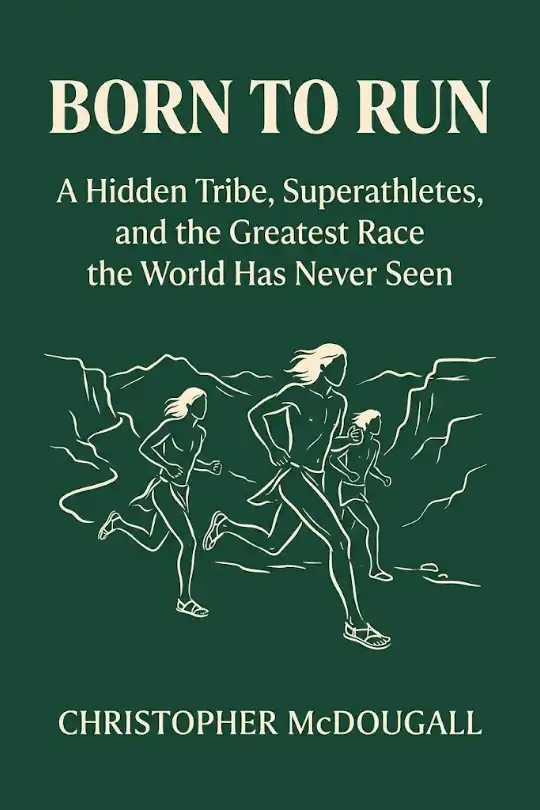
But two years later, while on assignment in Mexico, McDougall stumbled across an article that stopped him cold. Deep in the Copper Canyons of northwestern Mexico lived a tribe called the Tarahumara—or as they called themselves, the Rarámuri. These people were legendary runners. They ran distances that seemed impossible: fifty miles, a hundred miles, sometimes two hundred miles in a single outing. They ran through the night, over rock strewn trails and up thousand foot climbs. They ran into their old age, grandfathers and grandmothers gliding through the canyons like they owned the place.
And here was the part that made McDougall's jaw drop: they did it all without getting hurt. No shin splints. No plantar fasciitis. No runner's knee. No stress fractures. Zero. Nothing.
McDougall's article suddenly felt boring compared to the story he was reading. Here was a tribe that had "solved nearly every problem known to man," as he would later write. Crime didn't exist in Tarahumara territory. Obesity, high blood pressure,
In 2001, Christopher McDougall walked into a doctor's office with a hurting foot. He'd been a runner for five years, and the pain had become unbearable. The diagnosis hit him like a wall: he had a common running injury, one that would keep getting worse as long as he kept running. The sports medicine specialist gave him two options—quit running entirely, or get regular cortisone shots and invest in expensive orthotics.
McDougall didn't accept that. So he saw a second doctor. Same answer. Then a third. Same answer.
The medical consensus was clear: if you run, you get hurt. Up to eight out of every ten runners suffer some injury each year. It doesn't matter if you're fast or slow, heavy or thin, a marathon champion or a weekend jogger. The injuries come for everyone.
But two years later, while on assignment in Mexico, McDougall stumbled across an article that stopped him cold. Deep in the Copper Canyons of northwestern Mexico lived a tribe called the Tarahumara—or as they called themselves, the Rarámuri. These people were legendary runners. They ran distances that seemed impossible: fifty miles, a hundred miles, sometimes two hundred miles in a single outing. They ran through the night, over rock-strewn trails and up thousand-foot climbs. They ran into their old age, grandfathers and grandmothers gliding through the canyons like they owned the place.
And here was the part that made McDougall's jaw drop: they did it all without getting hurt. No shin splints. No plantar fasciitis. No runner's knee. No stress fractures. Zero. Nothing.
McDougall's article suddenly felt boring compared to the story he was reading. Here was a tribe that had "solved nearly every problem known to man," as he would later write. Crime didn't exist in Tarahumara territory. Obesity, high blood pressure, diabetes, heart disease—none of these plagued them. They were described as the healthiest and most serene people on earth.
And they ran. God, how they ran. They ran on unthinkable terrain in shoes that barely qualified as shoes—thin sandals cut from old tires or worn strips of leather. They ate very little protein. They didn't stretch. They didn't follow training programs. They just ran, and they never stopped, and they never got hurt.
The question burned in McDougall's mind: shouldn't we—the ones with state-of-the-art running shoes and custom-made orthotics and sports medicine specialists—have the zero casualty rate? Shouldn't the Tarahumara, who run way more on way rockier terrain in way worse footwear, be constantly banged up?
Instead, it was the exact opposite.
So McDougall set out to find the answer. He was a journalist, a former war correspondent who'd ridden Class IV rapids on a boogie board and mountain biked across the North Dakota Badlands. He knew how to chase a story into dangerous places. And the Copper Canyons were about as dangerous as they came—a vast network of gorges deeper than the Grand Canyon, home to drug cartels that had made it the deadliest region in Mexico for journalists.
But first, he needed to find one man. A mysterious American known only as Caballo Blanco—the White Horse. He was a ghost of a runner who had trekked into the canyons years earlier to live among the Tarahumara. Locals said he was the only outsider who truly understood them. If anyone could translate the ancient secrets of the Tarahumara, it was him.
The book that emerged from McDougall's journey weaves together three threads: the culture and traditions of the Tarahumara, the evolution of distance running, and the science of what makes humans capable of running. It's part adventure story, part investigative journalism, and part scientific detective work. The narrative builds toward an underground ultramarathon in the heart of the Copper Canyons, where the world's greatest hidden runners would finally face America's best ultrarunners.
But before that race, before the discovery of why humans were born to run, there was just McDougall's aching foot and the maddening contradiction: a tribe of people who ran farther and harder than anyone on earth, and never got hurt. How was that possible? And more importantly, what could the rest of us learn from them?
How could a people who live in caves, eat corn gruel, and wear sandals made from recycled tires have figured out something that the entire multi-billion-dollar running shoe industry had missed?
About the Book
A journalist plagued by chronic running injuries journeys into Mexico's deadly Copper Canyons to uncover the secrets of the Tarahumara, a tribe that runs hundreds of miles without getting hurt. Part adventure story, part scientific detective work, this book reveals why humans were born to run—and how modern shoes and culture broke what evolution perfected.
Key Takeaways
The body remembers what civilization forgets
Human anatomy is perfectly adapted for endurance running, with features like the nuchal ligament and Achilles tendon designed for persistence hunting. Modern running shoes and cushioned strides have deconditioned our natural biomechanics, making us more injury-prone than the Tarahumara who run barefoot or in tire sandals.
Joy is the ultimate performance enhancer
The Tarahumara run with glee and determination simultaneously, laughing at mile sixty of a hundred-mile race. This joyful presence prevents burnout and injury, proving that love for the activity itself—not external rewards—unlocks human potential.
True connection requires surrender, not extraction
When outsiders like Rick Fisher treated the Tarahumara as resources to be mined for their running talent, the result was failure and exploitation. Caballo Blanco succeeded only by living among them, sharing their food and customs, and embracing korima—the principle of giving without expectation.
Poverty is not a performance advantage
Romanticizing the Tarahumara's barefoot running as a superior technique erases the economic reality that they run without shoes because they cannot afford them. True respect means seeing their full humanity, not reducing them to exotic superathletes.
Competition can become communion across cultures
The Copper Canyon race transformed enemies into friends—Tarahumara helping Americans cross rivers, Mexicans treating indigenous runners as champions. When competition is rooted in mutual respect rather than conquest, it becomes a bridge between worlds.
The curse of Ali haunts every great athlete
No matter what you achieve, the question lingers: could you have beaten the ones who never left their canyons? This existential doubt drives champions like Scott Jurek to seek out hidden rivals, revealing that greatness is never fully satisfied.
Silence is a language that must be learned
McDougall's cultural blunders—walking directly to Arnulfo's hut, asking direct questions—taught him that the Tarahumara communicate through patience and presence. Information cannot be demanded; it must be offered when trust is earned.
We were born to run—but only if we let ourselves
The human body evolved over millions of years for endurance running, yet modern culture has conditioned us to fear movement. The Tarahumara secret is not a technique but a permission slip: running is our birthright, waiting to be remembered.
Who Should Listen?
Runners of any level who have suffered from shin splints, runner's knee, plantar fasciitis, or other recurring injuries and want a science-backed alternative to modern running shoes and orthotics.
Armchair adventurers who love immersive travel narratives about remote cultures, dangerous journeys, and the eccentric characters who inhabit the fringes of the endurance sports world.
Health and fitness enthusiasts curious about the evolutionary biology of human movement, particularly why our bodies are designed for endurance running and how modern lifestyles have undermined that design.
Coaches, physical therapists, and sports medicine professionals looking for a deeper understanding of why injury rates remain high despite advances in footwear and training technology.