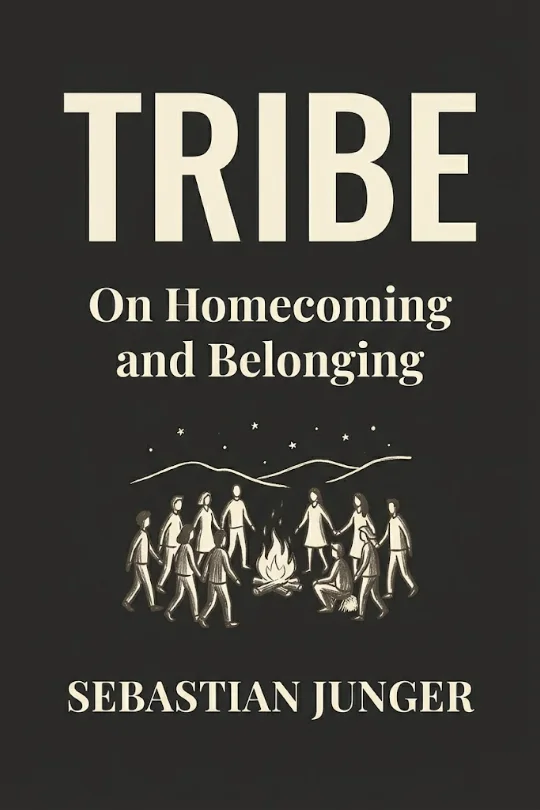
Tribe
On Homecoming and Belonging
Book Summary
Narrator: Ethan
Timeline
Summary Preview
Sebastian Junger was twenty two years old, broke, and hitchhiking across Wyoming. He stood on the side of a highway outside Gillette, thumb out, hoping someone would stop. Instead, a man walked toward him.
The man was a coal miner who had lost his job. He was homeless. He had almost nothing. But he had walked a mile out of his way to find Junger. In his hands, he carried a lunch box. He handed it over. Inside was a sandwich, chips, and an apple.
Junger never forgot that moment. Thirty years later, he wrote a book trying to understand it. The question at the heart of Tribe: On Homecoming and Belonging is simple: Why did that man—who had so little to spare—feel compelled to share his last meal with a stranger? And why does that kind of generosity feel so rare in modern life?
The book's argument cuts against almost everything we assume about progress. Modern society has given us unprecedented wealth, safety, and comfort. We live longer, suffer less disease, and enjoy more material abundance than any humans in history. And yet, by nearly every measure of psychological well being, we are worse off. Depression rates in wealthy countries run eight times higher than in poor ones. Suicide claims up to 25 people per 100,000 in modern nations, while many indigenous tribes experienced none at all. The more assimilated a person becomes into American society, the more likely they are to develop depression—regardless of their ethnicity.
Junger's central claim is that we have traded something essential for our affluence. Human beings evolved over hundreds of thousands of years living in small, tight knit groups where survival depended on mutual reliance. The tribe was not a luxury; it was the only way to stay alive. That ancient wiring still
Sebastian Junger was twenty-two years old, broke, and hitchhiking across Wyoming. He stood on the side of a highway outside Gillette, thumb out, hoping someone would stop. Instead, a man walked toward him.
The man was a coal miner who had lost his job. He was homeless. He had almost nothing. But he had walked a mile out of his way to find Junger. In his hands, he carried a lunch box. He handed it over. Inside was a sandwich, chips, and an apple.
Junger never forgot that moment. Thirty years later, he wrote a book trying to understand it. The question at the heart of Tribe: On Homecoming and Belonging is simple: Why did that man—who had so little to spare—feel compelled to share his last meal with a stranger? And why does that kind of generosity feel so rare in modern life?
The book's argument cuts against almost everything we assume about progress. Modern society has given us unprecedented wealth, safety, and comfort. We live longer, suffer less disease, and enjoy more material abundance than any humans in history. And yet, by nearly every measure of psychological well-being, we are worse off. Depression rates in wealthy countries run eight times higher than in poor ones. Suicide claims up to 25 people per 100,000 in modern nations, while many indigenous tribes experienced none at all. The more assimilated a person becomes into American society, the more likely they are to develop depression—regardless of their ethnicity.
Junger's central claim is that we have traded something essential for our affluence. Human beings evolved over hundreds of thousands of years living in small, tight-knit groups where survival depended on mutual reliance. The tribe was not a luxury; it was the only way to stay alive. That ancient wiring still runs through us. But modern society has ripped out the circuits that connected us to each other.
The homeless miner in Wyoming embodied what Junger calls the "tribal ethos." He had nothing, but he still understood that his well-being was tied to the well-being of others. He refused to be dead inside, even when his circumstances gave him every reason to be.
Junger builds his case across four chapters, drawing from anthropology, history, military science, and his own experience as a war journalist. He starts with a historical puzzle that baffled early American colonists: Why did white captives taken by Native Americans so often refuse to return to colonial society? The French émigré Hector de Crèvecoeur wrote in 1782, "Thousands of Europeans are Indians, and we have no examples of even one of those Aborigines having from choice become European." The reverse—Indians choosing white society—was virtually unheard of. Tribal life offered something that civilization could not match: equality, freedom, and deep human connection.
From there, Junger moves through the paradoxes of war. Combat is horrific. But it also creates bonds of solidarity that many people find more satisfying than anything in peacetime life. During the London Blitz, psychiatric hospital admissions actually dropped. Long-term patients saw their symptoms subside. Communities devastated by disaster didn't collapse into chaos—they became more just, more egalitarian, more fair.
The most provocative argument comes in the book's third section. Junger argues that post-traumatic stress disorder is not primarily a disorder of war, but a disorder of recovery. The real damage happens when soldiers return home to a society that is isolating, individualistic, and indifferent. He points to Israel, where PTSD rates among soldiers are as low as one percent, despite decades of war. The difference is "shared public meaning"—a society that understands and honors the sacrifice its soldiers have made.
By the final chapter, Junger turns his critique on America itself. The United States is so powerful that the only country capable of destroying it is itself. Rampage shootings happen only in affluent, mostly white, low-crime communities. Wall Street bankers who caused the 2008 financial collapse faced no condemnation, while a soldier who deserted his unit was publicly pilloried. The hypocrisy, Junger says, is destroying the possibility of tribal loyalty.
The book ends where it began: with the homeless miner and his lunch box. Junger finally found his answer after thirty years. The man gave him that food because he refused to be dead inside. It was the one thing he absolutely would not surrender, even when he had lost everything else.
What does it say about us that a homeless man had to teach a journalist what tribe really means? And what would it take to build a society where that kind of generosity is not the exception, but the rule?
About the Book
In Tribe, Sebastian Junger argues that modern affluence has severed the ancient bonds of community and belonging that once defined us. Drawing on history, anthropology, and his own war reporting, he reveals how crisis and disaster paradoxically create the deep connection we crave—and why our isolation may be more dangerous than any external threat.
Key Takeaways
We traded community for comfort, and it is breaking us.
Modern society has given us unprecedented wealth and safety, but by nearly every measure of psychological well-being—depression, suicide, anxiety—we are worse off than our tribal ancestors, who worked far less and lived in deep, mutual reliance.
The tribe within us craves belonging more than safety.
Colonial captives who experienced both worlds consistently chose Native American tribal life over 'civilization' because it offered equality, autonomy, and profound human connection—proving that material comfort is a poor trade for freedom and community.
Crisis reveals our deepest need: to matter to others.
During the London Blitz and other disasters, mental health improved, suicide rates dropped, and communities became more egalitarian and just, because existential threat forces people back into the ancient, organic bonds of mutual care that modern life has stripped away.
PTSD is a disorder of homecoming, not of war.
The real damage to soldiers happens not on the battlefield but when they return to an isolating, individualistic society that offers no shared meaning for their sacrifice, leaving them grieving not trauma but the loss of tribal connection.
Young men need a tribe to initiate them into manhood.
Without clear, respected rites of passage that test courage and grant belonging, young men invent dangerous substitutes—reckless driving, gangs, hazing—because the drive to prove oneself worthy of the group is a fundamental human need that modern society has abandoned.
True courage is gendered not by sex, but by function.
In crisis, people spontaneously split into complementary roles—action-oriented leadership and morale-maintaining empathy—and the sexes are interchangeable in performing them, revealing that group survival depends on both direct confrontation and the moral solidarity that refuses to let anyone be left behind.
A nation that loses its external enemy turns its warrior skills inward.
America's selective outrage—condemning a deserter while excusing bankers who crashed the economy—shows that without a unifying threat, the tribe's aggression turns inward, producing political division, rampage shootings, and a society that is destroying itself from within.
The tribe is built one act of refused isolation at a time.
The homeless miner who gave his last meal to a stranger embodied the tribal ethos: the choice to remain connected, to share what little you have, to refuse to be dead inside—proving that belonging is not found but created through daily, substantive sacrifices for the people around us.
Who Should Listen?
Veterans or active-duty military struggling with reentry into civilian life and seeking to understand why homecoming feels harder than combat.
Mental health professionals and social workers looking for a fresh, evidence-based perspective on the root causes of PTSD, depression, and suicide.
Parents of adolescent boys who want to understand why their sons are drawn to risk, hazing, or violence, and what society can offer instead.
Urban professionals who feel isolated despite material success and wonder why their lives feel empty even when they have everything they need.