Book Summary
Narrator: Ethan
Timeline
Summary Preview
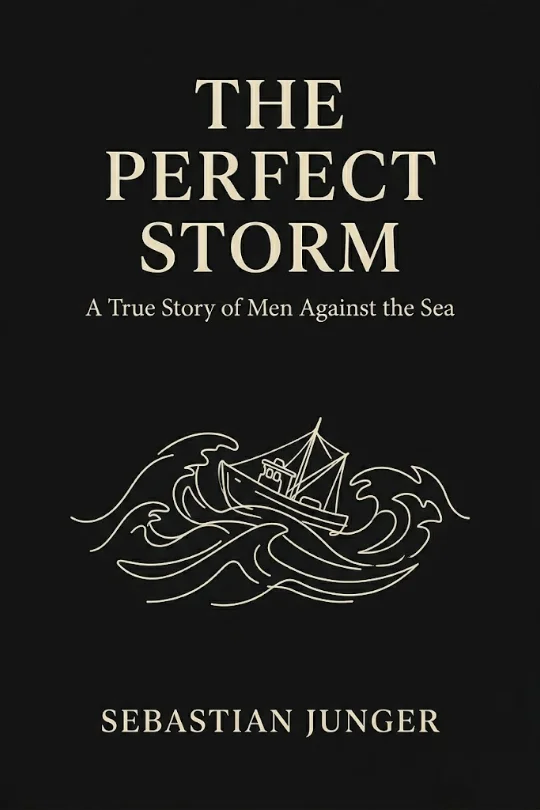
In late September 1991, a seventy two foot swordfishing boat called the Andrea Gail left the port of Gloucester, Massachusetts. Six men were on board. They expected to be gone for a month. They never came back.
The boat was built for one thing: finding swordfish in the North Atlantic and bringing them home. It had a steel hull, a refrigerated hold, and a wheelhouse perched above the deck where the captain could see the horizon. It was a working boat, not a fancy one. The Andrea Gail had been modified over the years, stretched and reinforced, made to handle the punishing conditions of the Grand Banks. But no amount of modification could prepare it for what was coming.
The captain was Billy Tyne. He was forty one years old, a seasoned fisherman who had made this run dozens of times. He knew the rhythms of the ocean, the way the weather could turn, the risks of pushing too far into the season. But October was still good fishing. The swordfish were out there, and the crew needed to make money. That's why men went to sea in Gloucester—not because they loved the ocean, but because they needed the cash.
On board with Tyne were five other men: Robert "Bobby" Shatford, a young man trying to pay off debts and start a new life; David "Sully" Sullivan, quiet and reliable; Michael "Bugsy" Moran, who had a reputation for drinking hard; Dale "Murph" Murphy, a seasoned hand; and Alfred Pierre, who had come up from Boston looking for work. They were not heroes. They were not adventurers. They were fishermen, doing a dangerous job for money.
The trip started normally. The Andrea Gail steamed east toward the Grand Banks, a stretch of ocean off the coast of Newfoundland where the water
In late September 1991, a seventy-two-foot swordfishing boat called the Andrea Gail left the port of Gloucester, Massachusetts. Six men were on board. They expected to be gone for a month. They never came back.
The boat was built for one thing: finding swordfish in the North Atlantic and bringing them home. It had a steel hull, a refrigerated hold, and a wheelhouse perched above the deck where the captain could see the horizon. It was a working boat, not a fancy one. The Andrea Gail had been modified over the years, stretched and reinforced, made to handle the punishing conditions of the Grand Banks. But no amount of modification could prepare it for what was coming.
The captain was Billy Tyne. He was forty-one years old, a seasoned fisherman who had made this run dozens of times. He knew the rhythms of the ocean, the way the weather could turn, the risks of pushing too far into the season. But October was still good fishing. The swordfish were out there, and the crew needed to make money. That's why men went to sea in Gloucester—not because they loved the ocean, but because they needed the cash.
On board with Tyne were five other men: Robert "Bobby" Shatford, a young man trying to pay off debts and start a new life; David "Sully" Sullivan, quiet and reliable; Michael "Bugsy" Moran, who had a reputation for drinking hard; Dale "Murph" Murphy, a seasoned hand; and Alfred Pierre, who had come up from Boston looking for work. They were not heroes. They were not adventurers. They were fishermen, doing a dangerous job for money.
The trip started normally. The Andrea Gail steamed east toward the Grand Banks, a stretch of ocean off the coast of Newfoundland where the water is shallow and the fish are plentiful. The crew set their longlines, baited hooks, and hauled in swordfish day after day. The work was brutal—shifts that lasted eighteen hours, hands cut by hooks and line, sleep stolen in short bursts. But the fishing was decent. They were making money.
Then the weather began to change.
In late October, a series of weather systems started to converge over the North Atlantic. A hurricane called Grace was spinning north from the tropics. A cold front was dropping down from Canada. A low-pressure system was brewing over the Great Lakes. These three systems were on a collision course, and they were heading straight for the fishing grounds where the Andrea Gail was working.
Meteorologists would later call this a "perfect storm"—not perfect in the sense of good, but perfect in the sense that the conditions could not possibly have been worse. It was a freakish alignment of variables, the kind of thing that happens once in a century.
On October 28, Billy Tyne began to understand what was coming. He had been in rough weather before. Every fisherman had. But this was different. The barometer was dropping fast. The wind was building. The waves were growing.
He radioed the other boats in the fleet. His voice came through the static, clear and steady. "She's coming on boys, and she's coming on strong."
Those were the last words anyone heard from the Andrea Gail.
The other captains in the fleet heard Tyne's warning. They knew what it meant. A man like Billy Tyne didn't send a message like that unless he was in serious trouble. The other boats started running for shelter. They battened down, turned their bows into the wind, and prayed they would make it through the night.
The Andrea Gail did the same. But the storm was bigger than anyone had anticipated. The waves rose to heights that few people on earth had ever seen. The wind screamed at over a hundred miles an hour. The sea became a chaos of white water and foam, a world where nothing was solid and everything was moving.
For the next several days, the Andrea Gail was out there, somewhere in the North Atlantic, fighting for survival. We know what happened to the other boats. The Mary T., commanded by Captain Albert Johnston, survived the storm. The Allison, under Tommy Barrie, made it through. Even the Contship Holland, a container ship ten times the size of the Andrea Gail, was battered and nearly lost. But the Gail never came home.
The search began on November 1, when the boat was reported overdue. Fifteen aircraft flew grid patterns over the ocean, looking for any sign of the vessel or its crew. They found some deck gear—a fuel barrel, a piece of the hull, an EPIRB that had never been activated. But no survivors. No bodies. Just the cold, empty sea.
On November 8, the search was suspended. The Andrea Gail and its six crew members were declared lost.
But the question remained: what actually happened? How does a seventy-two-foot steel boat vanish without a trace? What were the last moments like for Billy Tyne and his crew? Was there a rogue wave that flipped them end over end? Did the boat founder under the weight of successive waves? Did the crew know what was happening, or did it happen too fast for them to understand?
These are the questions that Sebastian Junger set out to answer in his book The Perfect Storm. He interviewed survivors from other boats. He studied the meteorological data from the storm. He reconstructed the final days of the Andrea Gail as best he could, piecing together what must have happened from the fragments of evidence that remained.
But the ocean keeps its secrets. The Andrea Gail is still out there, somewhere on the bottom of the North Atlantic, a steel tomb for six men who went to sea and never came home.
What happened in those final hours? How do you fight a storm that has no mercy, a sea that has no memory, a wind that has no end?
About the Book
In October 1991, the swordfishing boat Andrea Gail and its six crew members sailed into the North Atlantic—and never returned. Sebastian Junger reconstructs their final days, weaving together the science of a once-in-a-century storm, the dangerous lives of Gloucester fishermen, and the heroic rescues that unfolded. A gripping, tragic elegy for men lost to the sea.
Key Takeaways
The sea does not discriminate; it rewards neither skill nor courage.
The Perfect Storm shows that the ocean is indifferent to human effort—experienced captains like Billy Tyne and elite rescuers like John Spillane were equally vulnerable, reminding us that nature's power transcends human merit and preparation.
Men go to sea not for romance, but for survival on land.
The fishermen of Gloucester are driven by debt, alimony, and the need for quick money, not by a love of the ocean—their sacrifice reveals how economic desperation often forces people into mortal danger.
A perfect alignment of forces can turn the ordinary into the catastrophic.
Three separate weather systems converging into a 'perfect storm' illustrates how ordinary risks, when aligned, can create conditions beyond any human design—a metaphor for how small failures in life can compound into tragedy.
The deepest tragedy is not death, but disappearance without witness.
The Andrea Gail's crew vanished without a final message, body, or explanation, leaving families in a limbo of endless hope and grief—showing that closure is a luxury, and that the unknown can be more painful than certainty.
Survival often depends on a single, fragile link in a chain of events.
The Satori crew survived because their mayday was heard, a cutter arrived, and a helicopter found them—while the Andrea Gail perished because a radio failed, an EPIRB was never activated, and no one knew they were in trouble, proving that life hangs on threads we rarely see.
The body's own reflexes can become instruments of death or salvation.
The laryngospasm that causes 'dry drowning' can kill or preserve a person, and John Spillane's broken body swam on pure instinct—revealing that our biology operates beyond conscious control, both betraying and saving us in extremis.
Heroism is not a choice but a reflex born of training and love.
Rescuers like John Spillane and the Coast Guard crew risked their lives not for glory but because their training and humanity demanded it—showing that true courage emerges not from calculation but from an ingrained commitment to others.
The sea is an eternal, unknowable grave that gives nothing back.
The empty raft of the Terri Lei and the vanished Andrea Gail remind us that the ocean offers no explanations, no bodies, no closure—only the cold truth that some stories end without resolution, and we must learn to live with that silence.
Who Should Listen?
Readers fascinated by true survival stories and maritime disasters, like *Into the Wild* or *The Endurance*.
Anyone who lives or works near the ocean and wants to understand the raw power of rogue waves and hurricanes.
History buffs interested in the gritty, dangerous lives of 1990s commercial fishermen and the communities they built.
Listeners who appreciate deep-dive journalism that blends science, human drama, and elegiac storytelling.