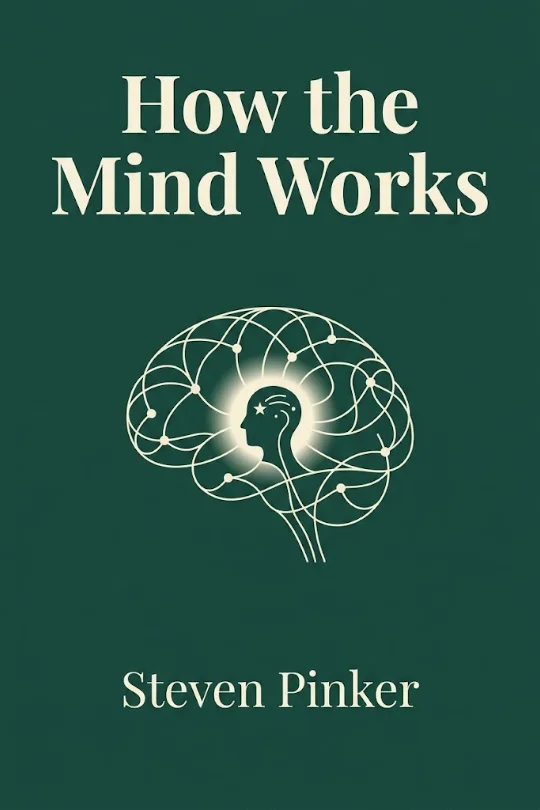
How the Mind Works
Book Summary
Narrator: Ethan
Summary Preview
Think about every robot you've ever seen in fiction. R2 D2 beeps and whirs through space stations. HAL 9000 speaks in a calm, menacing voice. The Terminator learns to crack jokes. These fictional machines walk, talk, see, reason, and even feel. They seem just a few upgrades away from being human.
Now look at real robots. They bump into walls. They can't tell a coffee mug from a cat. Ask one to pick up a toy, and it might crush it—or miss it entirely. The gap between fictional robots and real ones is enormous. And that gap, Steven Pinker argues in How the Mind Works , is our starting point. Because understanding why we can't build a robot that acts like a four year old is the first step toward understanding ourselves.
The problem isn't that engineers aren't clever enough. The problem is that we take our own minds for granted. Every time you walk into a room, your brain solves problems that supercomputers can't touch. It takes chaotic light hitting your retina and turns it into a stable, three dimensional world. It recognizes your grandmother's face even though she's standing in shadow, wearing a hat, and smiling in a way you've never seen before. It understands that when someone says "I'm feeling blue," they aren't talking about their skin color. These feats feel effortless. That's exactly why they're so deceptive.
Pinker, a cognitive scientist at MIT, spent years researching this book—and it shows. He pulls from computer science, anthropology, evolutionary biology, philosophy, and neuroscience. But his argument rests on two core ideas. The first is the computational theory of mind. This isn't the simple minded idea that the brain is like a desktop computer. It's deeper. The mind, Pinker argues, is a system that processes information using symbols. Beliefs,
Think about every robot you've ever seen in fiction. R2-D2 beeps and whirs through space stations. HAL 9000 speaks in a calm, menacing voice. The Terminator learns to crack jokes. These fictional machines walk, talk, see, reason, and even feel. They seem just a few upgrades away from being human.
Now look at real robots. They bump into walls. They can't tell a coffee mug from a cat. Ask one to pick up a toy, and it might crush it—or miss it entirely. The gap between fictional robots and real ones is enormous. And that gap, Steven Pinker argues in How the Mind Works, is our starting point. Because understanding why we can't build a robot that acts like a four-year-old is the first step toward understanding ourselves.
The problem isn't that engineers aren't clever enough. The problem is that we take our own minds for granted. Every time you walk into a room, your brain solves problems that supercomputers can't touch. It takes chaotic light hitting your retina and turns it into a stable, three-dimensional world. It recognizes your grandmother's face even though she's standing in shadow, wearing a hat, and smiling in a way you've never seen before. It understands that when someone says "I'm feeling blue," they aren't talking about their skin color. These feats feel effortless. That's exactly why they're so deceptive.
Pinker, a cognitive scientist at MIT, spent years researching this book—and it shows. He pulls from computer science, anthropology, evolutionary biology, philosophy, and neuroscience. But his argument rests on two core ideas. The first is the computational theory of mind. This isn't the simple-minded idea that the brain is like a desktop computer. It's deeper. The mind, Pinker argues, is a system that processes information using symbols. Beliefs, desires, memories—these aren't mystical vapors. They're patterns of activity. When you think "I want to go to Grandma's house," that thought is a set of symbols that connect logically to other symbols: the bus route, the street names, the turn you need to make. The brain manipulates these symbols the way a program manipulates data. Except the brain isn't running a single program. It's running millions, in parallel, on hardware that evolved over hundreds of millions of years.
That's where the second core idea comes in: natural selection. The human mind wasn't designed by an engineer. It was shaped by the slow, blind process of evolution. Every feature of your mental life—from your ability to see depth to your tendency to feel disgust at certain foods—exists because it helped your ancestors survive and reproduce. The brain is expensive. It's only two percent of your body weight, but it burns twenty percent of your energy. That kind of cost demands an explanation. Natural selection provides it. The brain, like the eye or the wing, is a product of adaptation.
Pinker structures the book to mirror how the mind itself works: starting with simple pieces and building toward complexity. He begins with the basic equipment—neurons, the building blocks. Then he shows how these simple yes/no units form networks capable of learning, pattern recognition, and even fuzzy logic. From there, he moves to vision, to reasoning, to emotions, to family dynamics, and finally to the highest human pursuits: art, music, humor, and philosophy. At each level, he asks the same question: What problem was this mental faculty designed to solve?
The book is not a dry textbook. Pinker writes with wit and a sharp edge. He takes aim at popular misconceptions—the idea that emotions are irrational, that the mind is a blank slate, that natural selection can't explain complex organs. He refutes the famous Chinese Room thought experiment, which claimed computers could never truly understand language. He explains why morning sickness might actually be an adaptation to protect developing fetuses from toxins. He argues that our taste for music may be a side effect of having a brain built for language and emotional calls.
But Pinker is also honest about the limits of his framework. The book ends by acknowledging two mysteries that resist explanation: consciousness and free will. Why does it feel like something to be you? Why do you experience the redness of a rose or the ache of a tooth? The computational theory can explain how the brain processes information, but it can't explain why that processing comes with a subjective experience. And free will—the sense that you could have chosen differently—remains as puzzling as ever. Pinker doesn't pretend to solve these riddles. He simply points out that they are the exceptions, not the rule. For most of what the mind does, we now have a powerful scientific framework.
That framework is what this book delivers. By the end, you'll see your own thoughts differently. You'll recognize the hidden machinery behind every joke, every glance, every moment of fear or love. And you'll understand why building a robot that can do what you just did—read these words, understand them, and feel something about them—is one of the hardest problems in all of science.
So here's the question that drives the entire book: If the mind is just a biological computer running programs shaped by natural selection, then why does it feel like so much more? And what does that feeling reveal about who we really are?
Who Should Listen?
A curious reader who has ever wondered why optical illusions work or why emotions sometimes override logic.
A psychology or neuroscience student seeking a clear, engaging synthesis of computational theory and evolutionary biology.
A software engineer or AI researcher fascinated by why human cognition remains so hard to replicate in machines.
A parent or educator who wants to understand the innate mental tools children are born with and how they shape learning.