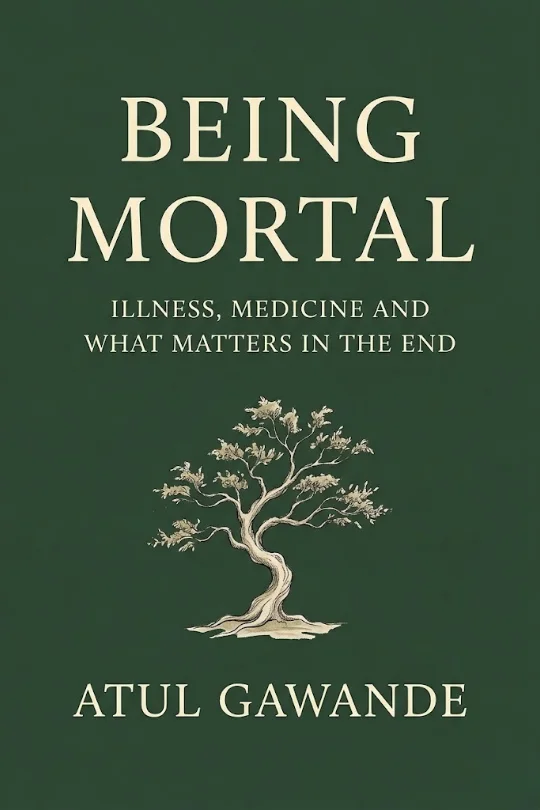
Being Mortal
Medicine and What Matters in the End
Book Summary
Narrator: Ethan
Timeline
Summary Preview
Atul Gawande spent years training to become a surgeon. He learned how to cut, how to stitch, how to diagnose, how to save lives. But there was one thing no one taught him. What to do when saving a life was no longer possible.
His medical education simply skipped over mortality. The subject never came up in lectures, never appeared on exams, never entered the conversation during rounds. Death was treated as a failure, an enemy to be fought, never accepted. The only time Gawande remembers confronting the reality of dying was in a Patient Doctor seminar designed to make physicians more humane. The assigned reading? Leo Tolstoy's novella, "The Death of Ivan Ilyich."
The story haunted him. Ivan Ilyich is a mid level judge who develops a mysterious pain in his side. As his condition worsens, his doctors insist he is merely ill, not dying. They send for more specialists, prescribe more treatments, offer more empty reassurances. Meanwhile, Ilyich suffers alone. His family avoids him. His colleagues pretend nothing is wrong. The only person who offers real comfort is a peasant servant named Gerasim, who simply sits with the dying man, holds his legs up to ease his pain, and does not lie to him.
Gawande realized something disturbing. More than a century after Tolstoy wrote that story, modern medicine was still failing dying patients in the same way. Doctors still avoided honest conversations. Families still clung to false hope. Patients still died in isolation, surrounded by machines rather than people.
The problem, Gawande came to see, was built into the very structure of medicine. The profession's central mission is to fight death, to prolong life at all costs. And that mission has produced extraordinary breakthroughs. Infections that once killed millions are now curable. Surgeries that once seemed impossible
Atul Gawande spent years training to become a surgeon. He learned how to cut, how to stitch, how to diagnose, how to save lives. But there was one thing no one taught him. What to do when saving a life was no longer possible.
His medical education simply skipped over mortality. The subject never came up in lectures, never appeared on exams, never entered the conversation during rounds. Death was treated as a failure, an enemy to be fought, never accepted. The only time Gawande remembers confronting the reality of dying was in a Patient-Doctor seminar designed to make physicians more humane. The assigned reading? Leo Tolstoy's novella, "The Death of Ivan Ilyich."
The story haunted him. Ivan Ilyich is a mid-level judge who develops a mysterious pain in his side. As his condition worsens, his doctors insist he is merely ill, not dying. They send for more specialists, prescribe more treatments, offer more empty reassurances. Meanwhile, Ilyich suffers alone. His family avoids him. His colleagues pretend nothing is wrong. The only person who offers real comfort is a peasant servant named Gerasim, who simply sits with the dying man, holds his legs up to ease his pain, and does not lie to him.
Gawande realized something disturbing. More than a century after Tolstoy wrote that story, modern medicine was still failing dying patients in the same way. Doctors still avoided honest conversations. Families still clung to false hope. Patients still died in isolation, surrounded by machines rather than people.
The problem, Gawande came to see, was built into the very structure of medicine. The profession's central mission is to fight death, to prolong life at all costs. And that mission has produced extraordinary breakthroughs. Infections that once killed millions are now curable. Surgeries that once seemed impossible are routine. But this same relentless drive to defeat death has created a terrible blind spot. When death becomes inevitable, modern medicine has no script. It offers more treatments, more procedures, more hospital stays, even when those interventions only cause suffering.
Gawande watched this happen with his own patients. He saw people spend their final weeks in intensive care units, hooked to ventilators, enduring painful surgeries that offered little chance of meaningful recovery. He saw families refuse to accept the inevitable, demanding every possible intervention, even as their loved ones grew weaker and more miserable. He saw doctors, himself included, avoid the hard conversations that might have helped patients die peacefully at home.
The result was a system that inflicted unnecessary suffering while denying dying patients the one thing they needed most: true compassion.
Being Mortal is Gawande's attempt to find a better way. It is a quest, part professional and part personal, to understand what it means to care for the dying, not just to treat the dying. The book draws on research, history, and the stories of patients and their families. It explores how we have lost the art of dying well, and how we might reclaim it.
But this is not a book about giving up. It is about asking a different question. Instead of "How can we keep you alive longer?" Gawande proposes we ask, "What matters to you most in the time you have left?"
That question forces a shift in perspective. It acknowledges that medicine's job is not simply to extend life, but to enable well-being. And sometimes, enabling well-being means accepting that death is near and helping patients spend their remaining days doing what they truly value.
Gawande's journey begins with a confession. He was not prepared for this work. His medical training taught him to be "Dr. Informative," to lay out options and let patients decide. But he learned that information alone is not enough. Patients need guidance. They need someone to help them think through what they fear, what they hope for, and what trade-offs they are willing to make.
The book follows his education in real time. He learns from geriatricians who focus on quality of life rather than heroic cures. He studies innovators who have redesigned nursing homes to restore autonomy and purpose to elderly residents. He watches patients who chose hospice and died peacefully, and he watches others who fought until the end and died in agony. He applies these lessons to his own family, facing the same difficult decisions with his father.
Throughout, Gawande returns to Tolstoy's dying judge. What Ilyich wanted, more than anything, was simple. He wanted someone to acknowledge his fear. He wanted companionship. He wanted to be treated as a person, not a problem to be solved. The servant Gerasim gave him that. But Ilyich's doctors and family could not.
Being Mortal asks whether we can do better. Whether modern medicine, with all its power, can learn to serve patients not just by fighting death, but by helping them live fully until the very end. Whether doctors can find the courage to have the conversations they have been trained to avoid. And whether we, as patients and families, can face mortality honestly enough to make those conversations possible.
Gawande's answer is both hopeful and urgent. But it requires a radical rethinking of what medicine is for. And that rethinking begins with a simple, terrifying question: What would you trade for more time?
About the Book
A surgeon confronts medicine's greatest failure: its inability to face mortality. Through gripping patient stories and his own father's final journey, Atul Gawande reveals how aggressive treatments often cause more suffering than they prevent. This is a radical rethinking of what it means to care for the dying—not by fighting death, but by asking what truly matters in the time we have left.
Key Takeaways
Medicine's True Purpose Is Well-Being, Not Mere Survival
The relentless medical drive to prolong life at all costs often inflicts unnecessary suffering, and the real goal of healthcare should be to enable patients to live fully and meaningfully, even as they approach death.
Safety Can Become a Prison That Crushes the Spirit
When we prioritize physical safety for our loved ones over their autonomy and dignity, we risk trapping them in sterile institutions where they lose all purpose and will to live, as seen in Alice Hobson's silent exit.
The Courage to Ask 'What Matters to You?' Transforms Care
Moving from 'Dr. Informative' to 'Dr. Guide'—asking patients about their fears, hopes, and what they value most—opens the door to end-of-life choices that honor their personhood rather than just treating their disease.
Hope Becomes a Trap When It Denies Reality
Unwillingness to accept the limits of medicine, driven by love and fear, can lead families to choose aggressive treatments that only prolong suffering, robbing patients of peaceful final days with those they love.
A Life Worth Living Requires Purpose, Companionship, and Freedom
Bill Thomas's Green House model proves that elderly and dying people thrive not through sterile safety protocols, but through meaningful relationships, pets, children, and the autonomy to make their own choices—even risky ones.
We Must Reclaim the Lost Art of Dying at Home
Modern medicine has moved death from the family home to sterile institutions, stripping away the rituals of companionship and leaving people to die alone; reclaiming a humane death means restoring connection and presence.
Being a Good Doctor or Son Means Letting Go of Your Own Agenda
Gawande learned that honoring his father's choice to prioritize quality of life over a longer, suffering-filled existence required him to set aside his own desire for his father to fight, and instead trust his father's wisdom.
The Smallest Interventions—Listening, Companionship—Are Often the Most Powerful Medicine
Geriatricians like Dr. Bludau show that humble acts like referring a patient to a podiatrist or ensuring they have company for meals can preserve independence and life far more effectively than aggressive, invasive treatments.
Who Should Listen?
Adult children of aging parents who are struggling with whether to move them into a nursing home or assisted living facility.
Doctors and medical students who have never been trained to have honest conversations about death and end-of-life care.
Patients recently diagnosed with a terminal illness who feel pressured to pursue aggressive treatments they don't actually want.
Nursing home administrators and elder care professionals looking for evidence-based models that prioritize resident autonomy over institutional safety.