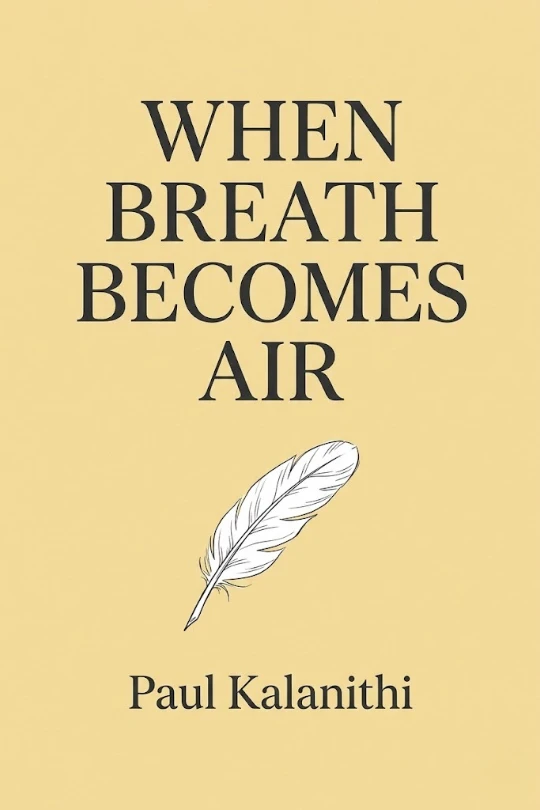
When Breath Becomes Air
Book Summaries
Hosts: Ethan
Timeline
Summary Preview
Paul Kalanithi sits in a hospital room with his wife, Lucy. She asks him if there's any chance his ailment isn't cancer. He looks at her and says no.
Six months earlier, Paul was thirty-six years old and climbing toward the peak of his profession. He was a neurosurgeon at Stanford, with just fifteen months left in his residency. One of his professors had told him he'd be the first candidate for a teaching position when one opened up. He had reached what he called the mountaintop, able to see the Promised Land stretching before him.
Then came the back pain. The weight loss. The chest pain that wouldn't go away. He searched his symptoms on his phone while lying in the park with Lucy, but when she asked what was wrong, he changed the subject. He kept his fears locked inside. The isolation pushed Lucy away, and they were on the brink of separation when the scans came back and confirmed what he already suspected.
Now here he is, in a room he's walked into countless times as a doctor, but this time as a patient. The reversal is complete. He has crossed from being the one who controls death to the one who faces it.
This is the opening scene of *When Breath Becomes Air*, a memoir that chronicles Paul Kalanithi's transformation from a brilliant neurosurgeon at the height of his powers to a terminal cancer patient grappling with the ultimate unknown. The book is a fusion of three identities: the scientist who understands the biological machinery of life, the man of letters who searches for meaning in literature and philosophy, and the patient who must confront his own mortality head-on.
The story that unfolds is not simply a medical case study or a philosophical meditation. It is a deeply personal account of what happens when the person who has spent years learning how to save lives must suddenly learn how to let go of his own. Paul writes with the precision of a surgeon and the lyricism of a poet, weaving together his experiences in the operating room, his love for books, and his struggle to find a new vocabulary for a life that has been radically shortened.
What makes this memoir unique is the dual perspective Paul brings to every page. He knows the statistics, the survival curves, the probabilities that other patients face. But knowing them as a doctor is entirely different from living them as a patient. He understands the anatomy of pain, the physiology of disease, the language patients use to describe suffering. Yet none of this prepares him for what it actually feels like to be the one lying in the bed, to be the object rather than the subject of every sentence of his life.
The book asks a question that cuts to the core of human existence: How do you find meaning when your life is cut short? Paul had spent his career helping patients and their families answer this question for themselves. Now he must answer it for himself, with the clock ticking and his body failing.
Lucy, who appears in this opening scene as a partner in shock and grief, becomes a central figure in the pages that follow. Their marriage, strained by Paul's silence before the diagnosis, is tested in new ways as they navigate treatment decisions, the possibility of having a child, and the slow unraveling of the future they had planned together.
The prologue ends with Paul and Lucy staring at the CT scan images, the evidence of what has invaded his body and derailed his life. Everything he has worked for—the years of training, the sleepless nights, the mastery of his craft—now stands in the shadow of a disease that does not care about his accomplishments.
But Paul does not write this book to inspire pity or to offer easy answers. He writes it to explore what it means to live fully when death is no longer a distant abstraction but a close companion. He writes it to find a language that can hold both the terror and the beauty of being human.
As the story moves from this hospital room back to his childhood in the Arizona desert, then forward through medical school, residency, and the operating room where he learned to hold life and death in his hands, one question lingers: What do you do when the future you imagined disappears, and all that's left is the present moment, fragile and fleeting?
About the Book
When Breath Becomes Air is Paul Kalanithi's unforgettable memoir of his transformation from a brilliant neurosurgeon at the peak of his career to a terminal cancer patient. With the precision of a scientist and the lyricism of a poet, he explores what makes life meaningful when the future is stripped away. This is a profound meditation on mortality, love, and the human spirit.
Key Takeaways
The body and soul are not separate; they are one unified whole.
Paul's journey from literature to neurosurgery was driven by the conviction that meaning cannot be understood from a distance—it must be felt in the flesh, in the operating room, in the ache of a dying body, because the physical and the spiritual are inextricably woven together.
To remain human, you must let the pain in, even when the armor feels safer.
The callousness that protects a surgeon from daily horror can become a prison; Paul learned that true resilience is not numbness but the courage to feel the full weight of loss, because the alternative is to lose the very humanity that makes healing possible.
The future you imagined is a phantom; the only real territory is the present moment.
When cancer erased the career he had spent a decade building, Paul discovered that clinging to a vanished future only magnified suffering—meaning is not found in the dream you once had, but in the fragile, fleeting now that remains.
Hope is not a probability; it is a decision to keep living despite the odds.
Statistics cannot cure the angst of mortality; Paul realized that hope is not a mathematical calculation but a deliberate choice to carry on living—to have a child, to write, to love—even when the numbers say the end is near.
Saying no to the dream job can be the most profound act of love.
Turning down the career he had chased his whole life was not surrender but clarity—Paul understood that the truest measure of success is not what you build, but whom you stay present for when the building stops.
You must learn to let yourself go, to become both the patient and the surgeon of your own life.
The hardest lesson for a healer is to stop being the expert and simply suffer; Paul found that surrendering control—allowing others to carry the weight—was not weakness but the beginning of a new, more honest way to be human.
A child is not a continuation of your life, but a blank page on which love writes itself forward.
Holding his daughter, Paul saw that his future was not an empty wasteland but a canvas—his joy was not about legacy or duration, but about the sated, restful happiness of knowing that love outlasts the breath that carries it.
Meaning is found not in the outcome, but in the striving itself.
Paul did not defeat cancer or finish his book or live to see his daughter grow—yet his life was not a failure; the value lay in the relentless act of showing up, of writing while dying, of loving while fading, of choosing to live fully until the very last breath.
Who Should Listen?
Medical professionals and students who grapple with the emotional weight of caring for dying patients and need a humanizing perspective.
Anyone facing a serious or terminal illness who is searching for a companion in their journey and a vocabulary for their experience.
Readers of literary memoirs who appreciate beautiful, philosophical writing about life's biggest questions from authors like Atul Gawande or Joan Didion.
People in high-pressure careers who are questioning their priorities and wondering what truly matters in the limited time we have.