Book Summary
Narrator: Ethan
Timeline
Summary Preview
In January 2008, Milwaukee was suffering through the coldest winter on record. The temperature had dropped to negative ten degrees. The snow piled high on the streets. It was the kind of cold that made people stay inside, that made children restless and stir crazy. And it was that restlessness that set off a chain of events sociologist Matthew Desmond would spend the next two years documenting.
Arleen Belle's teenage son, Jori, threw a snowball at a passing car. It was a kid's impulse, nothing more. But the driver stopped. He got out. He kicked in the door of their apartment. And that was it. The police came. The landlord got involved. Within days, Arleen, Jori, and her younger son Jafaris were evicted. They ended up at a homeless shelter called the Lodge, where they would stay for months.
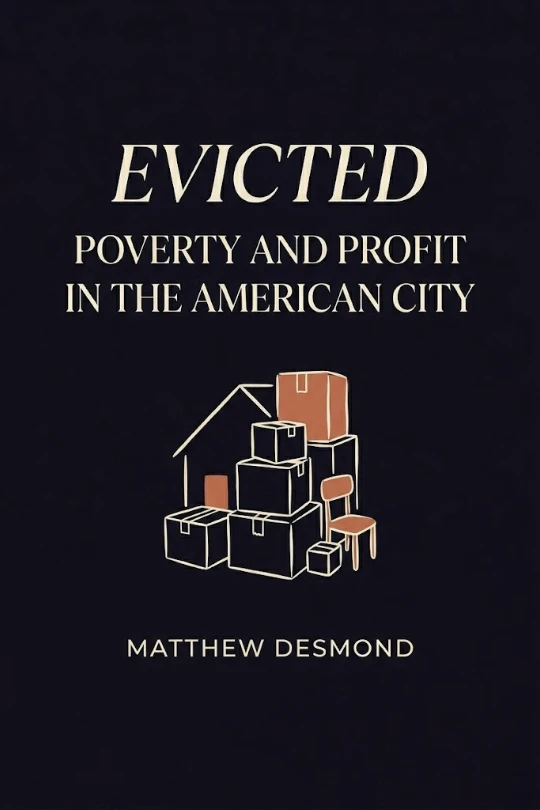
This is how Evicted: Poverty and Profit in the American City opens—not with a grand policy failure or a dramatic economic collapse, but with a snowball. A small, stupid, almost random act that triggers a cascade of misfortune. The book's central argument is right there in that opening scene: eviction is not just a consequence of poverty. It is a cause. It creates the very conditions it seems to reflect.
Desmond, a Princeton sociologist, spent 2008 and 2009 living in Milwaukee's poorest neighborhoods. He followed eight families—some Black, some white, some with children, some without—as they navigated a rental system designed to extract everything they had. He lived in a trailer park on the South Side, then moved to a rooming house on the North Side. He sat in eviction court. He rode along with moving crews. He recorded over five thousand pages of field notes.
What he found was a relationship: between poor tenants and wealthy landlords. The book focuses
In January 2008, Milwaukee was suffering through the coldest winter on record. The temperature had dropped to negative ten degrees. The snow piled high on the streets. It was the kind of cold that made people stay inside, that made children restless and stir-crazy. And it was that restlessness that set off a chain of events sociologist Matthew Desmond would spend the next two years documenting.
Arleen Belle's teenage son, Jori, threw a snowball at a passing car. It was a kid's impulse, nothing more. But the driver stopped. He got out. He kicked in the door of their apartment. And that was it. The police came. The landlord got involved. Within days, Arleen, Jori, and her younger son Jafaris were evicted. They ended up at a homeless shelter called the Lodge, where they would stay for months.
This is how Evicted: Poverty and Profit in the American City opens—not with a grand policy failure or a dramatic economic collapse, but with a snowball. A small, stupid, almost random act that triggers a cascade of misfortune. The book's central argument is right there in that opening scene: eviction is not just a consequence of poverty. It is a cause. It creates the very conditions it seems to reflect.
Desmond, a Princeton sociologist, spent 2008 and 2009 living in Milwaukee's poorest neighborhoods. He followed eight families—some Black, some white, some with children, some without—as they navigated a rental system designed to extract everything they had. He lived in a trailer park on the South Side, then moved to a rooming house on the North Side. He sat in eviction court. He rode along with moving crews. He recorded over five thousand pages of field notes.
What he found was a relationship: between poor tenants and wealthy landlords. The book focuses on two landlords in particular. Sherrena Tarver, a former elementary school teacher, owned thirty-six units on Milwaukee's predominantly Black North Side. She was worth roughly two million dollars and collected twenty thousand dollars in monthly rent. She felt genuine guilt about evicting people. She also believed her tenants were always trying to take advantage of her. Tobin Charney, seventy-one years old, owned a trailer park on the South Side. He made nearly half a million dollars a year from his 131 units. He had no illusions about his tenants. They were revenue streams. Nothing more.
The tenants were people like Lamar Richards, a double amputee who crawled around painting apartments to catch up on rent. People like the Hinkston family, eight people crammed into a duplex they called "The Rathole." People like Crystal Mayberry, an eighteen-year-old with an IQ of 70 and a diagnosis of bipolar disorder. And people like Arleen Belle, who just wanted a place to keep her sons safe.
The snowball incident that got Arleen evicted wasn't unusual. In the book's telling, eviction rarely comes from catastrophic events. It comes from small moments that spiral out of control. A missed appointment with a caseworker. A borrowed fifty dollars that can't be repaid. A child's tantrum at the wrong moment. Poor families operate with no margin for error. One mistake, and the whole structure collapses.
But Desmond argues this isn't individual failure. It's systemic. Wages have stagnated while rents have soared. The majority of poor renting families pay over fifty percent of their income for housing. One in four pays over seventy percent. During the time Desmond conducted his research—May 2008 to December 2009—sixteen thousand adults and children were evicted from Milwaukee each year. The city's total population was just over one hundred thousand.
Here's the statistic that haunted me: nearly all of the families Desmond followed had a landlord. Not a gang member, not a parole officer, not a pastor. A landlord. The relationship between tenant and landlord, Desmond argues, is the most important relationship in the creation of poverty. And we have failed to understand it.
Arleen Belle moved into a duplex owned by Sherrena Tarver for $550 a month—eighty-eight percent of her monthly welfare check. Sherrena brought them forty dollars worth of groceries when they moved in. Within weeks, Arleen was already behind on rent. She had borrowed money for her sister's funeral. She had missed an appointment with her caseworker. The cycle had already begun.
This is the world Evicted takes us into. A world where a snowball can cost you your home. Where landlords profit from dilapidation. Where the system punishes the poor for being poor. But Desmond doesn't just describe the problem. He follows the people living through it, day by day, month by month, through evictions and shelters and storage units and the endless, grinding search for a place to call home.
What happens to Arleen and her sons after that eviction? What happens to Lamar, to the Hinkstons, to Crystal? And what does their experience tell us about a country where one in five Black women will be evicted in their lifetime? These are the questions the book sets out to answer. But first, we have to understand the landlords—the people who profit from poverty, and the business model that keeps the poor perpetually behind.
About the Book
In Milwaukee, a snowball thrown by a child triggers an eviction, revealing a brutal truth: eviction is a cause of poverty, not just a symptom. Matthew Desmond follows eight families and two landlords through a system where profit is extracted from dilapidation, where calling 911 can get you evicted, and where home is a privilege the poor can never afford.
Key Takeaways
Poverty Is a Relationship, Not a Condition
Desmond reveals that poverty is not simply a state of lack but a dynamic relationship between those who have and those who have not, where landlords like Sherrena and Tobin actively profit from the desperation of their tenants, making the 'hood good' for the rich precisely because it is devastating for the poor.
The Margin for Error Is Zero for the Poor
A single snowball, a missed appointment, or a borrowed fifty dollars can trigger a cascade of irreversible misfortune, exposing how the poor operate without any buffer against life's small accidents, while the wealthy enjoy countless second chances.
The System Punishes Virtue and Rewards Extraction
Calling the police to stop domestic violence leads to eviction through nuisance ordinances, while landlords profit from dilapidated housing because maintaining properties costs more than evicting tenants, creating a machine that punishes the very acts of decency and self-protection.
Disposable Ties Replace True Community Under Duress
When poverty destroys family bonds and church support systems, the poor are left with fragile, unreliable relationships with strangers—disposable ties that offer temporary shelter but no real security, leaving people one argument away from homelessness.
Living in Color Is a Rational Response to Hopelessness
Larraine's lobster dinner on food stamps is not a sign of poor decision-making but a profound act of human dignity; when extreme frugality cannot lift you out of poverty, choosing small moments of beauty and pleasure becomes a rational, even heroic, assertion of self-worth.
The Home Is the Foundation of All Human Flourishing
Stable housing is not a luxury but the bedrock of identity, family, and civic life—without it, people cannot heal from addiction, children cannot thrive, and communities cannot form, making the right to a home more fundamental than the right to profit from another's suffering.
The Poor Judge Themselves More Harshly Than the Rich
Desmond observes that no one thinks the poor more undeserving than the poor themselves, as families and churches police each other's spending with a ferocity that mirrors conservative critiques, internalizing a shame that prevents collective action against systemic injustice.
One Success Story Exposes the Failure of the Whole System
Scott Bunker's redemption through subsidized housing proves that stability makes everything possible, but his singular success among dozens of failures reveals that the system is designed to produce suffering, not salvation—a few escape, but the machine keeps churning.
Who Should Listen?
Policy makers and urban planners who design housing and welfare systems that inadvertently trap families in cycles of poverty.
Social workers, case managers, and legal aid attorneys who work directly with low-income tenants facing eviction.
Landlords and property managers who want to understand the human cost behind their business decisions and the systemic pressures they face.
General readers interested in social justice, economic inequality, and the hidden mechanisms that keep millions of Americans from achieving stable housing.