Book Summary
Narrator: Ethan
Timeline
Summary Preview
The year is 1931. A three year old girl stands at the front of the Colored Methodist Episcopal Church in Stamps, Arkansas, wearing a dress her grandmother sewed for Easter Sunday. She's supposed to recite a poem. But she can't remember the lines. Instead, her mind drifts to the dress itself—a "plain ugly cut down from a white woman's once was purple throwaway." She had hoped the dress would transform her, make her look like "one of the sweet little white girls who were everybody's dream of what was right with the world." But it didn't. Standing there in that borrowed fabric, she feels every eye on her skinny legs. She believes that one day she will wake up from this "Black ugly dream" and appear as her true self—beautiful and blond. In her imagination, she was "really white," and some cruel fairy stepmother had turned her into a big Black girl.
Then the need to urinate becomes overwhelming. She jumbles the poem's words together, rushes out of the church, trips over someone's foot, and wets herself as she runs. The feeling of release is freedom itself, even though she knows punishment awaits.
This is how Maya Angelou opens I Know Why the Caged Bird Sings —not with triumph, but with humiliation. Not with belonging, but with a child wishing she were someone else entirely.
The memoir covers Maya's life from age three to sixteen, chronicling a journey that takes her from the segregated South to the wartime bustle of San Francisco. But the geography matters less than the internal terrain. At its core, this is a story about a girl trying to find herself in a world that tells her, in a thousand ways, that she doesn't belong.
The title comes from a poem by Paul Laurence Dunbar called
The year is 1931. A three-year-old girl stands at the front of the Colored Methodist Episcopal Church in Stamps, Arkansas, wearing a dress her grandmother sewed for Easter Sunday. She's supposed to recite a poem. But she can't remember the lines. Instead, her mind drifts to the dress itself—a "plain ugly cut-down from a white woman's once-was-purple throwaway." She had hoped the dress would transform her, make her look like "one of the sweet little white girls who were everybody's dream of what was right with the world." But it didn't. Standing there in that borrowed fabric, she feels every eye on her skinny legs. She believes that one day she will wake up from this "Black ugly dream" and appear as her true self—beautiful and blond. In her imagination, she was "really white," and some cruel fairy stepmother had turned her into a big Black girl.
Then the need to urinate becomes overwhelming. She jumbles the poem's words together, rushes out of the church, trips over someone's foot, and wets herself as she runs. The feeling of release is freedom itself, even though she knows punishment awaits.
This is how Maya Angelou opens I Know Why the Caged Bird Sings—not with triumph, but with humiliation. Not with belonging, but with a child wishing she were someone else entirely.
The memoir covers Maya's life from age three to sixteen, chronicling a journey that takes her from the segregated South to the wartime bustle of San Francisco. But the geography matters less than the internal terrain. At its core, this is a story about a girl trying to find herself in a world that tells her, in a thousand ways, that she doesn't belong.
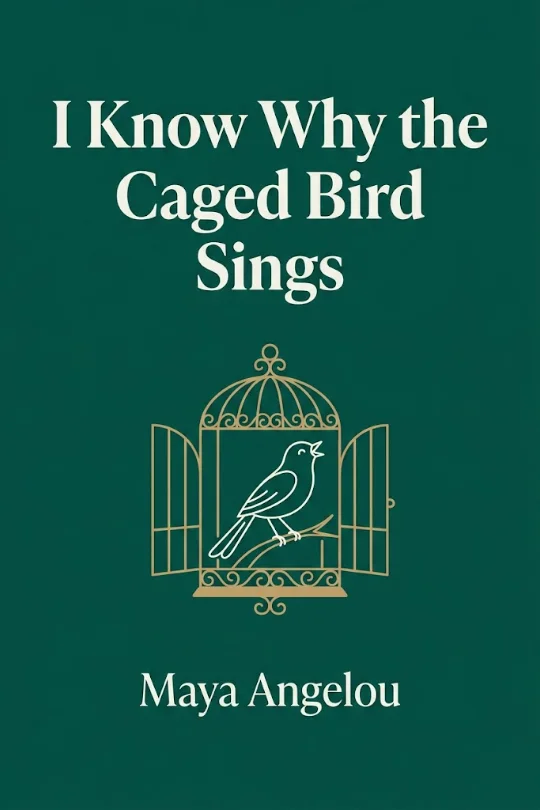
The title comes from a poem by Paul Laurence Dunbar called "Sympathy." In it, a caged bird beats its wings against the bars, singing not from joy but from longing. For Maya, the cage is made of many things: racism that limits her opportunities before she even understands what opportunity means; self-doubt that makes her wish for blue eyes and blond hair; the trauma of sexual violence that silences her for years; and the constant displacement of being shipped between relatives who love her but can't quite keep her.
The opening scene at the church establishes all of this in miniature. The homemade dress that doesn't transform her. The fantasy of whiteness as salvation. The physical humiliation that follows her failed performance. Even the poem she was supposed to recite—"What you looking at me for? I didn't come to stay..."—becomes a kind of accidental prophecy. She doesn't come to stay, not in Stamps, not in St. Louis, not anywhere she's sent. The question that haunts the entire memoir is whether she'll ever find a place where she can stay.
What makes the book remarkable is that Maya doesn't remain a victim of these circumstances. She observes, she remembers, and she eventually finds her voice. The caged bird doesn't just sing—she learns to sing her own song, not the one others expect from her.
The book follows Maya from Stamps to St. Louis and back again, then to California. In each location, she confronts different versions of the same problem: How do you become yourself when the world keeps trying to define you? In Stamps, her grandmother Momma Henderson runs a general store that serves as a refuge for the Black community. Momma is strict, religious, and practical—a woman who has learned to survive by keeping her head down and her dignity intact. She teaches Maya to avoid confrontation with white people, to speak of them with respect even when they don't deserve it. But Maya struggles with this strategy. She watches white girls mock her grandmother, call her by her first name, and do handstands that reveal they're not wearing underwear. Momma hums a hymn and refuses to react. Maya burns with rage.
In St. Louis, living with her glamorous mother Vivian, Maya experiences a different kind of wound. Her mother's boyfriend, Mr. Freeman, sexually abuses her and then rapes her. She is eight years old. She mistakes his initial touch for affection—she craves physical contact so desperately that she doesn't understand what's happening until it's too late. After the rape, Mr. Freeman is arrested, tried, and released. Then he is found dead, kicked to death behind a slaughterhouse. Maya believes her words killed him. She believes there is something evil in her that will escape and hurt people every time she opens her mouth. So she stops talking.
For almost a year, Maya speaks to no one except her brother Bailey. The silence is her cage.
It's Mrs. Bertha Flowers, an educated woman from Stamps, who throws Maya a lifeline. She invites Maya to her home, serves her lemonade and cookies, and reads aloud from A Tale of Two Cities. She tells Maya that words need a human voice to have "shades of deeper meaning." She gives Maya books and asks her to read them aloud at home. Slowly, Maya begins to speak again—first through the words of others, then through her own.
This moment reveals the book's deepest truth: language can wound, but it can also heal. The same words that Maya believed killed Mr. Freeman become the tools of her salvation.
The memoir moves through other defining moments: Maya's eighth-grade graduation, where a white politician delivers a speech that limits Black futures to "maids and farmers"; her mother's quiet revenge against a white dentist who refuses to treat Maya's toothache; her summer living in a junkyard with a community of homeless teenagers who accept her without question; her determination to become the first Black female streetcar conductor in San Francisco; and finally, her pregnancy at sixteen and the birth of her son.
Each of these episodes builds toward the same end: Maya learning to claim her own life. The girl who wanted to be white becomes a woman who can hold her Black baby and see "mysterious perfection." The child who was silenced by trauma becomes a storyteller.
But the book never pretends this transformation is easy or complete. Maya doesn't arrive at some final, stable identity. She keeps growing, keeps questioning, keeps pushing against the bars of her cage. The memoir ends not with a resolution but with a beginning—the birth of her son, which marks her passage from a displaced child to a mother who can provide the stability she never had.
The opening scene in the church, with its ruined dress and ruined poem and ruined dignity, sets up a question that the entire book works to answer: How does a Black girl in a racist society learn to love herself? The answer, Angelou suggests, is not through a single dramatic event but through a thousand small acts of resistance, connection, and creativity. It's found in the books that transport her beyond Stamps. In the grandmother who teaches dignity through silence. In the brother who loves her unconditionally. In the mentor who shows her the power of her own voice. In the city that welcomes her anonymity. And finally, in the child who needs her to be whole.
What does it take for a caged bird to finally believe she was meant to fly?
About the Book
Maya Angelou's classic memoir traces her childhood from a segregated Arkansas town to wartime San Francisco, surviving racism, abandonment, and sexual trauma. Through the love of her grandmother, the mentorship of Mrs. Flowers, and the birth of her son, she discovers that her voice—once silenced by guilt—is her greatest weapon. A story of resilience, dignity, and the power of language to heal.
Key Takeaways
Silence can be a cage, but words can become the key to freedom.
After her rape, Maya stops speaking for nearly a year, believing her words have lethal power; yet it is through Mrs. Flowers' gentle invitation to read aloud that she rediscovers language not as a weapon but as a tool for healing, connection, and self-reclamation.
True dignity is not in fighting every battle, but in refusing to let your oppressors define your worth.
When the 'powhitetrash' girls humiliate her grandmother, Momma Henderson stands still and hums a hymn, denying them the reaction they seek—a quiet victory that teaches Maya that the deepest resistance sometimes lies in unshakeable composure rather than visible rage.
The cage of racism is built not only from violence but from the daily erosion of hope.
Maya's eighth-grade graduation is shattered by a white politician who publicly limits Black futures to 'maids and farmers,' yet the community's spontaneous singing of the Negro National Anthem transforms despair into defiant pride, proving that no external narrative can own a people's spirit.
Trauma can make a child believe she is the problem; healing begins when someone sees her as whole.
After the rape, Maya internalizes guilt so deeply that she silences herself to protect others from her imagined evil, but Mrs. Flowers' unconditional respect and intellectual companionship offer a lifeline, showing that the path back to voice requires not fixing but witnessing.
Displacement can be a gift when it frees you from the weight of others' expectations.
In wartime San Francisco, Maya finds belonging not in stability but in collective displacement, discovering that the city's fog offers a 'soft breath of anonymity' that allows her to shed the fixed identity imposed by her past and become whoever she chooses to be.
The most profound transformations often come not from dramatic events but from small, consistent acts of love and resistance.
Maya's journey from a girl who wished to be white to a woman who holds her Black son in 'mysterious perfection' is built on countless quiet moments—a grandmother's hymn, a mentor's lemonade, a brother's unwavering loyalty—each one a bar bent in the cage of her life.
Motherhood can be the final act of self-creation: becoming the shelter you never had.
When Maya gives birth to her son, she transforms from a displaced child desperate for a nest into the one who can build a nest for another, discovering that the deepest healing comes not from being saved but from becoming the savior.
The caged bird sings not because it is free, but because it refuses to stop hoping.
Maya's memoir is not a story of triumph over circumstance but of persistent, imperfect becoming—a testament that the will to sing one's own song, even through humiliation, trauma, and rejection, is itself the most radical act of freedom.
Who Should Listen?
Readers who have experienced trauma or abuse and are seeking a story of survival and reclaiming one's voice.
Anyone interested in the lived experience of growing up Black in the Jim Crow South and the psychological toll of systemic racism.
Book club members looking for a powerful, layered memoir that sparks deep conversation about identity, family, and resilience.
Writers and storytellers who want to study how a masterful author transforms personal pain into universal, lyrical art.