Book Summary
Narrator: Ethan
Timeline
Summary Preview
It was July 2012 in Washington, DC. The summer had been unusually hot, even by the capital's standards. Flight 3935 touched down at Reagan National Airport and rolled toward the gate. Then it stopped. The plane had sunk into the tarmac. The asphalt had actually melted in the extreme heat, trapping the aircraft. A tow truck had to be brought in to drag it free.
That image stuck with Naomi Klein. A plane stuck in the melting runway because of heat caused by the profligate burning of fossil fuels. And the solution? Another fossil fuel burning vehicle to tow it out. It became, for her, a perfect metaphor for the moment we're living through. Faced with a crisis that threatens our survival, we keep doing the very thing that caused the crisis in the first place, only with more elbow grease.
The scientific consensus is clear. The World Bank, in a 2012 report, warned that humanity is on course for a 4 degree warmer world by the end of the century. A world marked by extreme heat waves, declining food stocks, and life threatening sea level rises. Island nations could drown. Major cities could be submerged. Climatologist Kevin Anderson from the Tyndall Centre for Climate Change Research has shown that wealthy countries need to cut emissions by 8 to 10 percent per year starting immediately. That kind of cut requires radical and immediate degrowth strategies.
But here's the thing: we have the technology to make these cuts. We have the plans. What we don't have is the political will.
And that's not an accident. It's not because people are too selfish to change, or because the problem is too complex for global cooperation. The obstacles are political and economic. The changes required to seriously address climate change directly conflict with
It was July 2012 in Washington, DC. The summer had been unusually hot, even by the capital's standards. Flight 3935 touched down at Reagan National Airport and rolled toward the gate. Then it stopped. The plane had sunk into the tarmac. The asphalt had actually melted in the extreme heat, trapping the aircraft. A tow truck had to be brought in to drag it free.
That image stuck with Naomi Klein. A plane stuck in the melting runway because of heat caused by the profligate burning of fossil fuels. And the solution? Another fossil-fuel-burning vehicle to tow it out. It became, for her, a perfect metaphor for the moment we're living through. Faced with a crisis that threatens our survival, we keep doing the very thing that caused the crisis in the first place, only with more elbow grease.
The scientific consensus is clear. The World Bank, in a 2012 report, warned that humanity is on course for a 4-degree warmer world by the end of the century. A world marked by extreme heat waves, declining food stocks, and life-threatening sea level rises. Island nations could drown. Major cities could be submerged. Climatologist Kevin Anderson from the Tyndall Centre for Climate Change Research has shown that wealthy countries need to cut emissions by 8 to 10 percent per year starting immediately. That kind of cut requires radical and immediate degrowth strategies.
But here's the thing: we have the technology to make these cuts. We have the plans. What we don't have is the political will.
And that's not an accident. It's not because people are too selfish to change, or because the problem is too complex for global cooperation. The obstacles are political and economic. The changes required to seriously address climate change directly conflict with the ideology of deregulated capitalism that has dominated the world since the 1980s.
Think about what meaningful climate action requires: regulation of industry, protection of fledgling green businesses from global competition, public investment in infrastructure, reduced consumption, higher taxes on the wealthy and on polluters, collective action on a global scale. Every single one of these measures clashes with the core principles of free-market fundamentalism. As Klein puts it, "our economic system and our planetary system are now at war."
This is why meaningful action has been blocked for decades. Not because the science is uncertain. Not because the technology doesn't exist. But because the required changes threaten the wealth and power of the elite who benefit from the status quo. The same elite who fund the climate denial movement. The same elite who have a stranglehold over our economy, politics, and media.
Klein argues we've run out of time for half measures. The door to keep global temperature rise below 2 degrees is closing. We've squandered the opportunity for gradual, evolutionary change. In the early 1990s, after the first UN climate convention, modest targets and paths were possible. But then globalization took hold. The free-market counterrevolution swept the world. And the chance for moderate solutions was lost.
What's required now is a radical transformation of economies and societies. A fundamental challenge to the logic of deregulated capitalism. A shift from an extractivist worldview that sees nature as a resource to be exploited, to a regenerative worldview based on cooperation and respect for the living systems that sustain us.
Klein doesn't pretend this will be easy. The forces arrayed against this transformation are powerful and deeply entrenched. But she also sees reason for hope. She sees it in the rise of a new kind of grassroots movement, one that is springing up wherever the fossil fuel industry tries to push into new frontiers. A movement of ordinary people, farmers, shop owners, Indigenous communities, who are simply saying "No." No to the pipeline. No to the fracking. No to new carbon frontiers.
This movement, which Klein calls "Blockadia," is still in its early stages. It's loose, decentralized, and often reactive. But it's growing. And it's connecting local struggles into a global front that is making the fossil fuel industry's expansion harder and more expensive.
The question Klein poses is this: Can this movement grow fast enough, and become powerful enough, to force the kind of fundamental change that's needed? Or will we continue, like Flight 3935, stuck in the melting tarmac, calling for a tow truck that runs on the very fuel that got us stuck in the first place?
About the Book
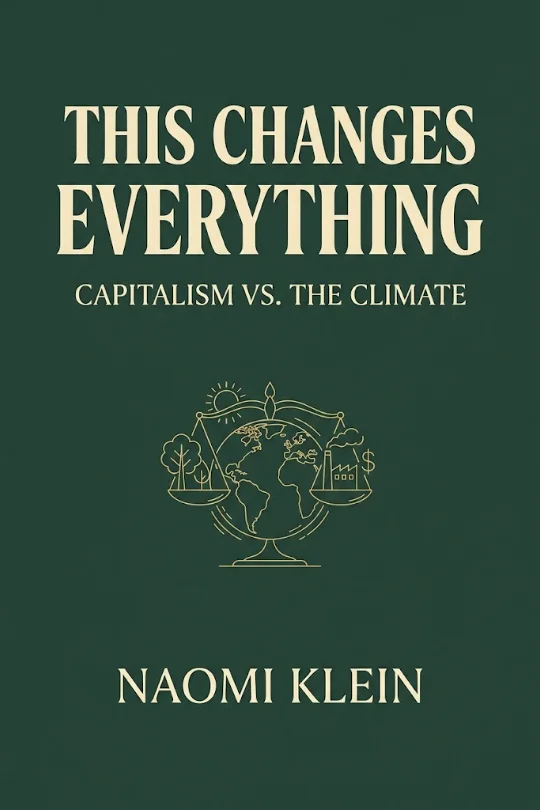
Naomi Klein argues that the climate crisis is not a technical problem but a fundamental conflict with free-market capitalism. She exposes how corporate greed, failed green alliances, and billionaire fantasies block real change—while grassroots movements like Blockadia offer the only true path to a regenerative, just future.
Key Takeaways
The Crisis We Face Is Not a Failure of Science but a War of Worldviews
The real obstacle to climate action is not scientific uncertainty or technological limits, but a deep ideological conflict between the logic of deregulated capitalism and the collective, regulatory measures required to save the planet. Accepting climate science threatens the core beliefs of free-market fundamentalism, making denial a rational defense of an entire way of life.
Our Economic System Treats the Planet as a Sacrifice Zone for Profit
International trade laws and market-based solutions have been systematically prioritized over climate action, creating a legal architecture that blocks green industrial policy while allowing fossil fuel expansion to continue. This extractivist mindset reduces living ecosystems to disposable resources, poisoning the very conditions that sustain life.
Billionaire Philanthropy and Corporate Partnerships Are a Dangerous Illusion
Voluntary action by the wealthy and alliances between big environmental groups and polluters have failed catastrophically, providing the illusion of progress while emissions soar. The fundamental conflict between profit and planetary health means that market-based approaches cannot deliver the radical transformation required.
Geoengineering Is the Ultimate Expression of Hubris, Not a Solution
Proposals to dim the sun or engineer the climate represent a dangerous gamble that perpetuates the same extractivist mindset that caused the crisis, risking catastrophic consequences for the world's most vulnerable people. These techno-fixes allow the powerful to avoid the hard work of systemic change while treating the entire planet as an experiment.
Ordinary People Defending Their Homes Are the Most Powerful Force for Change
The grassroots resistance movement called 'Blockadia'—composed of farmers, Indigenous communities, and local citizens simply saying 'No' to new fossil fuel projects—has proven remarkably effective at slowing industry expansion. Their power comes not from money or political access, but from a deep, rooted love for the places they call home.
The Climate Crisis Is a Fertility Crisis for Both People and the Planet
The same extractivist system that poisons water and destroys ecosystems also damages human reproductive health, creating a profound connection between personal and planetary infertility. True healing requires shifting from a relationship of dominance and taking to one of reciprocity, nurturing, and promoting more life.
Indigenous Rights and Wisdom Offer the Last Line of Defense and a Path Forward
Indigenous communities, armed with treaty rights and a worldview based on reciprocity with nature, are on the front lines of resistance and are building real alternatives like solar energy projects. Their ancient legal protections and regenerative philosophy provide both a powerful barrier to fossil fuel expansion and a model for a just, sustainable future.
We Must Make the Leap from Incremental Reform to a Civilization-Scale Transformation
History shows that major change comes in rapid bursts during moments of crisis, not through slow, polite negotiation. The climate movement has the opportunity to complete the unfinished work of liberation by uniting labor, civil rights, and environmental struggles into a single force powerful enough to overthrow the extractivist worldview and build a regenerative, just world.
Who Should Listen?
Environmental activists frustrated by decades of failed incrementalism and looking for a radical, systemic framework.
Policy makers and economists who want to understand how international trade laws and neoliberal ideology sabotage climate action.
Readers of political nonfiction who are curious about the intersection of climate science, capitalism, and social justice.
Indigenous rights advocates and community organizers seeking validation and strategies for frontline resistance against extractive industries.