Book Summary
Narrator: Ethan
Timeline
Summary Preview
When Timothy Egan set out to write about the death of small towns, he wasn't looking for the Dust Bowl. He was working on a different story when a researcher made an offhand remark that stopped him cold. Most people during the Dust Bowl era, the researcher said, actually stayed.
This simple fact contradicted everything Egan thought he knew. Like most Americans, his mental picture of the 1930s came from John Steinbeck's The Grapes of Wrath —the iconic novel of desperate families loading up jalopies and fleeing westward to California. But here was a different story entirely. The people Steinbeck wrote about were tenant farmers from eastern Oklahoma, near Arkansas, ruined by economic collapse. Nobody knew much about the people who stayed in the heart of the disaster, near the Oklahoma and Texas Panhandles. In 1930, two thirds of that population never left.
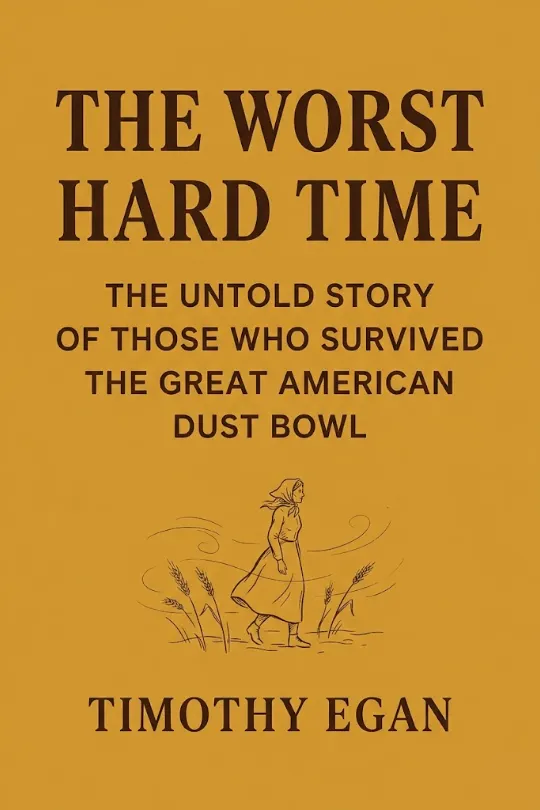
Egan became obsessed with these people—the ones who "hunkered down out of loyalty or stubbornness, who believed in tomorrow." The result was The Worst Hard Time , a National Book Award winner that tells the story of the Dust Bowl from the inside out, through the eyes of the people who refused to abandon their land.
The book's core argument is radical: the Dust Bowl was not a natural disaster. It was a man made catastrophe, caused by government policy, human greed, and the hubris of believing we could conquer the land rather than live with it.
Here's the paradox Egan starts with. The Great Plains had been described as a "promised land," a place where the government offered free land through the Homestead Acts, where railroad companies printed brochures promising wealth and prosperity, where real estate agents made claims like "rain follows the plow." And for a time, it worked. Farmers using new tractor technology tripled
When Timothy Egan set out to write about the death of small towns, he wasn't looking for the Dust Bowl. He was working on a different story when a researcher made an offhand remark that stopped him cold. Most people during the Dust Bowl era, the researcher said, actually stayed.
This simple fact contradicted everything Egan thought he knew. Like most Americans, his mental picture of the 1930s came from John Steinbeck's The Grapes of Wrath—the iconic novel of desperate families loading up jalopies and fleeing westward to California. But here was a different story entirely. The people Steinbeck wrote about were tenant farmers from eastern Oklahoma, near Arkansas, ruined by economic collapse. Nobody knew much about the people who stayed in the heart of the disaster, near the Oklahoma and Texas Panhandles. In 1930, two-thirds of that population never left.
Egan became obsessed with these people—the ones who "hunkered down out of loyalty or stubbornness, who believed in tomorrow." The result was The Worst Hard Time, a National Book Award winner that tells the story of the Dust Bowl from the inside out, through the eyes of the people who refused to abandon their land.
The book's core argument is radical: the Dust Bowl was not a natural disaster. It was a man-made catastrophe, caused by government policy, human greed, and the hubris of believing we could conquer the land rather than live with it.
Here's the paradox Egan starts with. The Great Plains had been described as a "promised land," a place where the government offered free land through the Homestead Acts, where railroad companies printed brochures promising wealth and prosperity, where real estate agents made claims like "rain follows the plow." And for a time, it worked. Farmers using new tractor technology tripled wheat production. Towns boomed. People built houses, bought pianos, sent their children to school.
Then it all turned to hell.
The same land that had been sold as paradise became a living nightmare. The topsoil, once held in place by deep-rooted buffalo grass, had been ripped up by plows. When the drought came, there was nothing to hold the earth down. The wind picked up millions of tons of loose dirt and hurled it across the plains in storms so thick they turned day into night. People died of "dust pneumonia," a new disease doctors had never seen before. Children suffocated in their own beds.
But Egan isn't interested in the famous exodus to California. He's interested in the stubborn ones who stayed. People like Bam White, a mixed-race cowboy who settled near Dalhart, Texas when his horse died and he couldn't go any further. People like Hazel Lucas Shaw, a young woman who forced herself to think positive thoughts even as the dust piled against her door. People like the German Russian immigrants who had fled persecution in the old world only to find themselves choking on American topsoil.
These were "last chancers," Egan calls them—people who had arrived with nothing, who had bet everything on this land, and who couldn't bear to admit they had lost.
The book follows these characters through the worst environmental disaster in American history. It shows how the government that had lured them to the plains with promises of prosperity then turned its back on them when the banks failed and the wheat prices crashed. It shows how the same government that had pushed them to plow every acre then blamed them for the consequences.
And it asks a question that still haunts us today: What happens when we treat the earth as a commodity rather than a living system?
Egan's answer is unflinching. The Dust Bowl was a verdict on human arrogance. The land had been "raped," as one character puts it, and the reckoning was terrible. But the book is also about endurance—about people who refused to give up even when the sky turned black and the earth itself seemed to rise up against them.
So this is the story Egan tells: not of the Okies who fled, but of the people who stayed. Not of a natural disaster, but of a man-made tragedy. Not of victims, but of survivors who kept believing in tomorrow even when tomorrow brought nothing but dust.
What made these people stay when everything told them to leave? What kept them rooted to land that was killing them? And what does their story teach us about our own relationship with the natural world?
About the Book
The Dust Bowl was the worst environmental disaster in American history—but it wasn't caused by drought. Timothy Egan reveals how government greed, false promises, and reckless plowing turned the Great Plains into a living hell. Through the eyes of the stubborn, forgotten people who refused to leave, this National Book Award winner exposes a tragedy of human arrogance and enduring survival.
Key Takeaways
The land does not forgive our arrogance, only waits to reveal it.
The Dust Bowl was not a natural disaster but a verdict on human hubris—the belief that we could conquer the land rather than live with it. When the deep-rooted buffalo grass was torn away by plows, the earth itself rose up against those who had treated it as a commodity, proving that nature's patience has limits.
Staying is often harder than leaving, and reveals more about who we are.
While Steinbeck immortalized those who fled, the true story of the Dust Bowl belongs to the two-thirds who stayed—people who endured suffocating dust, dying children, and collapsing economies out of loyalty, stubbornness, or the simple inability to admit defeat. Their endurance teaches us that the deepest courage is often invisible.
Promises of prosperity can become instruments of destruction when they ignore reality.
The government, railroads, and real estate agents sold the High Plains as a promised land with slogans like 'rain follows the plow,' luring settlers onto land that could never sustain intensive farming. The same institutions that created the boom then turned their backs when the dust came, revealing how systems designed for profit can become engines of ruin.
Grief can break the most faithful believers in tomorrow.
Hazel Lucas Shaw wore white gloves at dinner as an act of defiance against the dust, forcing herself to think positive thoughts—until Black Sunday, when she lost both her baby and her grandmother to the storm. Her story shows that even the most resilient hope can shatter when the world takes everything at once.
Those who talk loudest about loyalty are often the first to leave.
John McCarty founded the Last Man Club, called his neighbors Spartans, and swore never to abandon Dalhart—then took a better job in Amarillo at the first opportunity. The true last men were the quiet ones like Dick Coon and Doc Dawson, who stayed without fanfare and died penniless with their membership cards still in their wallets.
A single human action can destroy what took millennia to create.
The one-way plow could rip through fifty acres of ancient buffalo grass in a single day, severing roots that had held the topsoil in place for thousands of years. The topsoil that blew away in an hour had taken a millennium to form—a stark reminder that the speed of destruction always outpaces the pace of creation.
The same greed that caused the disaster will find new targets if we do not learn.
After the dust settled and the grass grew back, new boomers arrived to drain the Ogallala Aquifer, talking as if the Dust Bowl had never happened. Melt White watched them and knew they had learned nothing—a warning that the cycle of exploitation repeats itself whenever short-term profit is valued over long-term survival.
A single moment of witness can change policy when words alone cannot.
Hugh Bennett timed his testimony before Congress so that a dust storm from the Plains would darken the Senate chamber as he spoke. The senators coughed and tasted Oklahoma soil on their tongues, and in that moment of visceral witness, the Soil Conservation Service was born—proof that sometimes only direct experience can break through denial.
Who Should Listen?
History buffs who want to understand the real, untold story of the Dust Bowl beyond Steinbeck's 'Grapes of Wrath.'
Environmentalists and climate activists looking for a stark historical warning about the consequences of exploiting natural resources.
Small-town residents or farmers who have witnessed rural communities shrink and want to understand the roots of that decline.
Readers interested in government policy failures and how well-intentioned programs can lead to catastrophic unintended consequences.