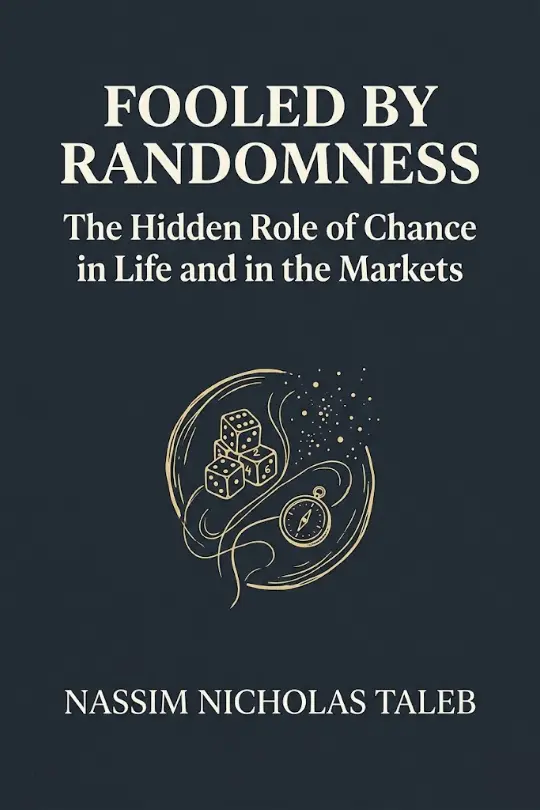
Fooled by Randomness
The Hidden Role of Chance in Life and in the Markets (Incerto)
Book Summary
Narrator: Ethan
Timeline
Summary Preview
More than two thousand years ago, Croesus, the king of Lydia, stood before his guest Solon and asked a simple question. Look at my gold. Look at my palaces. Am I not the happiest man in the world? Croesus was the wealthiest ruler of his age, and he expected admiration. But Solon, the Athenian legislator known for his wisdom, refused to play along. Fortune, Solen replied, is a wheel that turns without warning. Call no man happy until he is dead, for change is the only constant in life.
Croesus dismissed the warning. What could possibly go wrong? He had built his empire through brilliant strategy and decisive action. His success was his own doing. But soon after, his kingdom fell to the Persian army. As Croesus stood on a pyre about to be burned alive, he finally understood. He called out Solon's name, admitting the old man had been right. Everything he had credited to his own skill had been, at least in part, a gift of luck. And luck could be taken back just as quickly as it had been given.
This ancient fable captures the central problem of Nassim Nicholas Taleb's Fooled by Randomness . The human mind has a deep, almost automatic tendency to mistake luck for skill. When things go well, we credit our intelligence, our hard work, our superior strategy. When things go badly, we blame bad luck, market conditions, or forces beyond our control. This is what psychologists call attribution bias, and it is not a minor cognitive quirk. It is a systematic error that distorts how we evaluate success, how we make decisions, and ultimately, how we live our lives.
Taleb's core thesis is simple but devastating. In any field where randomness plays a significant role, the observed outcomes are a poor
More than two thousand years ago, Croesus, the king of Lydia, stood before his guest Solon and asked a simple question. Look at my gold. Look at my palaces. Am I not the happiest man in the world? Croesus was the wealthiest ruler of his age, and he expected admiration. But Solon, the Athenian legislator known for his wisdom, refused to play along. Fortune, Solen replied, is a wheel that turns without warning. Call no man happy until he is dead, for change is the only constant in life.
Croesus dismissed the warning. What could possibly go wrong? He had built his empire through brilliant strategy and decisive action. His success was his own doing. But soon after, his kingdom fell to the Persian army. As Croesus stood on a pyre about to be burned alive, he finally understood. He called out Solon's name, admitting the old man had been right. Everything he had credited to his own skill had been, at least in part, a gift of luck. And luck could be taken back just as quickly as it had been given.
This ancient fable captures the central problem of Nassim Nicholas Taleb's Fooled by Randomness. The human mind has a deep, almost automatic tendency to mistake luck for skill. When things go well, we credit our intelligence, our hard work, our superior strategy. When things go badly, we blame bad luck, market conditions, or forces beyond our control. This is what psychologists call attribution bias, and it is not a minor cognitive quirk. It is a systematic error that distorts how we evaluate success, how we make decisions, and ultimately, how we live our lives.
Taleb's core thesis is simple but devastating. In any field where randomness plays a significant role, the observed outcomes are a poor guide to the actual quality of decision-making. A lucky fool can appear brilliant for years. A skilled practitioner can appear foolish after a single unlucky event. The problem is that we cannot tell the difference just by looking at the results. We need a different framework.
The book's central thesis rests on a single, uncomfortable truth: that which came with the help of luck can be taken away by luck. The more dependent your success is on favorable random events, the more vulnerable you are to unfavorable ones. The reverse is also true. Success that comes with little help from luck is more resistant to randomness. This asymmetry is the foundation of everything that follows.
Taleb grounds this insight in what he calls the "Tragic Vision of Humankind." This is not a pessimistic philosophy but a realistic one. The Tragic Vision acknowledges that human beings have inherent limitations and flaws in how we think and act. We are not perfectly rational calculators. We are emotional, pattern-seeking creatures who evolved to survive on the savannah, not to parse probabilities in financial markets. Accepting this limitation is not a weakness. It is the first step toward making better decisions.
Think about what this means in practice. Every year, thousands of people enter professions where randomness plays a massive role. Finance, entrepreneurship, entertainment, sports management. A small number achieve extraordinary success. They write books, give speeches, and are celebrated as geniuses. But how many of them are actually skilled, and how many are simply the lucky survivors of a random process? The Tragic Vision forces us to ask this question rather than assume the answer is obvious.
The framework has three practical implications. First, you must distinguish between fields where skill dominates and fields where luck dominates. In chess, a grandmaster's past performance is a reliable predictor of future performance. In day trading, it is not. Second, you must judge decisions by their quality, not by their outcomes. A good decision can lead to a bad result through bad luck, and a bad decision can lead to a good result through good luck. Third, you must be humble about your own success. If you have done well, ask yourself how much of that was luck. If you cannot answer, assume more than you think.
This brings us back to Solon's warning. Croesus did not fail because he was stupid. He failed because he mistook a lucky streak for permanent skill. He thought his success was a reflection of his own excellence, not a temporary alignment of favorable circumstances. When the wheel turned, he had no backup plan, no humility, and no way to adapt.
The lesson is not that success is meaningless or that effort does not matter. It is that we must learn to see the role of randomness in our lives. We must resist the seductive story that our successes are entirely our own doing. And we must prepare for the possibility that what luck has given, luck can take away.
As we move through the rest of this book, Taleb will give us the tools to see through the illusion of skill, to evaluate risk properly, and to make better decisions in a world where randomness is always at play. But it all starts here, with the simple recognition that we are all, to some degree, fooled by randomness.
The question you must ask yourself is this: How much of what you credit to your own skill is actually luck, and what would happen if that luck ran out tomorrow?
About the Book
In a world obsessed with winners, Nassim Taleb reveals how randomness secretly drives success and failure. Through vivid stories—from Russian roulette traders to monkeys typing The Iliad—he exposes why we mistake luck for skill. This book will transform how you judge risk, evaluate success, and navigate a future you can never predict.
Key Takeaways
Distinguish between skill-based and luck-based fields before evaluating performance
In fields like chess or surgery, past performance reliably predicts future results because skill dominates. In fields like day trading or venture capital, randomness plays a massive role, making past outcomes a poor guide to actual ability. Before trusting any track record, first assess how much randomness influences the domain.
Judge decisions by their process, not by their outcomes
A good decision can lead to a bad result through bad luck, and a bad decision can lead to a good result through good luck. To avoid being fooled by randomness, evaluate the quality of the reasoning and strategy behind each decision, not just the final outcome.
Protect against catastrophic loss by designing for survival across many possible futures
High-risk strategies that produce massive short-term gains often hide a small chance of total ruin—like playing Russian roulette. Instead of chasing explosive success, build systems that survive in the vast majority of alternative histories, accepting modest but consistent gains.
Use Monte Carlo simulation to visualize the full range of possible outcomes, not just the one that happened
Our brains naturally focus on the single path that actually occurred, ignoring the many alternative histories that could have unfolded. By running thousands of simulations, you train yourself to evaluate strategies based on their entire distribution of outcomes, revealing hidden risks that a single track record conceals.
Actively seek to falsify your beliefs rather than confirm them
No amount of past success proves a strategy will continue to work—this is the problem of induction. Instead of collecting confirming evidence, ask yourself: 'What specific event would prove my approach is wrong?' If you cannot answer, you are not thinking critically, and a black swan is waiting to surprise you.
Beware of survivorship bias: the winners you see are the lucky monkeys, not necessarily the skilled ones
When you study successful people, you ignore the countless others who used the same methods but failed. In fields with high randomness, a few participants will appear brilliant purely by chance. Always ask: 'How many people started in this field, and what fraction of them succeeded?'
Put wax in your ears: design your environment to protect against your own emotional reactions
You cannot will yourself to be rational when real money or reputation is at stake—your emotional brain will override your analytical brain. Instead, reduce exposure to emotional triggers like constant news, market noise, and social comparison, and set binding rules (like stop-loss limits) before emotions take over.
Embrace satisficing over optimizing to build resilience against randomness
Optimizers try to control every variable and become brittle—one unexpected event breaks their entire plan. Satisficers accept 'good enough' solutions and build slack into their schedules and systems, allowing them to absorb random shocks without collapsing. Design your life to work even when things don't go perfectly.
Who Should Listen?
A young professional in finance or trading who has seen colleagues praised for risky wins and wants to understand which strategies actually survive over time.
An entrepreneur who has experienced a sudden business failure and needs a framework to distinguish whether it was bad luck or bad decisions.
A mid-career manager who evaluates team performance and wants to stop rewarding lucky outcomes while overlooking smart but unlucky efforts.
A curious investor who has watched market gurus rise and fall and wants a mental model to separate genuine skill from statistical noise.