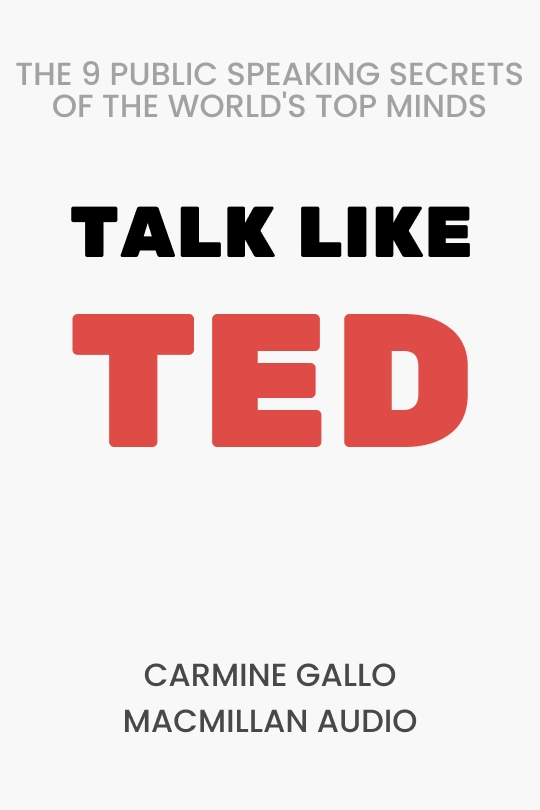
Talk Like TED
The 9 Public-Speaking Secrets of the World's Top Minds
Book Summary
Narrator: Ethan
Summary Preview
In 1984, a conference called TED—Technology, Entertainment, Design—brought together a small group of thinkers in Monterey, California. The first event lost money. The organizers tried again in 1990, and it slowly built a dedicated following among tech insiders and innovators. Then came 2006. TED posted its first six conference videos online for free. Within months, millions of people had watched talks on topics they never knew they cared about—statistics presented with animated bubbles, a former vice president warning about climate change, a creativity expert questioning the purpose of school. The TED Talk was born, and public speaking was forever changed.
That moment revealed something important. Ideas are the currency of the twenty first century. Your ability to generate insights matters, but your ability to communicate them matters more. The world is full of brilliant people whose work never gains traction because they cannot make others see what they see. A groundbreaking research finding, a revolutionary business model, a life saving invention—all of them fail if the person holding them cannot deliver a message that lands.
Carmine Gallo, a communications coach who had spent years training executives at companies like Intel and Coca Cola, saw the TED phenomenon as a laboratory. Here were hundreds of speakers from different backgrounds, different industries, different cultures, all delivering presentations under the same constraints: eighteen minutes, no lecterns, no notes allowed. Some talks went viral. Most did not. What separated the ones that captivated millions from the ones that faded into obscurity?
Gallo did something systematic. He analyzed five hundred of the most popular TED Talks. He watched them frame by frame. He timed how long speakers spent on stories versus statistics. He mapped their gestures, their vocal patterns, their slide designs. He interviewed the speakers themselves and neuroscientists who could explain why certain techniques
In 1984, a conference called TED—Technology, Entertainment, Design—brought together a small group of thinkers in Monterey, California. The first event lost money. The organizers tried again in 1990, and it slowly built a dedicated following among tech insiders and innovators. Then came 2006. TED posted its first six conference videos online for free. Within months, millions of people had watched talks on topics they never knew they cared about—statistics presented with animated bubbles, a former vice president warning about climate change, a creativity expert questioning the purpose of school. The TED Talk was born, and public speaking was forever changed.
That moment revealed something important. Ideas are the currency of the twenty-first century. Your ability to generate insights matters, but your ability to communicate them matters more. The world is full of brilliant people whose work never gains traction because they cannot make others see what they see. A groundbreaking research finding, a revolutionary business model, a life-saving invention—all of them fail if the person holding them cannot deliver a message that lands.
Carmine Gallo, a communications coach who had spent years training executives at companies like Intel and Coca-Cola, saw the TED phenomenon as a laboratory. Here were hundreds of speakers from different backgrounds, different industries, different cultures, all delivering presentations under the same constraints: eighteen minutes, no lecterns, no notes allowed. Some talks went viral. Most did not. What separated the ones that captivated millions from the ones that faded into obscurity?
Gallo did something systematic. He analyzed five hundred of the most popular TED Talks. He watched them frame by frame. He timed how long speakers spent on stories versus statistics. He mapped their gestures, their vocal patterns, their slide designs. He interviewed the speakers themselves and neuroscientists who could explain why certain techniques worked at the brain level. From that analysis, he distilled a framework with three components: Emotional, Novel, and Memorable.
The emotional component covers everything that creates a connection between speaker and audience—passion, storytelling, conversational delivery. The novel component covers what makes a presentation stand out—new information, surprise moments, humor. The memorable component covers what makes the message stick—the right length, multi-sensory engagement, authenticity. Each component contains three specific techniques, giving nine secrets total.
This is not theory. This is reverse engineering. Every technique Gallo presents comes from observing what actually worked on stage, then understanding why it worked based on how the human brain processes information, emotion, and memory.
Consider what the TED online launch revealed. Before 2006, the only people who experienced TED Talks were the twelve hundred attendees who could afford the conference fee. After 2006, anyone with an internet connection could watch. The same talk that worked in a hotel ballroom had to work on a laptop screen in a dorm room, a tablet on a subway, a phone in a waiting room. The talks that survived that transition had something in common. They were not lectures. They were experiences. They did not just inform. They transformed.
This is the core problem Gallo addresses. Most people approach presentations as information transfer. I have data. I will tell you the data. You will remember the data. But the brain does not work that way. The brain filters out most of what it hears. It pays attention to emotion, novelty, and stories. It remembers what made it feel something, what surprised it, what connected to something it already knew. If you ignore how the brain actually processes information, you are speaking to an audience that stopped listening three minutes ago.
Gallo's methodology gives you a shortcut. Instead of learning through trial and error over years of failed presentations, you can adopt the techniques that have already been tested on the world's most demanding stage. Five hundred talks. Thousands of hours of content. Millions of data points from audience reactions, online views, and social media shares. The patterns are clear. The techniques are teachable.
The book is structured around the three-part framework. Each section builds on the previous one. Emotional connection comes first because without it, nothing else matters. Novelty comes second because once you have their attention, you need to hold it. Memorability comes third because the goal is not just to be heard but to be remembered and acted upon.
Gallo positions this as a twenty-first-century update to Dale Carnegie's 1915 book The Art of Public Speaking. Carnegie taught fundamentals that still hold true—be genuine, tell stories, connect with your audience. But Carnegie could not draw on neuroscience. He could not analyze five hundred recorded presentations frame by frame. He could not point to a global library of successful talks that anyone can watch and learn from. Gallo can, and he does.
The result is a system that works whether you are pitching to venture capitalists, presenting to your board, speaking at a conference, or giving a wedding toast. The same principles that made Sir Ken Robinson's talk on creativity the most viewed in TED history apply to a quarterly business review. The same techniques that Bill Gates used to create a viral moment with a jar of mosquitoes can be adapted for a product launch.
Here is the uncomfortable truth Gallo wants you to face: your ideas are only as powerful as your ability to communicate them. You can have the most innovative solution to the most pressing problem, but if you cannot make people care, your solution dies with your presentation. The world does not reward good ideas. It rewards ideas that spread.
Your ability to communicate ideas determines your success. Not your intelligence. Not your expertise. Not the quality of your work alone. Your ability to make others see what you see, feel what you feel, and act on what you know. This book provides a proven system distilled from the world's best speakers. The question is not whether you have something worth saying. The question is whether you know how to say it in a way that lands.
What if the only thing standing between your idea and its impact is not the idea itself, but how you deliver it?
Who Should Listen?
Entrepreneurs and startup founders who need to pitch their ideas to investors, partners, or customers and want to command the room like Steve Jobs.
Corporate executives and managers who regularly present to boards, teams, or clients and struggle to keep their audiences engaged beyond the first three minutes.
Public speakers, coaches, and trainers who want to move from 'good' to 'viral-worthy' by adopting the exact delivery and storytelling techniques of TED's most-watched speakers.
Students and early-career professionals who must deliver high-stakes presentations for competitions, interviews, or conferences and need a systematic, neuroscience-backed method to stand out.