Men Explain Things to Me
Book Summary
Narrator: Ethan
Timeline
Summary Preview
Rebecca Solnit was at a party in snowy Aspen, Colorado. She wanted to leave. But the host, an imposing man who'd made a lot of money, insisted she stay and talk to him. So she stayed.
He asked about her writing. She mentioned her most recent book, River of Shadows: Eadweard Muybridge and the Technological Wild West . Before she could say another word, he interrupted. Had she heard about the very important Muybridge book that came out this year? He was already telling her about it—with that smug look Solnit knew so well in a man holding forth, eyes fixed on the fuzzy far horizon of his own authority.
Solnit's friend Sallie had to interrupt him. "That's her book," Sallie said. Once. Twice. Three times before he finally took it in.
For a moment, the information confused the neat categories into which his world was sorted. He went silent. Then, without missing a beat, he began holding forth again.
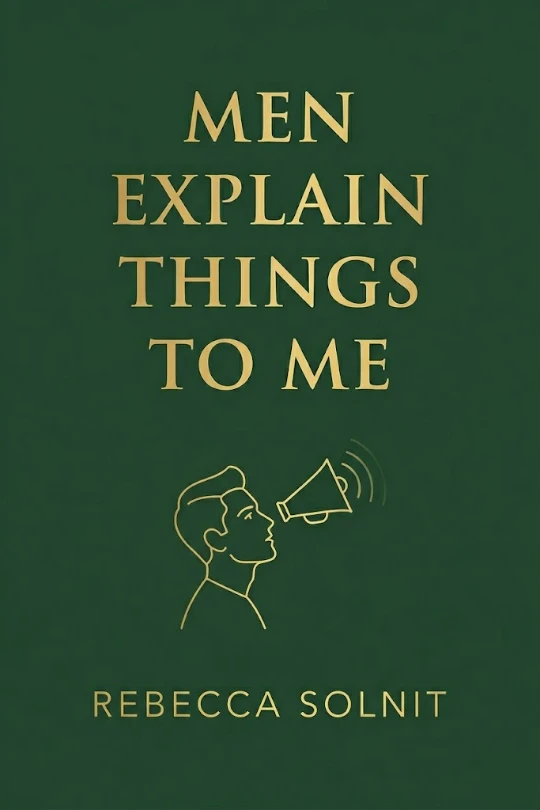
This book, Men Explain Things to Me , is a collection of essays published in 2014. It explores gender politics through several lenses. But the central problem runs through every page like a dark thread: how men systematically silence and dismiss women.
The party anecdote isn't just a funny story about an arrogant man. It's a microcosm. Solnit uses it to reveal something much larger. What happened to her that night wasn't an isolated incident of rudeness. It was a pattern—a pattern so common that most women recognize it instantly. Men who assume they know more than women, who talk over women, who lecture women about subjects the women themselves have mastered. The "out and out confrontational confidence of the totally ignorant," Solnit writes, is gendered.
This silencing ranges from casual conversation to violence and death. When a man talks
Rebecca Solnit was at a party in snowy Aspen, Colorado. She wanted to leave. But the host, an imposing man who'd made a lot of money, insisted she stay and talk to him. So she stayed.
He asked about her writing. She mentioned her most recent book, River of Shadows: Eadweard Muybridge and the Technological Wild West. Before she could say another word, he interrupted. Had she heard about the very important Muybridge book that came out this year? He was already telling her about it—with that smug look Solnit knew so well in a man holding forth, eyes fixed on the fuzzy far horizon of his own authority.
Solnit's friend Sallie had to interrupt him. "That's her book," Sallie said. Once. Twice. Three times before he finally took it in.
For a moment, the information confused the neat categories into which his world was sorted. He went silent. Then, without missing a beat, he began holding forth again.
This book, Men Explain Things to Me, is a collection of essays published in 2014. It explores gender politics through several lenses. But the central problem runs through every page like a dark thread: how men systematically silence and dismiss women.
The party anecdote isn't just a funny story about an arrogant man. It's a microcosm. Solnit uses it to reveal something much larger. What happened to her that night wasn't an isolated incident of rudeness. It was a pattern—a pattern so common that most women recognize it instantly. Men who assume they know more than women, who talk over women, who lecture women about subjects the women themselves have mastered. The "out-and-out confrontational confidence of the totally ignorant," Solnit writes, is gendered.
This silencing ranges from casual conversation to violence and death. When a man talks over a woman at a party, he's expressing power. When a man rapes or murders a woman, he's expressing the same kind of power—just at a different point on the same continuum. The casual assumption that men know better than women, that women's voices matter less, that women's credibility is suspect—these attitudes create the conditions for violence. They tell women, as Solnit puts it, that this is not their world.
Even Solnit, a successful writer with more confirmation of her right to think and speak than most women, struggles against this dynamic. At that party, she let Mr. Very Important talk over her about her own book. She wondered if maybe he was right, maybe there really was another Muybridge book she hadn't heard of. The presumption of male authority is so deeply embedded that it makes women doubt themselves.
The book links personal experience to wider social patterns. What happened to Solnit at that party connects to how women's testimony has no legal standing in some countries, how women who report rape are discredited, how domestic violence was for so long considered a private matter. The same assumptions that made Mr. Very Important lecture Solnit about her own book also make it hard for women to be believed when they say they've been harmed.
Solnit doesn't just identify the problem. She traces its roots. Traditional gender roles teach men that they are automatically better informed than women, that they have a right to speak over women. These roles teach women to be quiet, to defer, to doubt themselves. The result is a world where women fight wars on two fronts—one for whatever the actual topic is, and one simply for the right to speak, to have ideas, to be acknowledged as human beings.
The book is a series of linked explorations. Each essay examines a different aspect of this silencing and erasure. There's the essay on violence against women, with its staggering statistics: a reported rape every 6.2 minutes in the U.S., one in five women raped in her lifetime. There's the essay on how same-sex marriage challenges traditional gender roles by making marriage a union of equals rather than a hierarchy. There's the essay on how women are "obliterated" from history through naming practices and family trees that record only fathers and sons.
But it all starts with that party. With one man, confident in his ignorance, lecturing a woman about her own book. It's a small moment. It's also everything.
How can such a small thing—a rude man at a party—connect to violence, erasure, and death? What does that continuum from "minor social misery" to "violent silencing and violent death" actually look like?
About the Book
Rebecca Solnit’s groundbreaking essay collection dissects the everyday arrogance of men who explain, interrupt, and dismiss women—and traces this casual silencing directly to violence, erasure, and death. From a smug party guest to global statistics on rape, Solnit reveals a continuum of power that keeps women from being heard, believed, or even seen.
Key Takeaways
The Gendered Confidence of Ignorance Silences Women Before They Speak
Men often express an unwarranted confidence in their own knowledge, not based on facts but on a lifetime of being told their voices matter more, which systematically silences women and forces them to fight a second war for the basic right to be heard.
Credibility Is a Basic Survival Tool, Not a Social Luxury
When women are systematically disbelieved—in courtrooms, in homes, in everyday conversation—they are stripped of protection and made vulnerable to violence, proving that the casual dismissal of a woman's voice is a matter of life and death.
Violence Against Women Is a Long War We Refuse to Name
The staggering, routine violence against women—a rape every 6.2 minutes in the U.S., more women dying from male violence than from cancer and war combined—is treated as exceptional only when it makes headlines, while the everyday pandemic is ignored because naming it would force us to confront patriarchy.
Power and Privilege Create a Fable of Exploitation That Repeats Itself
The assault of a poor immigrant hotel maid by the head of the IMF is not an isolated crime but a perfect metaphor for how global systems of power—colonialism, capitalism, patriarchy—treat the bodies of poor women of color as available for use, while protecting powerful men from consequences.
Marriage Equality Is a Threat to Inequality Itself
Same-sex marriage challenges not just the institution of marriage but the entire structure of traditional gender roles, because a union between equals cannot rely on the old scripts of dominance and submission, making it a radical threat to hierarchy that deserves celebration.
Women Are Systematically Obliterated from History by Quiet Erasure
Through naming practices, family trees that record only fathers, veils that make women invisible, and the advice to stay indoors for safety, women are covered over like a white sheet—present but obliterated, their existence recorded only as an absence.
Embrace the Darkness of Uncertainty as a Source of Freedom and Hope
Virginia Woolf's celebration of a dark future offers a radical alternative to the aggressive certainty of mansplaining, teaching us that sitting with mystery and not-knowing is not weakness but liberation, and that real hope comes precisely from the fact that we cannot know what will happen next.
Feminist Ideas Are Genies That Cannot Be Put Back in Their Bottles
Despite relentless backlash, the core ideas of feminism—that women have inalienable rights, that domestic violence is not a private matter—have been released into the world's consciousness forever, and no amount of rearguard action can force them back into the prisons and coffins of silence.
Who Should Listen?
Any woman who has ever been talked over, interrupted, or lectured about her own expertise and wants to understand why it keeps happening.
Men who genuinely want to recognize their own unconscious patterns of silencing women and learn how to become better allies.
College students and young professionals studying gender studies, sociology, or communications who need a clear, accessible framework for understanding systemic sexism.
Readers of feminist nonfiction like *We Should All Be Feminists* or *The Feminine Mystique* who want a modern, intersectional take on the politics of voice and credibility.