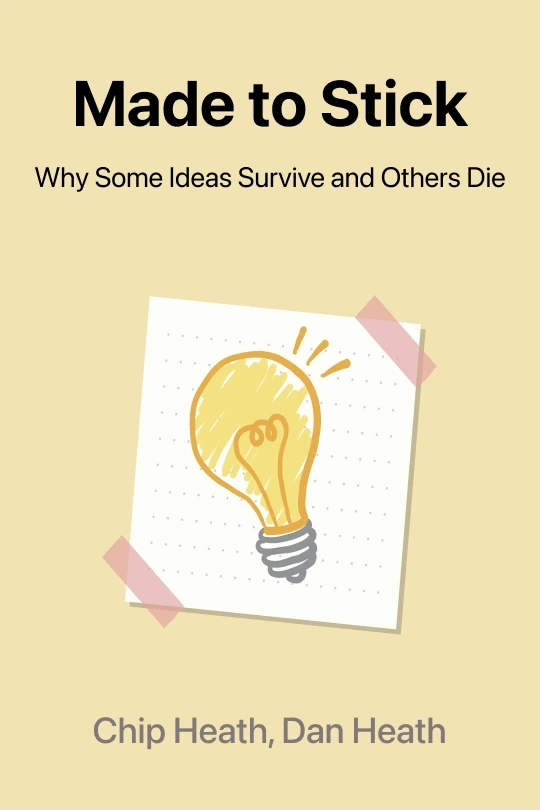
Made to Stick
Why Some Ideas Survive and Others Die
Book Summary
Narrator: Ethan
Summary Preview
Here's a simple experiment you can try at home. Pick a well known song—"Happy Birthday" works fine. Now tap out the rhythm on a table while someone else tries to guess what song you're playing. Go ahead. You'll probably assume they'll get it pretty quickly.
Psychologist Elizabeth Newton ran this exact experiment at Stanford. She recruited "tappers" and "listeners." Tappers were given a list of familiar songs and asked to tap the rhythm to their partner. Before starting, the tappers predicted the listeners would guess correctly about half the time—one in two songs.
The actual result? Listeners guessed just 3 out of 120 songs. That's a 2.5% success rate.
Here's what makes this experiment so revealing. When the tappers tapped, they heard the full song playing in their heads. The melody, the lyrics, the instrumentation—it was all there, rich and complete. The listeners, of course, heard none of that. All they got was a series of dull, rhythmic knocks on a table. Tap tap tap. Tap tap tap tap.
The tappers couldn't imagine what it was like to be a listener. They were cursed.
This is the central problem that Made to Stick sets out to solve, and it has a name: the Curse of Knowledge . The Curse of Knowledge is the fundamental barrier that kills good ideas before they ever have a chance to stick. It works like this: once you know something, it becomes nearly impossible to imagine what it's like not to know it. Your brain fills in all the context, all the background, all the meaning. You hear the full song. Your audience hears taps on a table.
The gap between what you know and what your audience knows isn't just a minor communication hiccup. It's a chasm that swallows even the most brilliant ideas.
Here's a simple experiment you can try at home. Pick a well-known song—"Happy Birthday" works fine. Now tap out the rhythm on a table while someone else tries to guess what song you're playing. Go ahead. You'll probably assume they'll get it pretty quickly.
Psychologist Elizabeth Newton ran this exact experiment at Stanford. She recruited "tappers" and "listeners." Tappers were given a list of familiar songs and asked to tap the rhythm to their partner. Before starting, the tappers predicted the listeners would guess correctly about half the time—one in two songs.
The actual result? Listeners guessed just 3 out of 120 songs. That's a 2.5% success rate.
Here's what makes this experiment so revealing. When the tappers tapped, they heard the full song playing in their heads. The melody, the lyrics, the instrumentation—it was all there, rich and complete. The listeners, of course, heard none of that. All they got was a series of dull, rhythmic knocks on a table. Tap tap tap. Tap tap tap tap.
The tappers couldn't imagine what it was like to be a listener. They were cursed.
This is the central problem that Made to Stick sets out to solve, and it has a name: the Curse of Knowledge. The Curse of Knowledge is the fundamental barrier that kills good ideas before they ever have a chance to stick. It works like this: once you know something, it becomes nearly impossible to imagine what it's like not to know it. Your brain fills in all the context, all the background, all the meaning. You hear the full song. Your audience hears taps on a table.
The gap between what you know and what your audience knows isn't just a minor communication hiccup. It's a chasm that swallows even the most brilliant ideas. Every expert, every manager, every teacher, every parent suffers from this curse. The more you know about your subject, the harder it becomes to explain it to someone who doesn't share your knowledge.
Let's break this down into what's actually happening.
When you're an expert in something—whether it's accounting, software engineering, parenting, or baseball statistics—your brain has built an elaborate mental model. Concepts that once seemed foreign are now second nature. Connections that took years to learn now feel obvious. You've forgotten what it felt like to be a beginner.
This isn't arrogance. It's neurobiology. Once information is encoded in your brain, you literally cannot un-know it. And because you can't un-know it, you can't accurately simulate what it's like for someone who doesn't have that knowledge. The tappers weren't trying to be misleading. They genuinely believed the listeners would hear what they heard. They just couldn't imagine the empty silence on the other side.
The Curse of Knowledge explains why so many good ideas die. A brilliant scientist publishes a paper full of jargon that only five other people in the world can understand. A CEO delivers a strategic vision that makes perfect sense to her but leaves her team confused about what to do next. A nonprofit writes a mission statement that sounds noble but doesn't actually tell anyone what they're supposed to do.
The curse doesn't just make communication harder. It makes it invisible. You don't realize you're tapping instead of singing. You don't notice the gap between what you mean and what your audience hears. You walk away from a meeting thinking everyone understood, when in reality they heard a series of confusing taps.
So what does "stickiness" actually mean? The Heath brothers define it precisely: a sticky idea is one that is understood, remembered, and impactful enough to change someone's behavior or thinking. Sticky ideas survive. Non-sticky ideas die. And the primary reason ideas die isn't that they're bad ideas. It's that the person communicating them suffers from the Curse of Knowledge.
Think about the urban legends that spread like wildfire. The Kidney Heist story—a man wakes up in an icy bathtub missing a kidney. That story is incredibly sticky. It's simple, concrete, unexpected, emotional, and tells a story. People remember it and retell it. Now contrast that with the dense, abstract paper about community-building strategies that the Heath brothers describe in the introduction. That paper is full of valuable insights, but it dies on the page because the author assumed readers already knew everything the author knew.
The difference isn't intelligence or importance. It's the presence or absence of the Curse of Knowledge.
Now here's the crucial insight: the Curse of Knowledge is not a permanent condition. It's a problem you can recognize and counteract. The first step is simply knowing it exists. When you understand that you're a tapper and your audience are listeners, you can start asking the right questions: What does my audience actually know? What do they need to hear? What am I assuming that they don't share?
The Heath brothers spent years studying why some ideas survive and others die. They analyzed naturally sticky ideas—urban legends, proverbs, conspiracy theories—alongside deliberately crafted messages like advertising campaigns and military strategies. And they found that sticky ideas share a common structure, a set of six principles that anyone can use to make their ideas survive.
But before you can apply those principles, you have to recognize the enemy. The Curse of Knowledge is the reason brilliant people fail to communicate. It's why your best ideas might be dying in silence while someone else's mediocre idea spreads like wildfire. It's the gap between the song in your head and the taps on the table.
Here's a question to sit with as you continue: When was the last time you assumed someone understood what you meant, only to discover they had no idea? What were you tapping that they couldn't hear?
Who Should Listen?
A startup founder struggling to explain their product's value to investors in under 60 seconds.
A teacher or trainer whose students forget key concepts the moment they leave the classroom.
A marketing manager whose campaigns get lost in the noise and fail to drive measurable action.
A nonprofit director whose mission statement sounds noble but fails to inspire volunteers or donors.