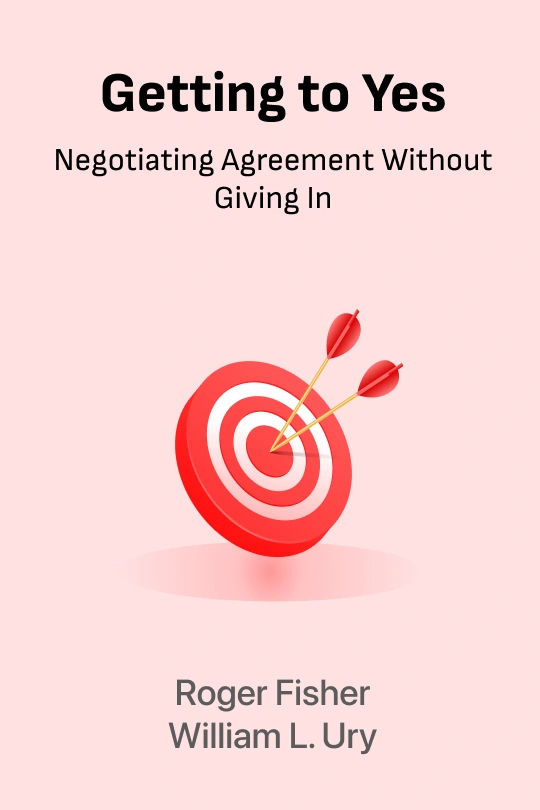
Getting to Yes
Negotiating Agreement Without Giving In
Book Summary
Narrator: Ethan
Summary Preview
You're in a negotiation. Maybe it's a salary discussion with your boss, a dispute with a neighbor over a property line, or a business deal with a potential partner. And you face a choice that feels like it's the only choice: Do you play nice, or do you play hard?
Most people think these are the only two options. Be soft—concede, compromise, preserve the relationship at all costs. Or be hard—dig in, demand, win at any expense. This is the false dichotomy that Roger Fisher and William Ury identify at the very beginning of Getting to Yes . And it's the core problem the entire book exists to solve.
Think about what happens when you choose soft negotiation. You want to be reasonable. You want to be liked. So you start by making a generous offer. The other side pushes back, and you give a little more. They push again, and you give again. Before long, you've given away more than you intended. You leave the table feeling taken advantage of. The relationship might be intact, but you resent it. And here's the brutal truth: soft negotiators often end up with agreements that don't serve them, and they rarely get the other side to reciprocate their generosity.
Now consider the alternative. Hard negotiation. You stake out an extreme position. You refuse to budge. You see every concession as a sign of weakness. You might threaten, bluff, or apply pressure. Sometimes this works—you get what you want. But at what cost? The other side leaves feeling beaten. They look for ways to undermine the agreement later. They remember you as someone not to trust. And if you're on the receiving end of hard bargaining, you know the frustration of being strong armed into a deal that feels unfair.
Fisher and Ury
You're in a negotiation. Maybe it's a salary discussion with your boss, a dispute with a neighbor over a property line, or a business deal with a potential partner. And you face a choice that feels like it's the only choice: Do you play nice, or do you play hard?
Most people think these are the only two options. Be soft—concede, compromise, preserve the relationship at all costs. Or be hard—dig in, demand, win at any expense. This is the false dichotomy that Roger Fisher and William Ury identify at the very beginning of Getting to Yes. And it's the core problem the entire book exists to solve.
Think about what happens when you choose soft negotiation. You want to be reasonable. You want to be liked. So you start by making a generous offer. The other side pushes back, and you give a little more. They push again, and you give again. Before long, you've given away more than you intended. You leave the table feeling taken advantage of. The relationship might be intact, but you resent it. And here's the brutal truth: soft negotiators often end up with agreements that don't serve them, and they rarely get the other side to reciprocate their generosity.
Now consider the alternative. Hard negotiation. You stake out an extreme position. You refuse to budge. You see every concession as a sign of weakness. You might threaten, bluff, or apply pressure. Sometimes this works—you get what you want. But at what cost? The other side leaves feeling beaten. They look for ways to undermine the agreement later. They remember you as someone not to trust. And if you're on the receiving end of hard bargaining, you know the frustration of being strong-armed into a deal that feels unfair.
Fisher and Ury spent years studying how people actually negotiate—from international diplomats to corporate lawyers to married couples dividing household chores. What they found was devastating: both approaches fail in predictable, costly ways.
Soft negotiation fails because it makes you vulnerable. You focus so much on keeping the peace that you sacrifice your legitimate interests. The agreement you get is often unwise—it doesn't actually meet your needs. And because you're constantly conceding, the process is inefficient. The other side learns that pushing you works, so they keep pushing.
Hard negotiation fails because it damages relationships. You focus so much on winning that you ignore the other side's needs. The agreement you force might be technically "yours," but the other side resents it. They comply only when forced. And if you need to work with them again—and in most negotiations, you will—you've poisoned the well.
But here's what Fisher and Ury noticed that changes everything: both soft and hard negotiation share the same fatal flaw. Both are forms of positional bargaining. You take a position, they take a position. Then you battle over who moves first and how far. The only difference is whether you're the one giving ground or demanding it.
This insight is the key. The problem isn't that you're too nice or too tough. The problem is the game you're playing. Positional bargaining—whether soft or hard—turns negotiation into a contest of wills. And contests of wills have losers, even when you "win."
So what's the alternative? Fisher and Ury call it principled negotiation. It's a third way that rejects the false choice between soft and hard. Instead of being soft on people and soft on the problem (the soft approach) or hard on people and hard on the problem (the hard approach), principled negotiation does something different: it goes easy on the people, hard on the problem.
Think about what that means in practice. You treat the other person with respect. You listen to them. You acknowledge their emotions and their perspective. But when it comes to the actual substance of the dispute, you're tough. You don't concede easily. You insist on fair standards. You demand that the solution actually works for both sides.
This isn't compromise. It's not splitting the difference. It's a fundamentally different way of approaching conflict. Instead of asking "What position should I take?" you ask "What problem are we trying to solve together?" Instead of measuring success by who gave up more, you measure it by whether the agreement meets both sides' legitimate interests.
Let's see how this plays out in a concrete example. Imagine you're negotiating the price of a used car. The soft approach: you say $10,000, the seller says $12,000, and you quickly agree to $11,000 because you don't want conflict. The hard approach: you offer $8,000, the seller counters at $13,000, and you spend hours trading insults and ultimatums until someone blinks.
The principled approach starts differently. You don't begin with a position at all. You begin by asking questions. "What's the car's history? Has it been in accidents? What maintenance has been done? Why are you selling?" You're exploring interests—yours and theirs. Your interest might be getting a reliable car at a fair price. Theirs might be getting enough money to buy their next car quickly. Once you understand those interests, you can look for solutions that serve both. Maybe you agree on a price based on the Kelley Blue Book value—an objective standard. Maybe you offer to pay cash today in exchange for a discount, because their interest is speed. You're not fighting over positions. You're solving a problem together.
This is the heart of what Fisher and Ury discovered. The choice between being a pushover and being a bully is a false one. There is a better way—a way that lets you be both fair and effective, both cooperative and tough. Principled negotiation doesn't ask you to choose between your relationship and your interests. It shows you how to protect both.
So before we dive into the specific techniques—the four-point framework that makes this work—here's the question to hold onto: In your next negotiation, will you play the old game of positions, or will you try a different game entirely? The answer determines everything that follows.
Who Should Listen?
A mid-level manager who dreads annual salary negotiations with their boss and wants to advocate for fair compensation without damaging their working relationship.
A small business owner who constantly feels pressured by larger suppliers or clients and needs a systematic way to protect their interests without being aggressive.
A recently promoted team lead who struggles to resolve conflicts between team members and wants practical tools to turn disagreements into collaborative problem-solving.
A real estate agent who regularly mediates between buyers and sellers stuck on price and needs techniques to uncover hidden interests and create win-win deals.