Book Summaries
Hosts: Clara
Timeline
Summary Preview
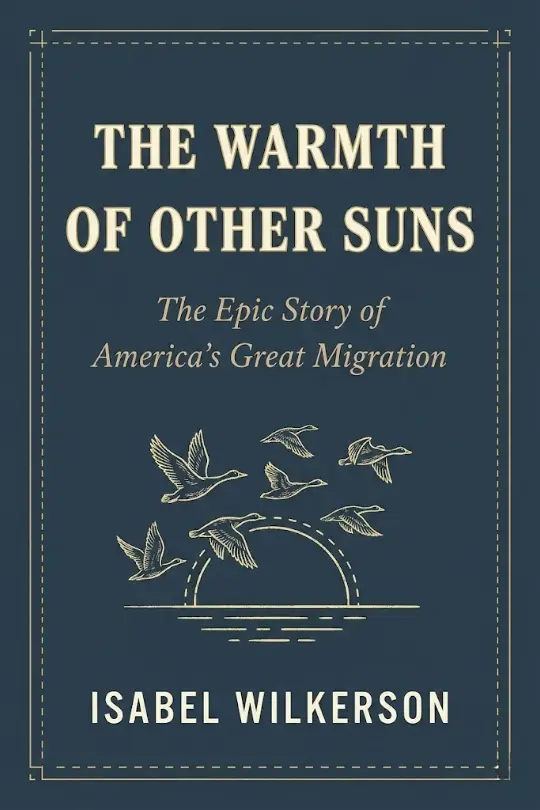
Between 1915 and 1970, something unprecedented happened in America. Nearly six million African Americans did something their parents and grandparents could not have imagined: they left. They abandoned the only land they had ever known—the Jim Crow South—and scattered across the North and West. This was the Great Migration, and it was one of the most transformative movements in American history. Yet it had no leaders, no organizers, no single moment of beginning. It crept along so many thousands of currents, over so many decades, that the press could barely capture it while it was happening.
Isabel Wilkerson spent fifteen years researching this exodus. But she didn't write a dry statistical account. Instead, *The Warmth of Other Suns* tells the story through three ordinary people who made the extraordinary decision to leave everything behind.
Ida Mae Gladney was a sharecropper's wife in Mississippi. She had never seen a city. Her world was cotton fields and wooden shacks and the constant, grinding fear that a wrong word or a glance could get someone she loved killed. She left with her husband, carrying whatever they could fit into a few bags, heading for Chicago.
George Swanson Starling was a brilliant student from Florida, a valedictorian forced to drop out of college because his family couldn't afford it. He ended up picking oranges, and when he tried to organize the workers for better wages, he became a marked man. He fled to Harlem with a price on his head.
Robert Pershing Foster came from an affluent Louisiana family. He was a doctor, an Army captain, a man who had achieved everything the South allowed a Black man to achieve. But that wasn't enough. He wanted to practice medicine without ceilings, to live without the daily humiliations of Jim Crow. He pointed his car toward California.
These three individuals could not have been more different. They came from different generations, different classes, different parts of the South. Yet they were all part of the same vast, leaderless movement. Wilkerson opens her book by showing them at the moment of decision—the moment when staying became impossible, and leaving became the only choice.
Wilkerson argues that this decision itself was the point. The Great Migration was not simply about escaping oppression. It was a decisive act of self-liberation. For people who had been denied the most basic freedoms—the freedom to vote, to work for fair wages, to walk down a street without fear—choosing to leave was a declaration. It said: *I will no longer live this way. I will remake my life somewhere else.*
The effects of this migration reshaped America. The migrants brought their music, their food, their faith, their work ethic. They transformed Northern cities. They created the cultural and political foundations of the Civil Rights Movement. Their descendants became mayors, artists, scientists, leaders. The America we know today—its politics, its culture, its very geography—was built in large part by these six million people who made the quiet, desperate choice to leave.
But Wilkerson's book refuses to romanticize. The North was not a promised land. It offered jobs and voting rights and freedom from legal segregation, but it also offered a subtler, more insidious racism—what the migrants called "James Crow." Housing discrimination, workplace prejudice, the cold shoulder of white neighbors who accepted integration in theory but resisted it in practice. Many migrants arrived with high hopes, only to find that the color of their skin followed them wherever they went.
Still, they came. They kept coming. And their individual journeys, when placed side by side, tell the story of a nation in transformation.
So who were these people? What drove them to abandon the only homes they had ever known? And what did they find when they got where they were going?
About the Book
Between 1915 and 1970, six million African Americans made a leaderless exodus from the Jim Crow South to the North and West. Isabel Wilkerson tells this epic story through three unforgettable individuals: a sharecropper's wife, a citrus picker, and a surgeon. Their journeys reveal a transformative act of self-liberation that reshaped America.
Key Takeaways
The Quiet Power of Leaderless Movements
The Great Migration transformed America without a single leader, organizer, or declaration—proving that millions of individual, private decisions to choose freedom can reshape a nation more profoundly than any orchestrated campaign.
Leaving Is Itself an Act of Self-Liberation
For those trapped in an oppressive system, the decision to walk away from everything familiar is not escape but a declaration: 'I will no longer live this way'—the first and most essential step toward reclaiming one's humanity.
The Wound of Oppression Does Not Heal with Success
Robert Foster achieved wealth, fame, and professional triumph, yet remained haunted by insecurity—proof that no amount of external achievement can fill the internal void left by years of being told you are less than human.
Racism Wears Different Clothes but Remains the Same Cage
Migrants fled the iron bars of Southern Jim Crow only to encounter the glass walls of Northern 'James Crow'—a hidden segregation enforced by custom, violence, and institutional complicity that proved racism is an American, not merely Southern, problem.
The Generational Divide: Gratitude vs. Entitlement
Parents who survived the terror of the South could not understand why their Northern-born children felt no gratitude for a freedom they had never known—a tragic chasm where one generation's miracle became the next generation's baseline.
Conspicuous Consumption as a Declaration of Dignity
When migrants bought Cadillacs and threw lavish parties, they were not merely showing off—they were buying what they could not be: respect, equality, and visible proof that they had made something of themselves despite every effort to stop them.
True Freedom Is the Power to Touch the Past and Let It Go
Ida Mae's return to the cotton fields as a free woman, laughing as she picked cotton she could now leave behind, reveals that the deepest victory is not escaping your history but transforming your relationship to it through choice.
The Unseen Inheritance: Psychological Scars Passed Through Generations
The migrants' children inherited not only opportunity but also a silent legacy of insecurity and vigilance—proof that the trauma of oppression outlasts the laws that enforced it, requiring generations to fully heal.
Who Should Listen?
Readers of narrative nonfiction who want to understand a pivotal, under-told chapter of American history through intimate human stories.
Anyone curious about the roots of modern racial segregation in Northern cities and how systemic racism evolved after the Great Migration.
Descendants of Great Migration families seeking to connect with the personal experiences and sacrifices of their ancestors.
Students and educators of American history, sociology, or race relations looking for a compelling, character-driven account of a mass demographic shift.